Regulation ATS: Alternative Trading Systems Compliance Requirements
Key Takeaways
Regulation ATS lets trading venues operate as broker-dealers instead of national securities exchanges.
ATS operators face Form ATS, surveillance, recordkeeping, cybersecurity, and supervisory obligations.
Material platform changes can trigger Form ATS amendments and updated regulatory disclosures.
Fair access rules may apply once an ATS reaches specified trading-volume thresholds.
Digital asset platforms may trigger Regulation ATS when traded tokens qualify as securities.
The US securities market is evolving. And so is the regulatory framework surrounding it. Regulation ATS is one of those core regulatory frameworks governing alternative trading systems. As fintech platforms continue to introduce new trading models, products, and investment infrastructure, understanding Regulation ATS requirements has become increasingly important for founders, broker-dealers, compliance teams, and legal advisors.
While Regulation ATS creates a pathway for innovative trading platforms to operate without registering as full exchanges, the framework comes with significant compliance obligations. The rules can become even more complex when digital assets or hybrid financial products are involved.
This guide explains how Regulation ATS works, who it applies to, the core compliance requirements firms should understand, and the operational challenges ATS operators commonly face. You’ll also learn some of the most recent regulatory developments and the evolving treatment of crypto and digital asset trading systems.
At InnReg, we help fintech companies build and operate ATS platforms. Our team supports firms with regulatory strategy, Form ATS filings, vendor oversight, surveillance workflows, and ongoing compliance management as platforms scale. Contact us to learn more.


What Is Regulation ATS?
Regulation ATS is an SEC regulatory framework governing alternative trading systems, commonly referred to as ATSs. These are trading venues that match buyers and sellers of securities outside traditional stock exchanges like the NYSE or Nasdaq.
Instead of registering as national securities exchanges, ATS operators typically register as broker-dealers and comply with the requirements outlined under Regulation ATS and the Securities Exchange Act of 1934.
The SEC adopted Regulation ATS in 1998 to create a regulatory structure for electronic trading platforms that were becoming increasingly common in the securities markets. The framework was designed to encourage market innovation while still subjecting ATS operators to regulatory oversight, reporting obligations, and market integrity requirements.
While ATSs operate outside traditional exchanges, they remain subject to SEC oversight and regulatory obligations under the federal securities laws. The specific compliance requirements depend on the nature, scale, and structure of the platform’s operations.
New to the ATS landscape? Get the full picture in our comprehensive ATS guide →
Who Needs to Comply With Regulation ATS?
Regulation ATS generally applies to firms operating trading systems that bring together multiple buyers and sellers of securities and use established methods to match trades. The framework is commonly associated with institutional trading venues, but the scope can be much broader.
As fintech companies continue building new trading infrastructure, more platforms are finding themselves within the scope of Regulation ATS compliance requirements.
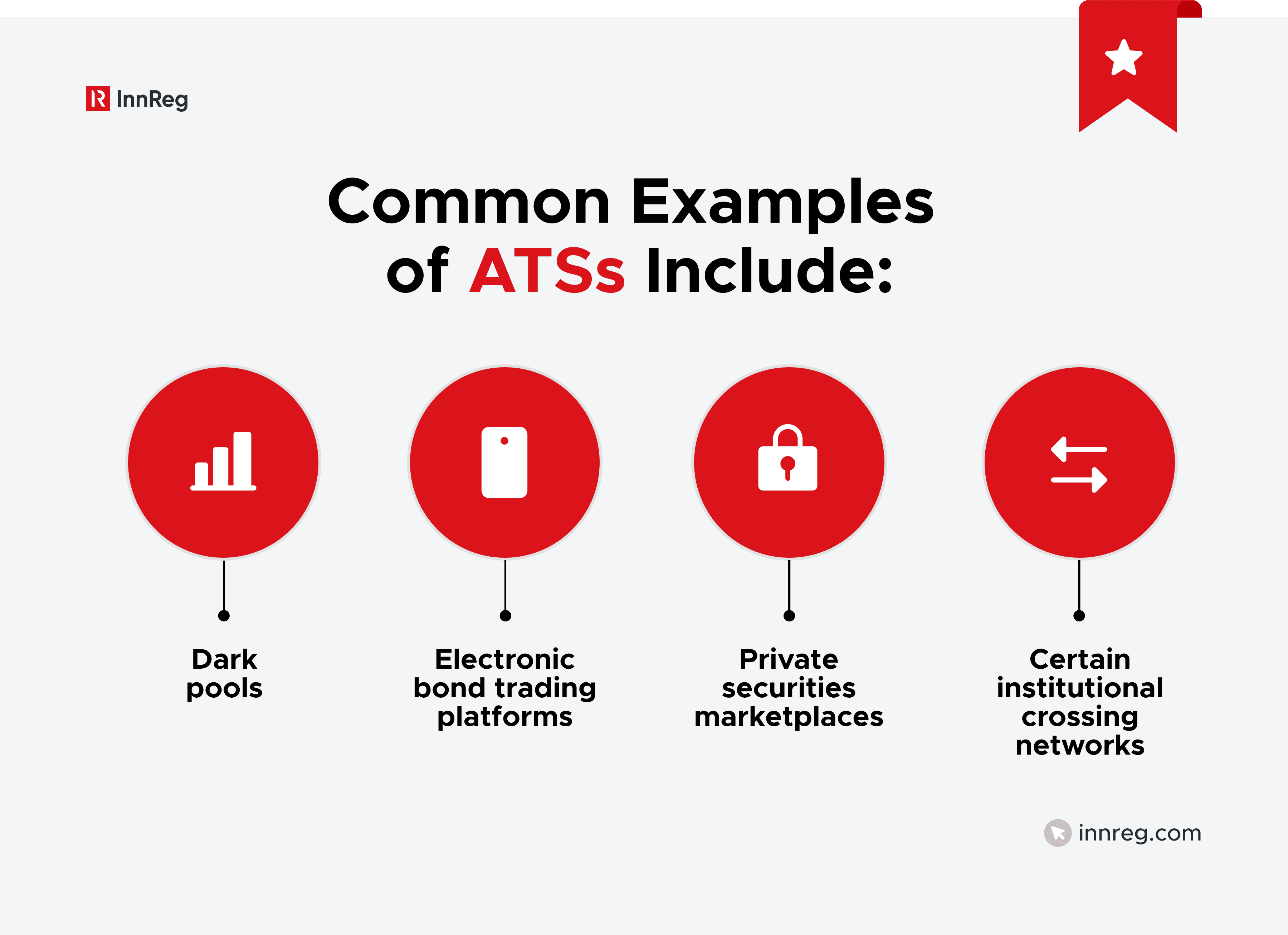
Entities that commonly fall under Regulation ATS include:
Alternative trading venues for equities
Electronic fixed-income trading platforms
Dark pools and crossing networks
Private securities marketplaces
Certain digital asset securities platforms
Trading systems supporting tokenized securities
A key issue is that regulators focus on how the platform functions, not how the company markets the product. A firm may consider itself a fintech platform, investment app, or marketplace, but regulators may still view the activity as operating an ATS if securities trading functionality is present.
Here are the factors the SEC generally evaluates and why each one matters:
Regulatory Consideration | Why It Matters |
|---|---|
Multiple buyers and sellers interact on the platform | Indicates exchange-like activity |
Orders are matched using defined protocols | Suggests organized trading functionality |
Securities transactions occur through the system | Brings activity within securities laws |
The platform facilitates regular trading activity | May trigger ATS analysis |
This analysis becomes more complicated when digital assets are involved. If a token or asset is treated as a security under federal securities laws, the trading venue facilitating those transactions may face broker-dealer and Regulation ATS obligations.
Regulation ATS vs. Exchange Registration
One of the main features of Regulation ATS is that it allows trading venues to operate without registering as national securities exchanges. As mentioned above, most ATS operators register as broker-dealers and comply with the requirements under Regulation ATS.
However, understanding the distinction is crucial because exchange registration comes with substantially broader regulatory obligations. National securities exchanges operate as self-regulatory organizations (SROs), which means they are responsible for establishing and enforcing their own market rules under SEC oversight.
ATSs operate under a different model. While they remain subject to SEC regulation and examination, they generally do not carry the same rulemaking and market governance responsibilities as exchanges.
Trade-Offs Between ATS and Exchange Status
For many firms, operating as an ATS can provide greater operational flexibility than registering as an exchange. This is one reason Regulation ATS has become a common framework for fintech trading platforms and institutional trading systems.
At the same time, ATS status comes with limitations and regulatory expectations. Firms still face significant obligations involving disclosures, reporting, operational controls, and market conduct.
Some of the main trade-offs include:
ATS Structure | Exchange Structure |
|---|---|
Operates through broker-dealer registration | Requires exchange registration with the SEC |
Subject to Regulation ATS requirements | Subject to a broader exchange regulatory framework |
Does not operate as an SRO | Functions as an SRO |
Often used for specialized or institutional markets | Typically supports broader public market activity |
May provide more operational flexibility | Involves greater governance and oversight obligations |
The decision between ATS status and exchange registration often depends on the platform’s business model, trading activity, target market, and long-term growth plans.
Still deciding between ATS, broker-dealer, or exchange registration? Read our breakdown →
ATS vs. National Securities Exchanges
A national securities exchange publicly lists securities and establishes formal market rules governing participation, trading conduct, and issuer requirements. Exchanges also play a direct role in market surveillance and regulatory enforcement.
An ATS generally does not list securities or establish the same type of public market structure. Instead, the platform facilitates trading activity between participants under its own system protocols and subscriber agreements.
ATS vs. Broker-Dealers
An ATS is not a separate registration category from a broker-dealer. In most cases, an ATS operator must first register as a broker-dealer and become a FINRA member before operating the platform.
However, not every broker-dealer operates an ATS. Traditional broker-dealers may execute customer transactions, provide investment services, or engage in market-making activity without operating a trading system that falls under Regulation ATS.
The distinction usually comes down to whether the firm operates a system that:
Brings together multiple buyers and sellers
Uses established methods to execute or match trades
Facilitates securities trading activity between participants
The table below highlights the difference:
Traditional Broker-Dealer | ATS Operator |
|---|---|
Executes customer securities transactions | Operates a trading venue or matching system |
May provide brokerage, custody, or advisory services | Facilitates trading between multiple market participants |
Does not necessarily operate a marketplace | Operates a system that matches or executes trades |
Subject to broker-dealer regulations | Subject to broker-dealer regulations plus Regulation ATS requirements |
May route orders to exchanges or ATSs | Operates the platform where trading activity occurs |
For fintech firms, this analysis can become more nuanced over time. A platform may begin as a brokerage or investment application but gradually introduce trading functionality that regulators interpret as ATS activity. This is especially common in products involving private securities, tokenized assets, or alternative execution models.
Core Requirements Under Regulation ATS
Firms operating under Regulation ATS are subject to a combination of SEC, FINRA, and broker-dealer compliance obligations. While the exact requirements depend on the platform’s structure and activity, regulators generally expect ATS operators to maintain strong operational controls, accurate disclosures, and ongoing supervisory procedures.
Broker-Dealer Registration and FINRA Membership
Before operating an ATS, a firm typically must:
Register as a broker-dealer with the SEC
Become a FINRA member
Establish written supervisory procedures (WSPs)
Implement AML and customer identification programs
Maintain required net capital levels
This requirement is foundational because ATSs generally operate through the broker-dealer regulatory framework rather than through direct exchange registration.
For fintech companies, broker-dealer registration often becomes one of the longest and most resource-intensive parts of the launch process. Regulators may closely review ownership structure, technology architecture, outsourcing arrangements, cybersecurity controls, and the qualifications of key personnel.
This is where working with a specialized compliance partner makes a measurable difference. At InnReg, we guide ATS operators through the full broker-dealer registration process so your team can stay focused on building the product while we manage the regulatory infrastructure.
Need a step-by-step guide to getting your broker-dealer registered? Start here →

Form ATS Filing and Disclosure Obligations
An ATS operator must file Form ATS with the SEC before beginning operations. The filing provides regulators with detailed information about how the platform functions and how trading activity will occur.
The form typically includes information relating to:
Types of securities traded
Subscriber access procedures
Order handling processes
Trade matching methodology
System operations and safeguards
Conflicts of interest
Material operational changes generally require amendments to Form ATS, particularly when the platform introduces new trading functionality or modifies execution protocols.
InnReg helps ATS operators manage amendment triggers, document material changes, and maintain filing accuracy as new features and asset classes are introduced. This helps in mitigating the risk of disclosure gaps that regulators most commonly scrutinize.
Note: Inaccurate or outdated disclosures have been a recurring focus in SEC enforcement actions involving ATS operators.
Systems Capacity, Integrity, and Security Requirements
Regulators expect ATS operators to maintain systems capable of handling trading activity reliably and securely. This includes operational resiliency, cybersecurity safeguards, and business continuity planning.
Areas regulators commonly focus on include:
Operational Area | Regulatory Focus |
|---|---|
System capacity | Ability to process trading volume reliably |
Cybersecurity controls | Protection of trading systems and data |
Business continuity | Recovery planning during disruptions |
Vendor oversight | Risks tied to outsourced technology providers |
Change management | Testing and approval of system updates |
For fintech firms operating lean teams, these requirements can create operational pressure quickly. Many platforms rely heavily on third-party infrastructure providers, cloud environments, APIs, and outsourced development resources. Regulators still expect the ATS operator to maintain oversight and accountability for those systems.
Cybersecurity obligations don't stop at the ATS filing. See what FINRA expects from your program →
See also:
Recordkeeping and Reporting Requirements
ATS operators are subject to extensive recordkeeping obligations under federal securities laws and broker-dealer regulations. Firms are generally expected to maintain records relating to:
Subscriber activity
Order information
Trade executions
System outages and incidents
Communications and supervisory reviews
Regulatory filings and amendments
Depending on the platform’s activity, firms may also face additional reporting obligations tied to trade reporting, suspicious activity monitoring, and market surveillance.
In practice, ongoing compliance often requires coordination between compliance, legal, engineering, operations, and vendor management teams. This is one reason many fintech firms build external compliance support into their operating model rather than relying on a single in-house compliance hire.
Many ATS operators also need to stay on top of Consolidated Audit Trail (CAT) requirements. Here's what that means for you →

Need help with ATS compliance?
Fill out the form below and our experts will get back to you.
Form ATS: Filing, Amendments, and Disclosures
Form ATS is one of the central regulatory requirements under Regulation ATS. Before beginning operations, an ATS operator must file the form with the SEC and disclose key information about how the trading system will function.
The filing gives regulators visibility into the platform’s structure, trading activity, subscriber access, and operational controls. Operating an ATS without properly filing Form ATS can create significant regulatory exposure.
Initial Form ATS Filing Process
An ATS operator generally files Form ATS at least 20 days before beginning operations. The filing must describe how the system operates and how participants interact with the platform.
The SEC typically expects detailed disclosures relating to:
Types of securities traded
Subscriber onboarding procedures
Trade execution and matching protocols
Market data handling
System safeguards and controls
Hours of operation
Fees and access standards
The filing process is often more operationally detailed than founders initially expect. Regulators may evaluate whether the platform’s actual functionality aligns with the disclosures made in the filing.
For fintech firms, this can become complicated when products continue evolving during development. Features added late in the product cycle may alter the platform’s regulatory profile.

Material Changes and Amendment Triggers
ATS operators must amend Form ATS when changes occur to information disclosed in the filing. The SEC expects filings to remain accurate and current as the platform evolves.
Common amendment triggers include:
Adding new asset classes or securities products
Changing trade matching logic
Expanding participant access
Modifying order handling procedures
Introducing new routing or execution functionality
Significant technology infrastructure changes
A common compliance issue arises when product, engineering, and compliance teams operate separately. In fast-moving fintech environments, platform updates may occur before regulatory analysis is completed.
This is one reason many ATS operators build structured internal change-management processes around product development and system modifications.
Public Disclosure and Transparency Requirements
Disclosure obligations can vary depending on the type of ATS and the securities traded on the platform. Certain ATSs, particularly those trading NMS stocks, face enhanced transparency requirements under Regulation ATS-N.
Depending on the platform structure, disclosures may include information relating to:
Disclosure Area | Regulatory Focus |
|---|---|
Subscriber access | How participants gain access to the ATS |
Order handling | How orders are processed and executed |
Conflicts of interest | Relationships that may affect trading activity |
Market data practices | Use and sharing of trading information |
System functionality | Core operational features of the platform |
The SEC has increasingly focused on whether ATS disclosures accurately reflect how platforms operate in practice. Enforcement actions have frequently involved allegations that firms failed to fully disclose platform functionality, order handling practices, or conflicts tied to affiliate relationships.
InnReg works with ATS operators at every stage from launch through ongoing compliance. See how we support alternative trading systems →
Fair Access Requirements Under Regulation ATS
Certain ATS operators become subject to additional obligations under Regulation ATS’s fair access provisions. These rules are designed to prevent large trading venues from unfairly restricting access to market participants.
The fair access requirements generally apply once an ATS reaches specific trading volume thresholds in NMS securities. At that point, the platform faces heightened scrutiny around participant access, standards, and operational fairness.
Volume Thresholds That Trigger Fair Access
Under Regulation ATS, fair access obligations are generally triggered when an ATS accounts for 5% or more of the average daily trading volume in a particular NMS security.
Once this threshold is met, the ATS may be required to:
Establish written access standards
Apply participant requirements consistently
Avoid unreasonable discrimination between subscribers
Maintain records relating to access decisions
The SEC introduced these provisions to address concerns that large ATSs could effectively function like major market centers while unfairly limiting participation.
Non-Discriminatory Access Obligations
An ATS subject to fair access requirements cannot arbitrarily deny or restrict access to eligible participants. Regulators expect access standards to be objective, documented, and applied consistently across similarly situated subscribers.
In practice, ATS operators often establish eligibility requirements tied to:
Creditworthiness
Regulatory status
Operational capabilities
Risk management considerations
Trading behavior standards
The challenge is balancing legitimate risk controls with regulatory expectations around fairness and transparency.
For fintech platforms, this can become operationally complex as participant volume grows. Internal onboarding procedures, surveillance controls, and subscriber reviews may require closer coordination between compliance, legal, operations, and technology teams.
Handling Subscriber Restrictions and Denials
ATS operators may still deny or limit access under certain circumstances. However, regulators generally expect firms to maintain clear documentation supporting those decisions.
Common reasons for restricting access may include:
Reason for Restriction | Compliance Consideration |
|---|---|
Suspicious or manipulative trading activity | Market integrity and surveillance obligations |
Failure to meet financial or operational standards | Risk management requirements |
Regulatory or sanctions concerns | AML and legal compliance issues |
System misuse or abusive conduct | Protection of platform operations |
The SEC has historically scrutinized situations where firms appeared to apply access standards inconsistently or failed to disclose material limitations affecting participation.
As ATS platforms scale, subscriber management often becomes more than a legal issue. It can evolve into a broader governance and operational challenge, particularly for fintech firms supporting complex or rapidly changing trading models.
Regulation ATS-N and NMS Stock ATS Requirements
In 2018, the SEC adopted Regulation ATS-N to increase transparency and regulatory oversight for ATSs trading NMS stocks. The rule introduced enhanced disclosure obligations for operators of equity ATSs that trade publicly listed national market system securities.
Under Regulation ATS-N, covered ATS operators must publicly disclose detailed information about how their platforms operate. This includes information relating to trading procedures, conflicts of interest, subscriber access, market data practices, and interactions with affiliated businesses.
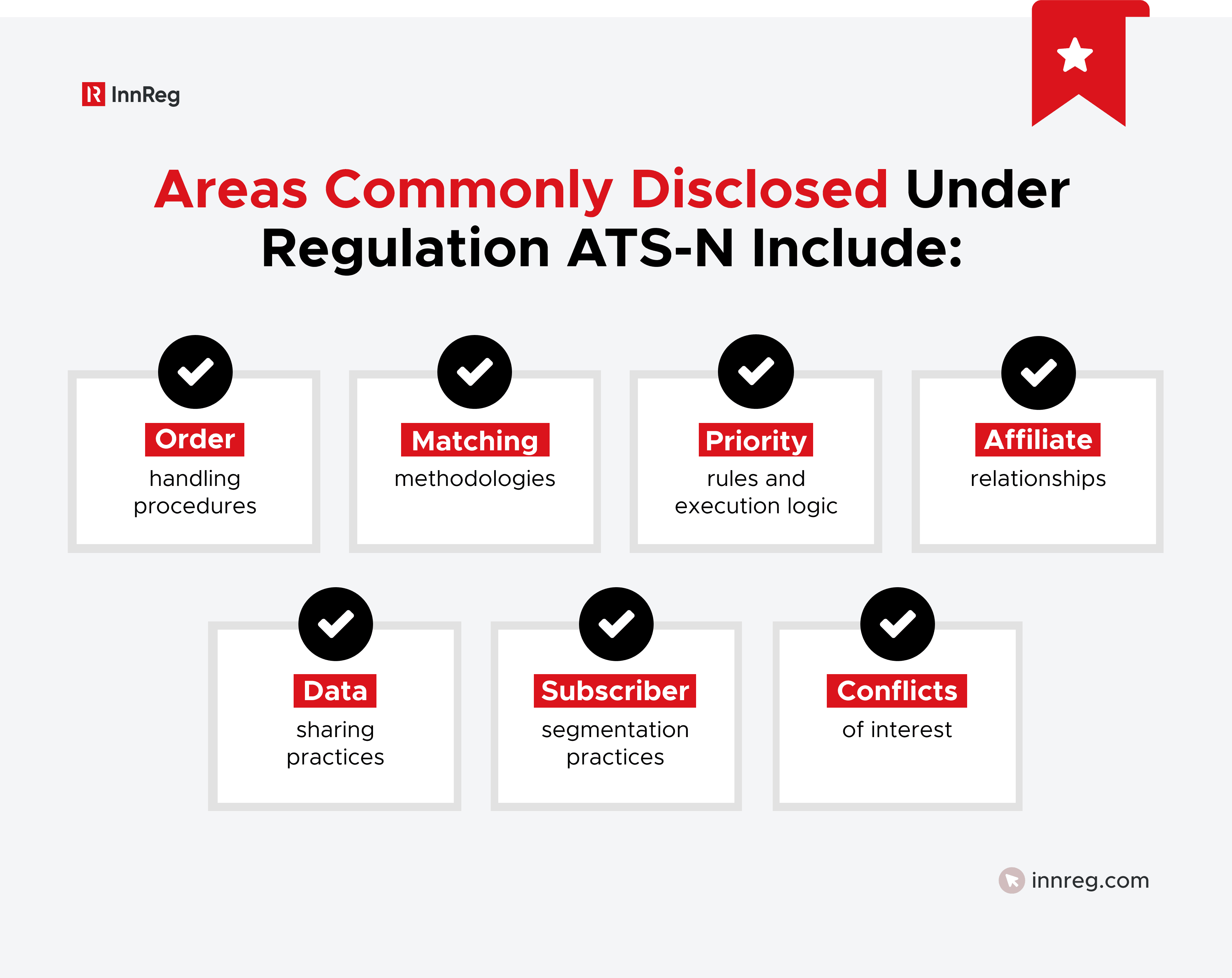
One of the SEC’s primary concerns was that many market participants lacked visibility into how certain ATSs functioned internally, particularly dark pools and institutional trading venues. Regulation ATS-N was designed to address these transparency concerns by requiring more public operational disclosures.
ATS-N filings are submitted through Form ATS-N and are reviewed by the SEC before the platform can operate under the updated framework. Unlike traditional Form ATS filings, many ATS-N disclosures become publicly available.
The rule also expanded the SEC’s authority to review, declare ineffective, or limit ATS-N filings where disclosures are incomplete or inconsistent with regulatory requirements.
For firms operating NMS stock ATSs, compliance obligations under ATS-N can become significantly more detailed than those applicable to non-equity ATS platforms.
Regulation ATS | Regulation ATS-N |
|---|---|
Applies broadly to ATS operators | Applies specifically to ATSs trading NMS stocks |
Standard Form ATS filing | Requires Form ATS-N filing |
Limited public disclosure | Enhanced public transparency requirements |
Focus on operational reporting | Greater scrutiny of conflicts and market practices |
Therefore, ATS-N compliance can create operational and governance challenges early in platform development for fintech firms entering public equities trading.
Equity ATSs also need to understand how Regulation NMS shapes execution obligations. Learn more about Regulation NMS →
See also:
Regulation ATS for Different Asset Classes
Regulation ATS applies across multiple segments of the securities markets, but compliance expectations can vary depending on the asset class involved. Equity ATSs, fixed income trading systems, and digital asset platforms often face different regulatory considerations, operational risks, and disclosure requirements.
In simpler words, your platform’s regulatory obligations may change significantly based on the types of products being traded.
Equity ATS Compliance Considerations
Equity ATSs are among the most heavily scrutinized trading venues under Regulation ATS. Platforms facilitating trading in NMS stocks may become subject to enhanced disclosure and transparency requirements under Regulation ATS-N.
Regulators often focus on areas such as:
Order routing practices
Trade execution quality
Market data usage
Conflicts of interest
Subscriber segmentation
Fair access compliance
Because equity ATSs can influence broader market activity, the SEC generally expects stronger operational controls and more detailed disclosures compared to some other ATS categories.
Dark pools operating in the equities markets have received particular regulatory attention over the years, especially regarding transparency, institutional order handling, and information-sharing practices.
Fixed Income ATS Market Structure
Fixed income ATSs operate differently from equity trading venues. Many facilitate trading in corporate bonds, municipal securities, Treasury securities, or other debt instruments.
Unlike equity markets, fixed income markets are often less centralized and may involve:
Dealer-to-client trading models
Request-for-quote (RFQ) systems
Institutional liquidity networks
Less transparent pricing environments
As a result, fixed income ATS operators may face different operational and surveillance challenges than equity ATSs.
Regulators still expect these platforms to maintain supervisory controls, accurate disclosures, and strong operational resiliency. However, the market structure itself tends to create different compliance priorities.
Digital Asset ATSs and Regulatory Uncertainty
Digital asset trading platforms remain one of the most complicated areas under Regulation ATS. The core issue is whether the assets traded on the platform qualify as securities under federal securities laws.
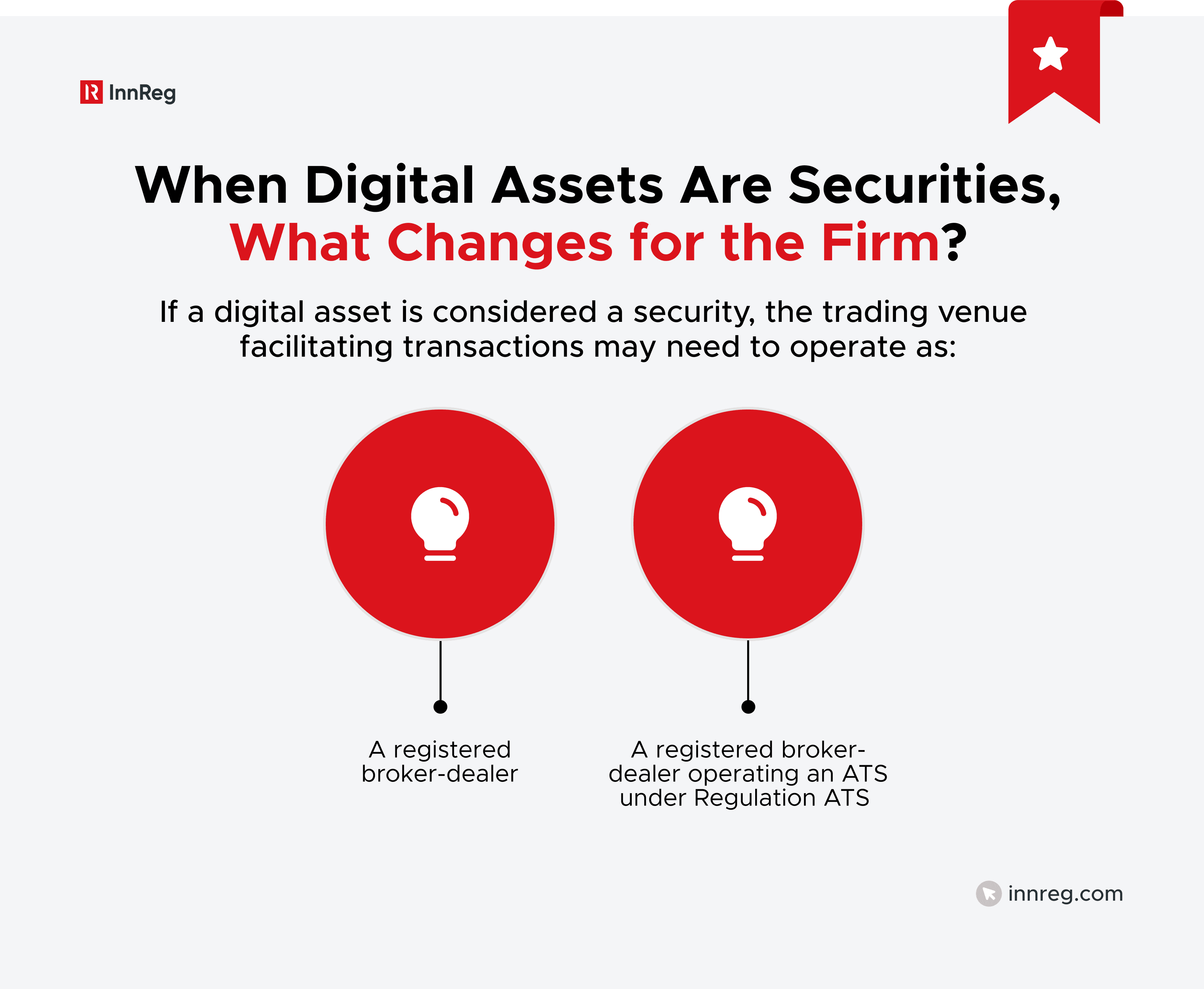
This has become a major area of SEC enforcement and regulatory scrutiny in recent years.
Digital Asset Issue | Regulatory Concern |
|---|---|
Token classification | Whether the asset is a security |
Secondary trading activity | Whether securities transactions are occurring |
Custody arrangements | Protection and control of customer assets |
Market surveillance | Detection of manipulation and abusive trading |
Cross-border activity | Jurisdictional and licensing complications |
Many crypto platforms initially operated outside traditional securities frameworks. However, regulators have increasingly argued that certain tokenized products and digital asset trading activities fall within existing securities laws.
If your platform touches digital assets, the regulatory analysis rarely has a clean answer. InnReg works with crypto and tokenized securities platforms to evaluate whether ATS or broker-dealer obligations apply, structure the compliance framework around that analysis, and position the platform ahead of ongoing SEC enforcement developments.
Uncertain whether your crypto platform falls under SEC securities rules? Get up to date on the latest SEC crypto guidance →

Operational and Technology Requirements
Operating an ATS involves more than regulatory filings and broker-dealer registration. As ATS platforms grow, operational failures can create market integrity concerns, trading disruptions, and regulatory exposure. This is one reason the SEC and FINRA often scrutinize technology governance alongside legal compliance.
Core operational areas regulators commonly evaluate include:
System reliability and uptime
Cybersecurity safeguards
Capacity and scalability
Vendor oversight
Business continuity planning
Incident response procedures
Change management controls
Many ATS operators rely heavily on third-party technology vendors, cloud infrastructure providers, APIs, and outsourced development teams. Even when functions are outsourced, regulators still expect the ATS operator to maintain oversight and accountability for critical systems and controls.
Operational Area | Regulatory Focus |
|---|---|
System capacity | Ability to handle trading activity without disruption |
Cybersecurity | Protection of systems, customer data, and trading information |
Business continuity | Recovery planning during outages or operational failures |
Vendor management | Oversight of outsourced technology providers |
Change management | Testing and approval of system modifications |
Incident response | Escalation and remediation of operational events |
In practice, ATS operators often need structured workflows connecting compliance, legal, engineering, security, and operations teams. Firms that treat compliance as a separate function rather than part of product and infrastructure development may face additional regulatory friction as the platform scales.
This is where InnReg’s support steps in. We act as your in-house compliance team to help you comply with regulatory requirements like Regulation ATS so you can focus on innovating your product.
Ongoing Regulation ATS Compliance Obligations
Launching an ATS is only the beginning of the compliance process. Once operational, ATS operators face continuing obligations involving reporting, supervision, surveillance, and regulatory oversight.
For many firms, the operational burden increases significantly after launch as trading activity, subscriber volume, and regulatory expectations grow. Here are the Regulation ATS compliance areas to keep a close eye on:
Periodic Filings and Reporting
ATS operators are generally required to maintain and update multiple regulatory filings over time. This can include amendments to Form ATS, broker-dealer reporting obligations, FINRA filings, and trade reporting requirements.
Depending on the platform’s structure and activity, firms may need to report:
Material operational changes
Trading volume information
System disruptions or outages
Changes to ownership or control
Supervisory or compliance updates
Failure to maintain current disclosures has been a recurring issue in SEC examinations and enforcement actions involving ATS operators.
Wondering what SEC examiners are actually focused on this year? See this year’s exam priorities most relevant to ATS operators →
Monitoring Trading Activity and Market Impact
Regulators expect ATS operators to maintain surveillance processes designed to identify problematic trading activity and market conduct risks.
Common monitoring areas include:
Potential market manipulation
Suspicious trading patterns
Wash trading activity
Insider trading indicators
Abusive order activity
Operational anomalies and system misuse
As trading activity scales, surveillance expectations generally become more sophisticated. Firms operating institutional or high-volume trading venues may need more advanced monitoring infrastructure and escalation procedures.
This is often where fintech firms encounter operational strain. Product growth can outpace compliance infrastructure, especially when engineering and compliance workflows are not closely aligned.
Internal Compliance Programs and Controls
ATS operators are typically expected to maintain documented supervisory and compliance frameworks supporting the platform’s operations.
Core compliance functions often include:
Compliance Area | Typical Focus |
|---|---|
Written supervisory procedures | Oversight of platform operations and personnel |
AML compliance | Detection and reporting of suspicious activity |
Cybersecurity governance | Protection of systems and trading data |
Vendor oversight | Monitoring outsourced service providers |
Regulatory change management | Updating controls as rules evolve |
Employee training | Ongoing compliance and operational education |
For fintech firms, maintaining these controls internally can become resource-intensive quickly. Many companies operate lean teams focused primarily on product development and growth.
As a result, some ATS operators use outsourced compliance support models to supplement internal resources, particularly for ongoing testing, supervisory procedures, regulatory filings, and operational compliance management.

How to Launch and Operate an ATS Under Regulation ATS
Launching an ATS involves much more than building a trading platform. Firms typically need to address broker-dealer licensing, regulatory filings, compliance infrastructure, operational controls, and ongoing supervisory requirements before the platform begins operating.
For most companies, the process is harder if you don’t have a reliable and experienced compliance partner by your side. That’s why at InnReg, we offer ATS compliance support.
See also:
Step 1: Register as a Broker-Dealer
Most ATS operators begin by registering as broker-dealers with the SEC and becoming FINRA members. This process typically involves:
Preparing Form BD filings
Developing written supervisory procedures
Establishing AML and customer identification programs
Meeting net capital requirements
Building compliance and operational infrastructure
Regulators may also review ownership structure, management experience, outsourcing arrangements, and technology systems during the application process.
For early-stage fintech firms, broker-dealer registration is often one of the longest parts of the launch timeline.
Step 2: Design the ATS Trading System
The platform’s functionality plays a central role in the regulatory analysis. Regulators will generally evaluate how orders are handled, matched, routed, displayed, and executed within the system.
Key design considerations often include:
Order matching methodology
Subscriber access controls
Market data handling
Trade reporting workflows
Cybersecurity safeguards
Operational resiliency planning
This is where coordination between legal, compliance, product, and engineering teams becomes especially important. Features introduced during development may change how regulators classify the platform.
Step 3: File Form ATS With the SEC
Before beginning operations, the firm must file Form ATS with the SEC. The filing describes how the platform operates and how trading activity will occur.
The SEC generally expects detailed disclosures relating to:
Form ATS Disclosure Area | Examples |
|---|---|
Securities traded | Equities, fixed income, digital asset securities |
Subscriber access | Onboarding and participation standards |
Order handling | Matching and execution procedures |
System safeguards | Business continuity and cybersecurity controls |
Conflicts of interest | Affiliate relationships and operational incentives |
If the platform later undergoes material operational changes, the ATS operator may need to amend the filing.
Step 4: Build Compliance and Reporting Infrastructure
Before launch, firms typically need operational controls supporting ongoing compliance obligations under broker-dealer and Regulation ATS rules.
This often includes:
Trade surveillance procedures
Recordkeeping systems
Regulatory reporting workflows
Incident escalation processes
Vendor oversight programs
Internal compliance testing
For many fintech firms, building this infrastructure internally can become resource-intensive. Some companies supplement internal teams with outsourced compliance support, particularly during early growth stages when operational demands increase quickly.

Step 5: Go Live and Maintain Ongoing Compliance
Once operational, the ATS enters an ongoing supervisory and examination environment involving both the SEC and FINRA.
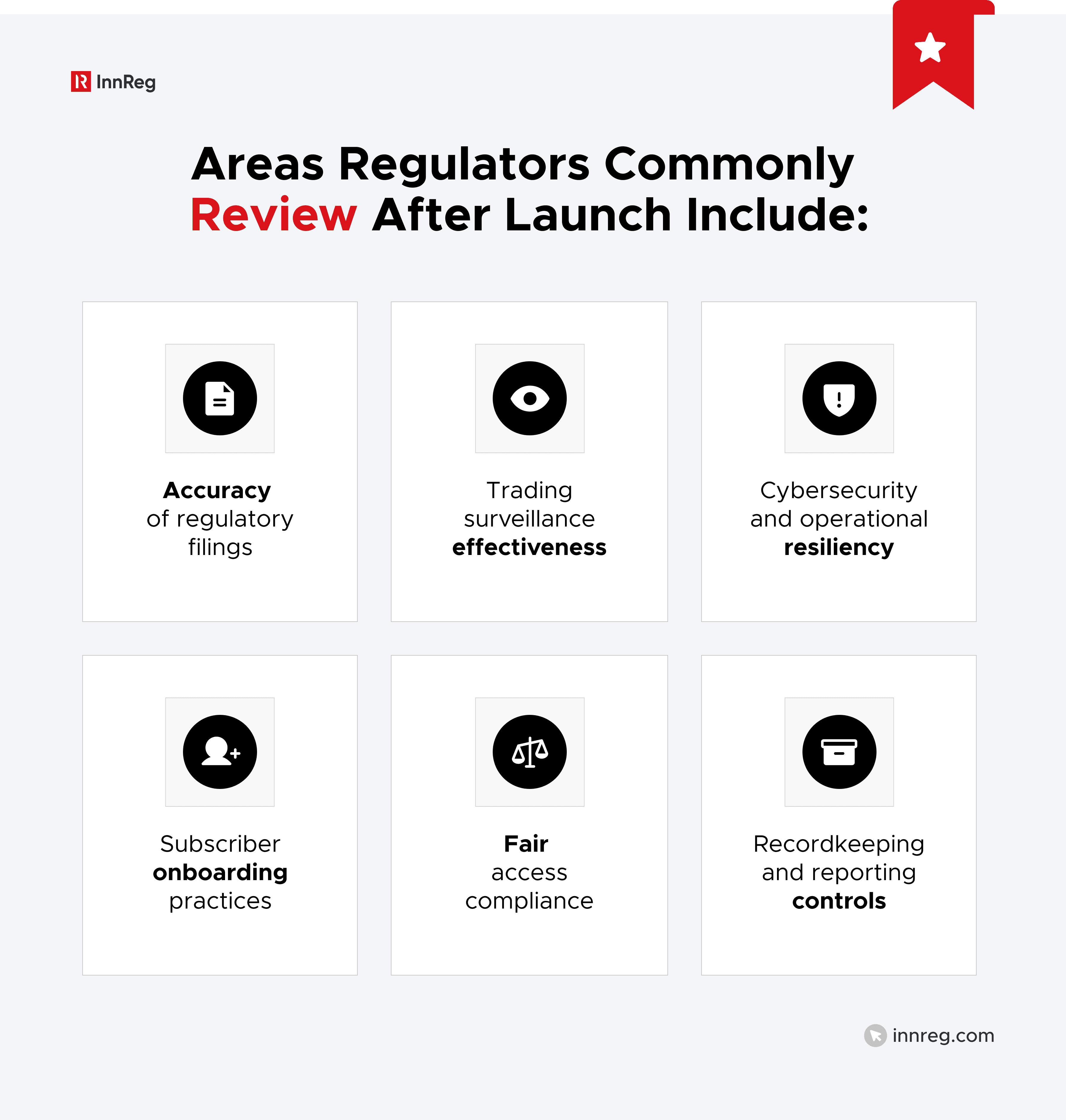
As trading activity scales, compliance programs often need to evolve alongside the platform’s operational complexity. Firms that integrate compliance into product development and operational governance early tend to navigate regulatory changes more effectively than firms that treat compliance as a secondary function after launch.
Regulation ATS Compliance Checklist
Use the checklist below as a high-level reference when evaluating whether a platform is operationally and regulatorily prepared to operate under Regulation ATS.
Registration and Licensing
Register as a broker-dealer with the SEC
Obtain FINRA membership
Evaluate whether the platform’s activity triggers ATS classification
Assess whether digital assets traded on the platform may be securities
Form ATS and Regulatory Filings
File initial Form ATS before launch
Document trading protocols and system functionality accurately
Establish internal procedures for Form ATS amendments
Maintain current disclosures as the platform evolves
Compliance Program and Supervisory Controls
Develop written supervisory procedures (WSPs)
Implement AML and customer identification programs
Establish compliance escalation and incident reporting procedures
Conduct periodic compliance reviews and testing
Trading Surveillance and Market Oversight
Monitor for manipulative or suspicious trading activity
Review subscriber activity and access controls
Maintain procedures for handling market conduct concerns
Implement trade surveillance and exception monitoring workflows
Operational and Technology Controls
Maintain cybersecurity policies and safeguards
Develop business continuity and disaster recovery procedures
Establish vendor oversight controls for third-party providers
Document system testing and change-management procedures
Recordkeeping and Reporting
Retain required trading and operational records
Maintain audit trails and supervisory documentation
Monitor ongoing SEC and FINRA reporting obligations
Track material platform changes requiring regulatory updates
Fair Access and Subscriber Management
Evaluate whether fair access requirements apply
Maintain objective participant onboarding standards
Document subscriber denials or restrictions
Review access procedures for consistency and transparency
Governance and Risk Management
Define responsibilities across compliance, legal, operations, and engineering
Establish internal governance for product and system changes
Review conflicts of interest and affiliate relationships
Conduct periodic risk assessments as the platform scales
Staying ahead of the checklist is an ongoing obligation for ATS operators. InnReg can help you manage regulatory expectations around Regulation ATS, from cybersecurity to recordkeeping. Reach out to our experts and start the conversation today.
When to Seek Legal and Compliance Support
For many firms, Regulation ATS issues do not appear all at once. They build gradually as the platform evolves. At each stage, the regulatory analysis can change. This is where many founders run into problems. Product development often moves faster than compliance infrastructure.
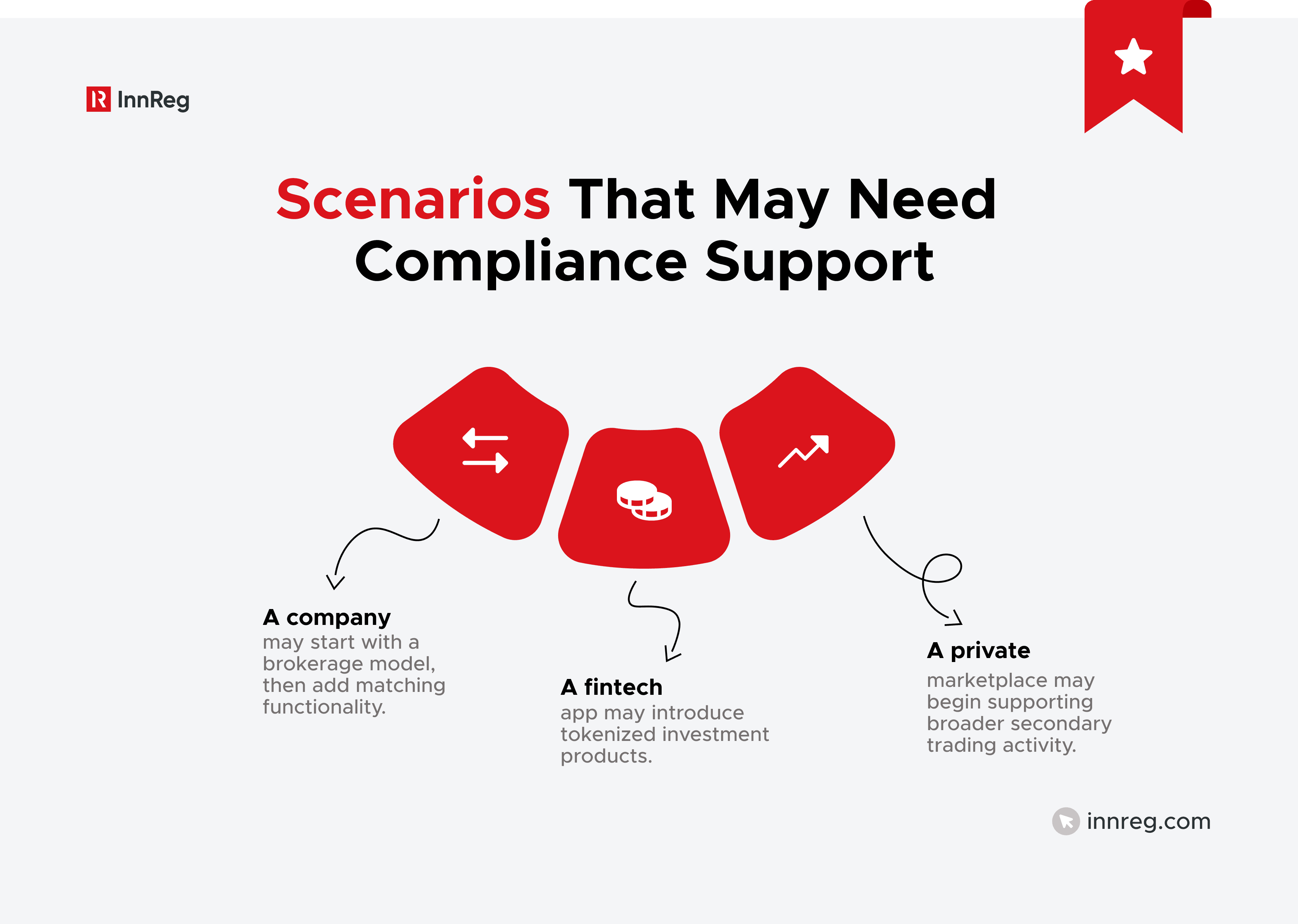
And this is one reason many ATS operators use outsourced compliance support models. Instead of relying on a single in-house hire, firms can access broader regulatory and operational expertise while maintaining flexibility as the platform grows.
At InnReg, we regularly work with fintech companies building complex trading and investment products, including platforms involving alternative execution models, tokenized securities, and hybrid financial structures. Our team supports firms with:
Broker-dealer and ATS regulatory strategy
Compliance program development
Supervisory procedures and operational workflows
Ongoing compliance management and testing
Vendor oversight and governance processes
Regulatory examination preparation
Because fintech products evolve quickly, compliance programs often need to evolve alongside them. Firms that address regulatory structure early are generally in a stronger position when scaling trading activity, onboarding new participants, or expanding into additional product lines.
FAQs About Regulation ATS
What Triggers Regulation ATS Compliance?
Regulation ATS compliance is generally triggered when a platform brings together multiple buyers and sellers of securities and uses established methods to match or execute trades. Regulators focus on how the system functions in practice, not how the company describes the product. Certain fintech and digital asset platforms may unintentionally fall within the framework.
Can Crypto Trading Platforms Qualify as ATSs?
Yes. If a crypto platform facilitates trading in digital assets that are considered securities under federal securities laws, the platform may need to operate as a broker-dealer and comply with Regulation ATS. This remains one of the most actively scrutinized areas of securities regulation and fintech compliance.
How Long Does the Form ATS Filling Process Take?
Form ATS must generally be filed at least 20 days before operations begin. However, the broader launch timeline is usually much longer because firms often need broker-dealer registration, FINRA membership, supervisory procedures, surveillance infrastructure, and operational controls in place before launching an ATS platform.
What Happens if an ATS Violates Regulation ATS?
Regulation ATS violations can lead to SEC investigations, enforcement actions, monetary penalties, operational restrictions, or required remediation measures. Common issues include inaccurate Form ATS disclosures, inadequate supervisory controls, cybersecurity failures, fair access violations, and failures involving trade surveillance or regulatory reporting obligations.
—
Regulation ATS sits at the intersection of securities regulation, market structure, and financial technology innovation. For fintech firms building trading infrastructure, the regulatory analysis often extends far beyond a simple filing requirement. That is where specialized compliance experience matters.
At InnReg, we work with innovative fintech companies building regulated financial products that do not fit neatly into traditional frameworks. Our team supports broker-dealers, ATS operators, digital asset platforms, and other regulated firms with registration strategy, compliance program development, supervisory procedures, ongoing compliance management, and operational oversight.
Unlike traditional consulting firms, we help firms manage the day-to-day realities of compliance while supporting product growth, regulatory interactions, and operational scaling. If your firm is evaluating an ATS structure, preparing for launch, or reassessing its current compliance framework, contact InnReg to discuss how we can support your platform.

Kushal Abeywickrama is the Chief Operating Officer at InnReg with over 10 years of experience in broker-dealer compliance, supervision, and regulatory operations across FINRA-regulated firms. He holds Series 7, 24, 4, 63, and 57 FINRA licenses and has previously held roles at HSBC and BlackSwan Technologies.
How Can InnReg Help?
InnReg is a global regulatory compliance and operations consulting team serving financial services companies since 2013.
We are especially effective at launching and scaling fintechs with innovative compliance strategies and delivering cost-effective managed services, assisted by proprietary regtech solutions.
If you need help with ATS compliance, reach out to our regulatory experts today:
Related Articles



Featured LinkedIn Posts