Key Takeaways
Fidelity ranks first by publicly reported customer count.
Vanguard, Schwab, and Fidelity dominate retail investing.
Advisor, clearing, and institutional broker-dealers serve different markets.
Firms report customer metrics using different methodologies.
Business models drive different compliance and operational requirements.
The top broker-dealer firms in the US play a central role in the financial system, facilitating securities transactions, holding customer assets, providing investment access, and supporting both retail and institutional market activity.
From legacy wirehouses and independent broker-dealers to app-based trading platforms and clearing firms, the industry has evolved into a highly diverse ecosystem serving millions of investors across different channels and business models.
This article ranks major US broker-dealers by the number of client accounts or customers, using publicly available data from annual reports, investor presentations, regulatory disclosures, and company filings.
As firms report customer metrics differently, the comparison is based on the closest available equivalent, including brokerage accounts, funded accounts, active clients, or customer households. Where necessary, distinctions and limitations are explained throughout the article to provide additional context around comparability.
At InnReg, we help broker-dealers and fintech companies navigate complex regulatory frameworks across licensing, compliance program development, and ongoing operations.


What Are Broker-Dealers?
A broker-dealer is a financial services firm that facilitates securities transactions in the market. The term combines two separate functions: acting as a broker on behalf of customers and acting as a dealer for the firm’s own account. In practice, many firms operate as both.
Most broker-dealers in the US are registered with the Securities and Exchange Commission (SEC) and regulated by the Financial Industry Regulatory Authority (FINRA). Depending on how the firm operates, additional oversight may come from agencies such as the CFTC, MSRB, NFA, or state securities regulators.
Broker-dealers handle many of the operational and transactional functions behind the securities markets. Depending on the firm, that can include executing trades, carrying customer accounts, clearing transactions, supporting public offerings, or providing liquidity in the market. Some firms mainly work with institutions, while others are built around retail investing and wealth management services.
Broker vs. Dealer: Key Differences
Although the terms are often grouped together, the functions are different from a regulatory and operational perspective.
Function | Role | Example Activity |
|---|---|---|
Broker | Executes transactions on behalf of clients | Buying shares for a retail customer |
Dealer | Trades securities for its own account | Acting as a market maker in equities |
Broker-Dealer | Performs both functions | Operating a retail brokerage while making markets internally |
A brokerage business may generate revenue from commissions, service fees, trading spreads, or payment for order flow arrangements. Dealer operations are typically tied to trading activity involving the firm’s own capital or securities inventory.
Many of the largest firms in the industry combine brokerage services with dealer operations under a single structure. In some cases, retail investors are the primary focus. In others, institutional markets and trading operations make up a larger portion of the business.
Types of Broker-Dealers (Retail, Institutional, Online, Clearing Firms)
The broker-dealer industry includes several distinct business models:
Retail Broker-Dealers: Retail firms provide investment access to individual customers. This category includes traditional wirehouses, independent broker-dealers, and app-based investing platforms. Examples include Fidelity and Charles Schwab.
Institutional Broker-Dealers: Institutional firms primarily serve hedge funds, asset managers, banks, corporations, and other financial institutions. Their activities often include prime brokerage, capital markets transactions, underwriting, and market making. Morgan Stanley and Goldman Sachs are examples of firms with large institutional broker-dealer operations.
Clearing Firms: Clearing broker-dealers handle the operational side of securities transactions, including execution, settlement, custody, recordkeeping, and margin processing. Some firms self-clear, while others rely on third-party clearing providers. Pershing is one of the best-known clearing firms in the US market.
Independent Broker-Dealers: Independent broker-dealers support networks of financial advisors who operate under the firm's regulatory umbrella while maintaining varying levels of independence in their practices. LPL Financial is one of the largest examples in this category.
Where Broker-Dealers Fit in the Financial System
The role of broker-dealers has evolved alongside the growth of fintech. A large number of digital investing platforms now rely on broker-dealer structures to offer securities products to customers. In many cases, the trading, custody, and clearing infrastructure operates behind the scenes through affiliated or third-party broker-dealers.
As these platforms grew, so did the operational expectations tied to them. Broker-dealer firms are expected to maintain documented supervisory procedures, communications review processes, AML programs, cybersecurity safeguards, and organized books and records. For startups, outsourcing portions of those responsibilities is often more practical than hiring a large internal compliance staff immediately.
Learn how InnReg helps broker-dealers navigate regulatory requirements →
—
The broker-dealer industry includes a wide range of firms with very different business models, customer bases, and regulatory obligations. Some focus on institutional markets and trading operations, while others primarily serve retail investors through advisory networks or online investing platforms.
In the next section, we look at the top broker-dealer firms in the US, ranked by the number of client accounts or customers. While client count is not the only way to measure the size or influence of a broker-dealer, it provides a useful benchmark for understanding which firms currently have the broadest reach across the market.
10. Interactive Brokers

Approximate clients/accounts: 3.6+ million customer accounts
Interactive Brokers is one of the largest electronic broker-dealers in the US market and is particularly well known among active traders, hedge funds, proprietary trading firms, and institutional investors. Unlike many retail-focused brokerages, the firm built its reputation around low-cost execution, advanced trading technology, and direct market access across global exchanges.
The company maintains a significant international presence, offering access to equities, options, futures, forex, bonds, and other products across dozens of markets worldwide.
One of the reasons Interactive Brokers became popular is its trading infrastructure. The platform is built around advanced execution tools, API connectivity, algorithmic trading functionality, and access to multiple asset classes across global markets. Although retail investors use the platform as well, it has long been associated with active traders and institutional market participants.
The business is also more operationally complex than a standard retail brokerage platform. Interactive Brokers supports customers trading across global markets and multiple asset classes, so functions like supervision, compliance monitoring, cybersecurity, and books and records management become a much larger part of day-to-day operations.
Interactive Brokers reflects how much the broker-dealer industry has changed over the last two decades. The company operates more like a technology-driven trading infrastructure provider than a traditional branch-based brokerage firm.

9. Pershing

Approximate clients/accounts: 7+ million investor accounts serviced
Pershing is not primarily built around direct-to-consumer investing. Instead, the firm provides the operational infrastructure that many broker-dealers, RIAs, banks, and wealth management firms rely on for custody, clearing, settlement, and securities processing functions.
The company operates through Pershing LLC, a broker-dealer regulated by the SEC and FINRA and owned by BNY. Much of its business involves supporting other financial firms with transaction processing, account servicing, custody support, and back-office operations.
Much of the brokerage industry depends on firms like Pershing to keep the operational side of securities transactions moving. Functions such as settlement, margin support, reconciliation, reporting, and recordkeeping are often handled through clearing providers rather than directly by customer-facing brokerage firms.
The firm's client base is also different from many of the broker-dealers on this list. Instead of focusing mainly on self-directed investors, Pershing works extensively with financial advisors, institutional firms, independent broker-dealers, and wealth management platforms that use its custody and clearing services.
From a regulatory perspective, clearing firms typically operate under substantial operational oversight because they sit close to the core transaction and custody infrastructure of the securities markets. Areas such as operational resilience, cybersecurity, customer protection requirements, capital rules, recordkeeping, and settlement processing tend to receive significant regulatory attention.
Pershing also reflects another important segment of the broker-dealer ecosystem that is often less visible to retail investors. Many investing apps, advisory firms, and financial institutions rely on third-party clearing infrastructure behind the scenes rather than fully self-clearing their brokerage operations.
8. Edward Jones

Approximate clients/accounts: 9+ million clients
Edward Jones operates very differently from most modern app-based brokerage platforms. The firm built its business around financial advisors working directly with clients through local branch offices, with a strong emphasis on relationship-driven wealth management rather than self-directed trading.
The company operates as an SEC- and FINRA-regulated broker-dealer and maintains one of the largest advisor networks in North America. Its client base is largely made up of retail investors, retirees, small business owners, and households working with dedicated financial advisors.
A large part of Edward Jones’ growth came from its branch-based approach to wealth management. Rather than concentrating operations in major financial centers, the firm expanded through smaller local offices designed around direct advisor-client relationships. That structure helped the company build one of the largest retail advisory networks in the country.
The firm's business is tied more closely to wealth management relationships than to rapid trading activity. Edward Jones primarily offers services such as brokerage accounts, retirement planning, advisory programs, mutual funds, portfolio management, and insurance-related products through its advisor network.
That structure creates a different set of compliance responsibilities compared to app-based brokerage models. Supervising branch offices, reviewing advisor communications, monitoring outside business activities, handling suitability obligations, and maintaining books and records are all important parts of day-to-day operations.
Edward Jones also represents a part of the brokerage industry that remains heavily relationship-driven. While digital investing platforms attracted significant growth over the last decade, traditional advisor-based firms continue to hold a large share of the US wealth management market.
See also:
7. LPL Financial

Approximate clients/accounts: 10+ million investor accounts
LPL Financial is the largest independent broker-dealer in the US and operates through a business model focused heavily on supporting financial advisors rather than directly building a retail consumer brand. The firm provides brokerage, custody, advisory, and operational infrastructure to independent advisors, RIAs, banks, and credit unions.
The company operates through LPL Financial LLC, a broker-dealer regulated by the SEC and FINRA. Unlike traditional wirehouses, where advisors are employees of the firm, many advisors working with LPL operate independently while using the firm's platform for compliance, custody, trading, supervision, and back-office support.
A major part of LPL’s growth came from the broader shift toward advisor independence within the wealth management industry. Over the last two decades, many registered representatives moved away from large bank-owned brokerage firms in favor of more flexible independent models that allow greater control over branding, client relationships, and business operations.
Because of that structure, LPL functions as both a broker-dealer and a large-scale support platform for thousands of independent financial practices. The firm's services extend beyond brokerage operations into areas such as technology infrastructure, portfolio management tools, compliance support, research, and advisor transition services.
Supporting a large network of independent advisors also comes with significant supervisory and operational responsibilities. Firms operating under this model often need processes around branch oversight, advisor communications, suitability reviews, outside activities, cybersecurity, vendor management, and regulatory recordkeeping across offices spread throughout the country.
LPL also highlights how the independent broker-dealer market evolved over time. Many advisors now expect more than basic custody and trading support from a platform provider. Technology, compliance assistance, operational infrastructure, and practice management resources have become a major part of the value proposition.

Need help with broker-dealer compliance?
Fill out the form below and our experts will get back to you.
6. Morgan Stanley
Approximate clients/accounts: 16+ million client relationships
Morgan Stanley is one of the largest and most recognizable broker-dealers in the US financial system. The firm operates across wealth management, institutional securities, investment banking, trading, asset management, and brokerage services, giving it a much broader business mix than many retail-focused broker-dealers.
The company operates through several regulated entities, including Morgan Stanley Smith Barney LLC, a SEC- and FINRA-regulated broker-dealer. Its wealth management division became significantly larger following the Smith Barney joint venture and the acquisition of E*TRADE, which expanded the firm's reach into self-directed retail investing and workplace financial services.
Morgan Stanley’s business spans both institutional and retail markets. On the institutional side, the firm is heavily involved in capital markets activity, prime brokerage, mergers and acquisitions, underwriting, and trading operations. At the same time, its wealth management platform serves millions of individual investors through financial advisors, retirement services, and brokerage accounts.
A large portion of the firm's growth over the last decade came from expanding recurring wealth management and advisory revenue rather than relying primarily on investment banking or trading activity. That shift reflected a broader industry trend where large financial institutions placed greater emphasis on stable fee-based client relationships.
Running a firm with this scale and business mix requires a significant amount of supervision and operational oversight. Broker-dealers involved in institutional trading, advisory services, retail brokerage, and international markets generally maintain large compliance frameworks covering areas such as communications review, trade monitoring, cybersecurity, AML procedures, conflicts management, and regulatory recordkeeping.
Morgan Stanley also shows how much the broker-dealer industry has changed over time. The firm is no longer just a traditional brokerage business. Its operations now extend across investment banking, wealth management, trading, workplace financial services, and retail investing under a much broader financial services structure.
5. Webull
Approximate clients/accounts: 20+ million registered users globally
Webull established itself as a retail trading platform during the broader growth of mobile investing apps. The company attracted a large number of self-directed investors by offering low-cost market access and trading-focused features through a smartphone-based platform.
Its US operations run through Webull Financial LLC, which is registered with the SEC and regulated by FINRA. The platform also relies on external providers for certain custody, clearing, and settlement functions tied to customer accounts and securities transactions.
The company positioned itself differently from other retail brokerages by focusing heavily on active trading tools. Users have access to extended-hours trading, advanced charting systems, technical indicators, and detailed market data designed for more engaged retail traders.
Webull’s customer base is made up largely of retail traders managing investments on their own. That differs from traditional brokerage and wealth management firms, where advisor-client relationships are a central part of the business model.
The rapid growth of app-based investing platforms also brought additional regulatory attention. Broker-dealers operating these platforms commonly face oversight tied to options trading supervision, cybersecurity programs, customer disclosures, AML procedures, operational controls, and maintenance of books and records.
Webull also reflects how fintech platforms reshaped part of the broker-dealer industry over the last decade. Mobile-first investing apps significantly lowered barriers to market participation for retail investors, while also increasing competition around trading technology, user experience, and account accessibility.

4. Merrill Lynch

Approximate clients/accounts: 20+ million client relationships
Merrill Lynch is one of the most recognizable names in the US wealth management industry and has been a major broker-dealer for decades. The firm built its business around financial advisors, brokerage services, investment products, and wealth management solutions serving individuals, families, businesses, and institutional clients.
The company operates through Merrill Lynch, Pierce, Fenner & Smith Incorporated, a broker-dealer regulated by the SEC and FINRA. Since becoming part of Bank of America, Merrill has expanded its integration with banking, lending, cash management, and broader financial planning services.
A significant portion of Merrill's business is tied to advisor-led wealth management. Clients typically work directly with financial advisors for investment planning, retirement strategies, portfolio management, brokerage services, and access to a broad range of financial products and services.
The firm's growth over time has been supported by both its advisor network and its connection to Bank of America's broader customer base. That combination allows Merrill to operate across wealth management, brokerage, banking, lending, and retirement planning under a single corporate structure.
Managing a business built around thousands of financial advisors also creates substantial supervisory and compliance responsibilities. Areas such as advisor oversight, communications review, suitability obligations, books and records, outside business activities, cybersecurity, and AML procedures remain important parts of day-to-day operations.
Merrill Lynch also represents a long-standing segment of the broker-dealer industry centered on advisor relationships and comprehensive wealth management services. While digital investing platforms expanded rapidly over the last decade, advisor-led brokerage firms continue to manage a significant share of client assets across the US market.
3. Charles Schwab

Approximate clients/accounts: 35+ million active brokerage accounts
Charles Schwab became one of the biggest names in retail investing by focusing heavily on individual investors instead of institutional Wall Street business. Over time, the company expanded well beyond traditional brokerage accounts and built a large presence in advisor custody and wealth management infrastructure.
The firm operates through Charles Schwab & Co., Inc., a broker-dealer regulated by the SEC and FINRA. Its acquisition of TD Ameritrade significantly increased the size of the platform and added a substantial number of brokerage accounts and advisor relationships.
A large portion of Schwab’s business comes from retail brokerage services, retirement accounts, banking products, and custody support for RIAs. That makes the company very different from broker-dealers whose business is tied mainly to investment banking or institutional trading operations.
The company also benefited from major changes in how retail investors access the markets. Lower trading costs, online brokerage accounts, and index investing became much more common over the years, and Schwab was one of the firms closely tied to that shift.
The advisor custody side of Schwab’s business also became increasingly important over time. Many RIAs use Schwab’s infrastructure for custody, trading, account administration, reporting, and operational support while maintaining independent advisory businesses outside of traditional broker-dealer employment structures.
Operating at Schwab’s scale also requires substantial compliance and operational infrastructure. Areas such as cybersecurity, books and records, advisor custody obligations, customer communications, AML programs, operational resiliency, and supervision across retail and advisory channels remain major parts of the firm's regulatory framework.
Charles Schwab also reflects how the lines between brokerage firms, banks, custody providers, and wealth management platforms became increasingly blurred over time. Today, the company operates across multiple areas of financial services while maintaining one of the largest retail investing platforms in the US market.
2. Vanguard
Approximate clients/accounts: 50+ million investors
Vanguard is one of the largest investment and brokerage firms in the world and is particularly well known for its role in expanding access to low-cost index investing. Although the company is often associated with mutual funds and ETFs, Vanguard also operates a substantial broker-dealer and retail investing platform serving millions of individual investors and retirement accounts.
Its brokerage operations are conducted through affiliated entities regulated by the SEC and FINRA, including Vanguard Marketing Corporation. The platform supports a wide range of retail investing activity, including retirement accounts, advisory services, self-directed brokerage, and employer-sponsored investment programs.
Much of Vanguard’s growth came from the broader adoption of passive investing strategies over the last several decades. The company became closely associated with index funds, long-term investing, and lower-cost portfolio construction for retail investors and retirement savers.
Unlike trading-focused brokerage platforms, Vanguard built much of its business around investors planning for retirement and long-term financial goals. The platform is widely used for diversified investing strategies designed to be held over longer time horizons.
Vanguard also maintains a significant presence in workplace retirement and retirement plan administration. That part of the business helped expand the firm's reach across employer-sponsored retirement accounts and long-term investment programs tied to retirement savings.
Managing a platform with millions of investors and retirement accounts also creates significant operational responsibilities. Functions tied to custody, retirement administration, cybersecurity, customer communications, AML procedures, advisory oversight, and regulatory recordkeeping all require large internal support and compliance teams.
Vanguard also shows how large brokerage firms evolved beyond traditional trading businesses. The company now operates across retail investing, retirement services, asset management, and brokerage infrastructure rather than focusing mainly on securities trading activity.
1. Fidelity
Approximate clients/accounts: 51+ million customers
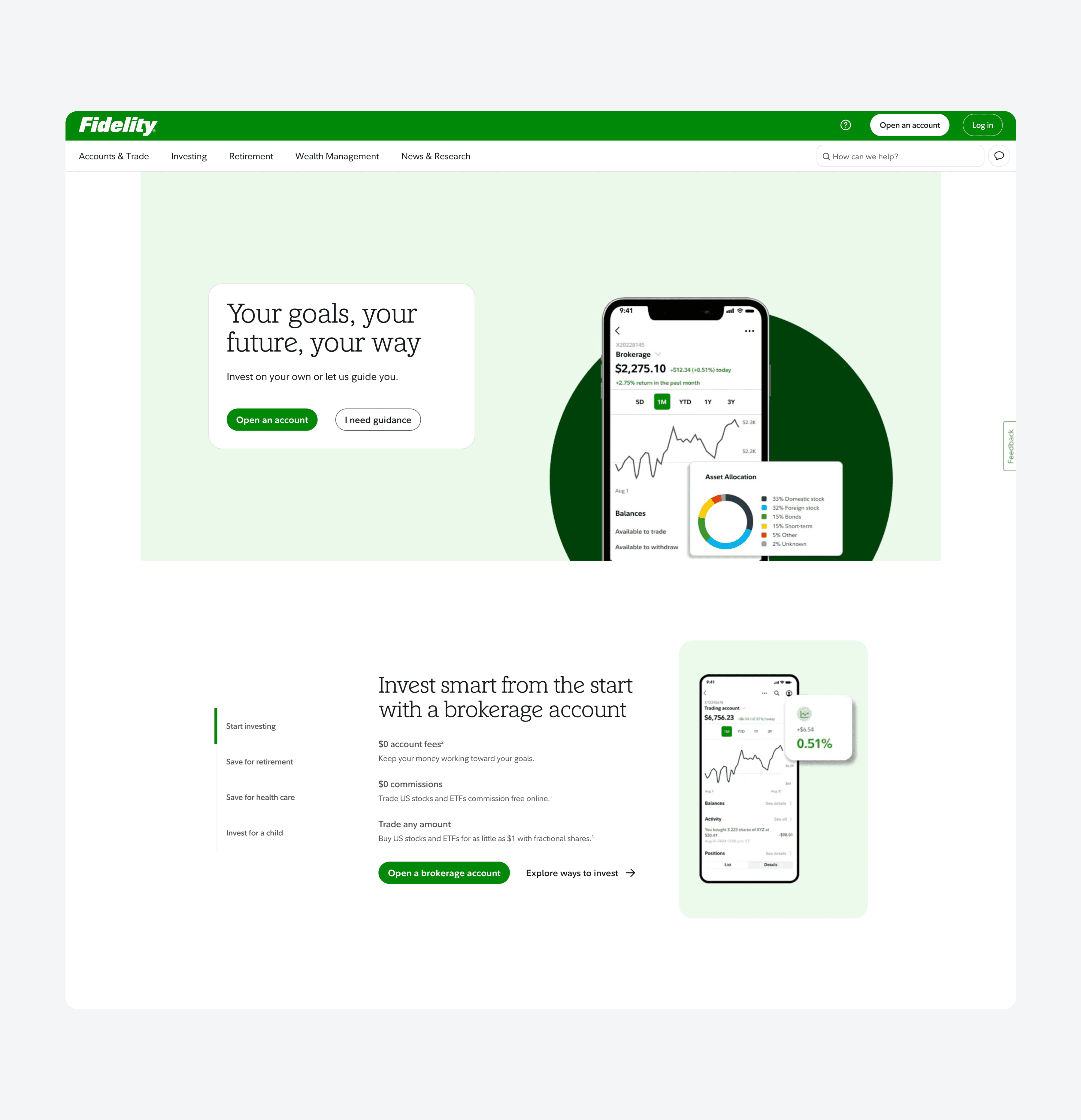
Fidelity operates one of the largest retail brokerage and financial services platforms in the US. In addition to brokerage accounts, the company has major businesses tied to retirement services, wealth management, custody, asset management, and institutional support infrastructure.
Its brokerage operations are primarily conducted through National Financial Services LLC and Fidelity Brokerage Services LLC, both regulated by the SEC and FINRA. The company also has a large custody and clearing presence supporting RIAs, advisory firms, and institutional clients.
Fidelity expanded over time by building businesses across several areas of financial services instead of relying mainly on trading activity. Retirement accounts, workplace investing programs, advisory relationships, brokerage services, and long-term retail investing all became major drivers of the firm's growth.
The company also expanded aggressively into digital investing infrastructure over the last decade. Fidelity invested heavily in mobile investing tools, self-directed brokerage platforms, fractional shares, and digital account access while continuing to maintain large advisor and retirement servicing operations.
Operating across so many parts of the financial industry also creates a significant amount of regulatory and operational work behind the scenes. Fidelity maintains large internal systems and teams focused on areas such as cybersecurity, AML procedures, supervisory controls, customer communications, operational continuity, and regulatory recordkeeping.
The company also reflects how the largest broker-dealers increasingly evolved into multi-segment financial platforms rather than standalone brokerage businesses. Today, Fidelity operates across retail investing, advisor custody, retirement infrastructure, asset management, and institutional services while maintaining one of the broadest customer bases in the US financial system.
Rank | Broker-Dealer | Approximate Clients | Primary Focus |
|---|---|---|---|
10 | Interactive Brokers | 3.6+ million accounts | Active trading / institutional |
9 | Pershing | 7+ million | Clearing and custody |
8 | Edward Jones | 9+ million clients | Retail wealth management |
7 | LPL Financial | 10+ million investor accounts | Independent advisor network |
6 | Morgan Stanley | 16+ million client relationships | Wealth management / institutional |
5 | Webull | 20+ million registered users globally | Mobile retail trading |
4 | Merrill Lynch | 20+ million client relationships (estimated) | Wealth management/brokerage |
3 | Charles Schwab | 35+ million active brokerage accounts | Retail brokerage/custody |
2 | Vanguard | 50+ million investors | Asset management/brokerage |
1 | Fidelity Investments | 51+ million customers | Brokerage/retirement/custody |
See also:
—
The largest broker-dealers in the US operate through very different business models. Some focus heavily on self-directed retail trading, others on advisor networks, custody infrastructure, retirement services, or institutional markets. Looking at client account volume helps show which firms currently have the broadest reach across the financial system, but it also highlights how diverse the broker-dealer industry has become.
The industry continues shifting as investing becomes more digital and more accessible to retail customers. Mobile brokerage apps, independent advisory firms, low-cost investing platforms, and institutional trading technology all play a much larger role in the market than they did in previous decades.
For fintech operators, understanding how these firms are structured is important well beyond market positioning. The operational requirements around custody, supervision, books and records, cybersecurity, AML compliance, and clearing infrastructure can look very different depending on the broker-dealer model involved.


How Can InnReg Help?
InnReg is a global regulatory compliance and operations consulting team serving financial services companies since 2013.
We are especially effective at launching and scaling fintechs with innovative compliance strategies and delivering cost-effective managed services, assisted by proprietary regtech solutions.
If you need help with broker-dealer compliance, reach out to our regulatory experts today:
Related Articles




Featured LinkedIn Posts