How Regulation NMS Shapes Equity Execution for Fintechs
Regulation NMS is a foundational framework in US equity markets, introduced initially to bring order, efficiency, and fairness to a rapidly digitizing landscape.
But the market it was built for in 2005 looks very different from today’s. With the rise of algorithmic trading, off-exchange execution, and zero-commission brokerage models, the need to modernize this regulation is active and underway.
This article explores what Regulation NMS is, why it’s being updated, and how the latest changes affect fintech companies operating in the equity trading space. We will cover the original rules, recent updates, including revisions to tick size and fee caps, and what fintech teams should watch for as the SEC pushes further reforms.
At InnReg, we help fintechs navigate Regulation NMS and broader equity market structure requirements. From registration and licensing to building and managing compliance programs, our team supports trading platforms at every stage.


What Is Regulation NMS and Why It Matters Today
Regulation NMS, short for National Market System, is a set of SEC rules that govern how equity markets in the US function. It promotes fair competition among market participants and protects investors by improving price transparency and execution quality.
Regulation NMS creates a structured framework for how trades are executed across multiple exchanges. It requires trading venues to display their best prices publicly, prevents trades from executing at inferior prices when better ones are available elsewhere, and sets limits on access fees and price quoting behavior.
These requirements are meant to keep markets efficient and prevent practices that disadvantage retail or institutional investors. Today, every equity trading platform operating in the US must operate within the Regulation NMS environment, whether directly or through intermediaries.
For fintechs, this means innovative models (e.g., fractional trading, app-based execution, in-app order matching) still need to align with rules built for cross-market fairness.
Key Components of Regulation NMS
Regulation NMS is made up of several core rules that define how quotes are displayed, orders are routed, and trades are executed across competing exchanges.
Each rule addresses a specific structural challenge in the equity markets, from preventing price discrimination to limiting sub-penny gaming:
Order Protection Rule (Rule 611)
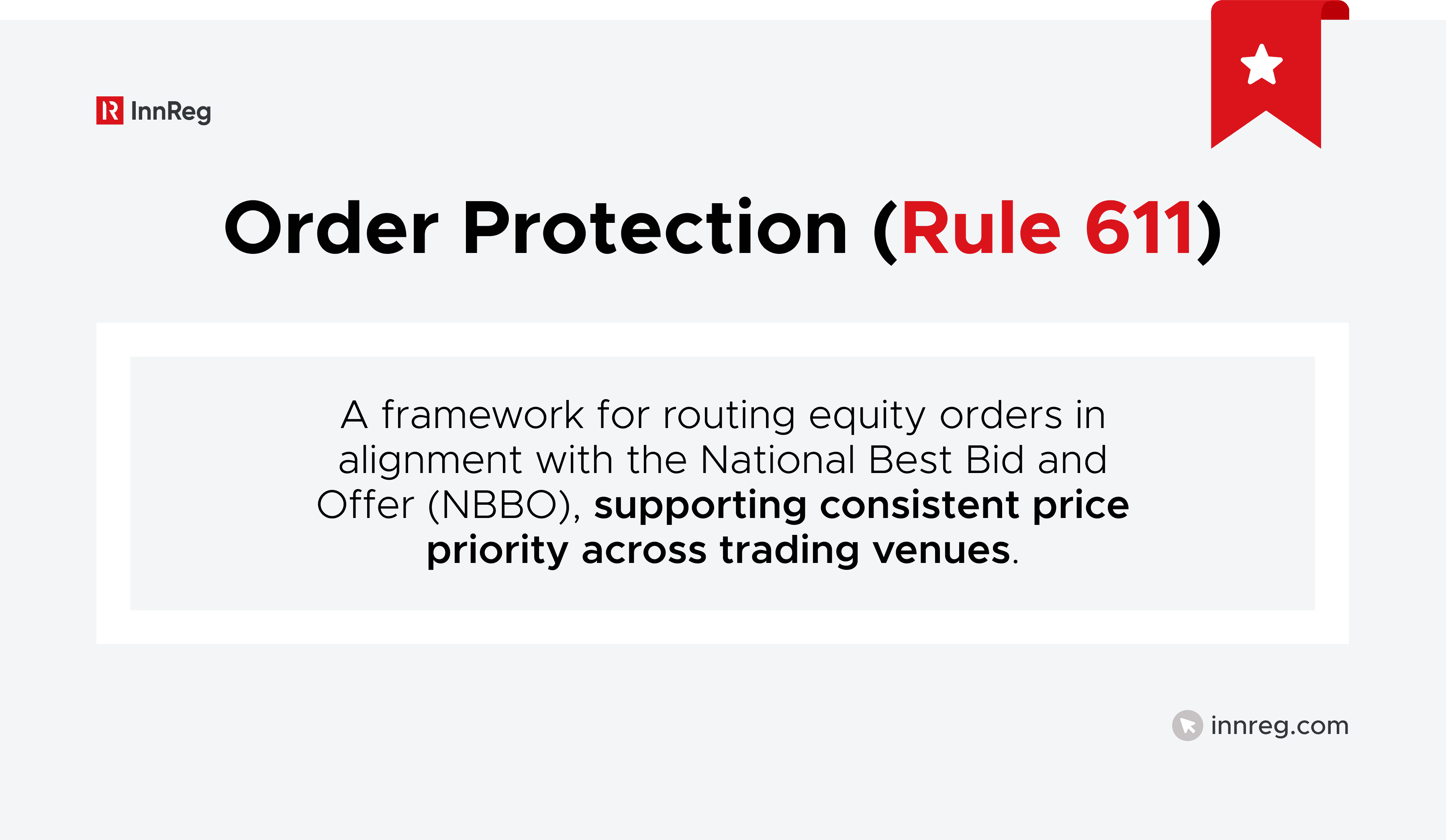
Order Protection Rule (Rule 611) prohibits "trade-through": executing a trade at a price that is lower than a protected bid, or higher than a protected offer. This rule is designed to protect investors from executing prices below what is available elsewhere in the market.
If Exchange A is offering a better price than Exchange B, an order hitting Exchange B must match that price or be rerouted. Trading platforms need real-time access to quotes across all protected venues, typically through smart order routing or compliant execution partners.
This rule presents operational and regulatory considerations for fintechs, especially those handling order execution internally or facilitating peer-to-peer matching. Matching trades inside an app without accounting for the national best bid and offer (NBBO) risks triggering violations.
Access Rule and Fee Caps (Rule 610)
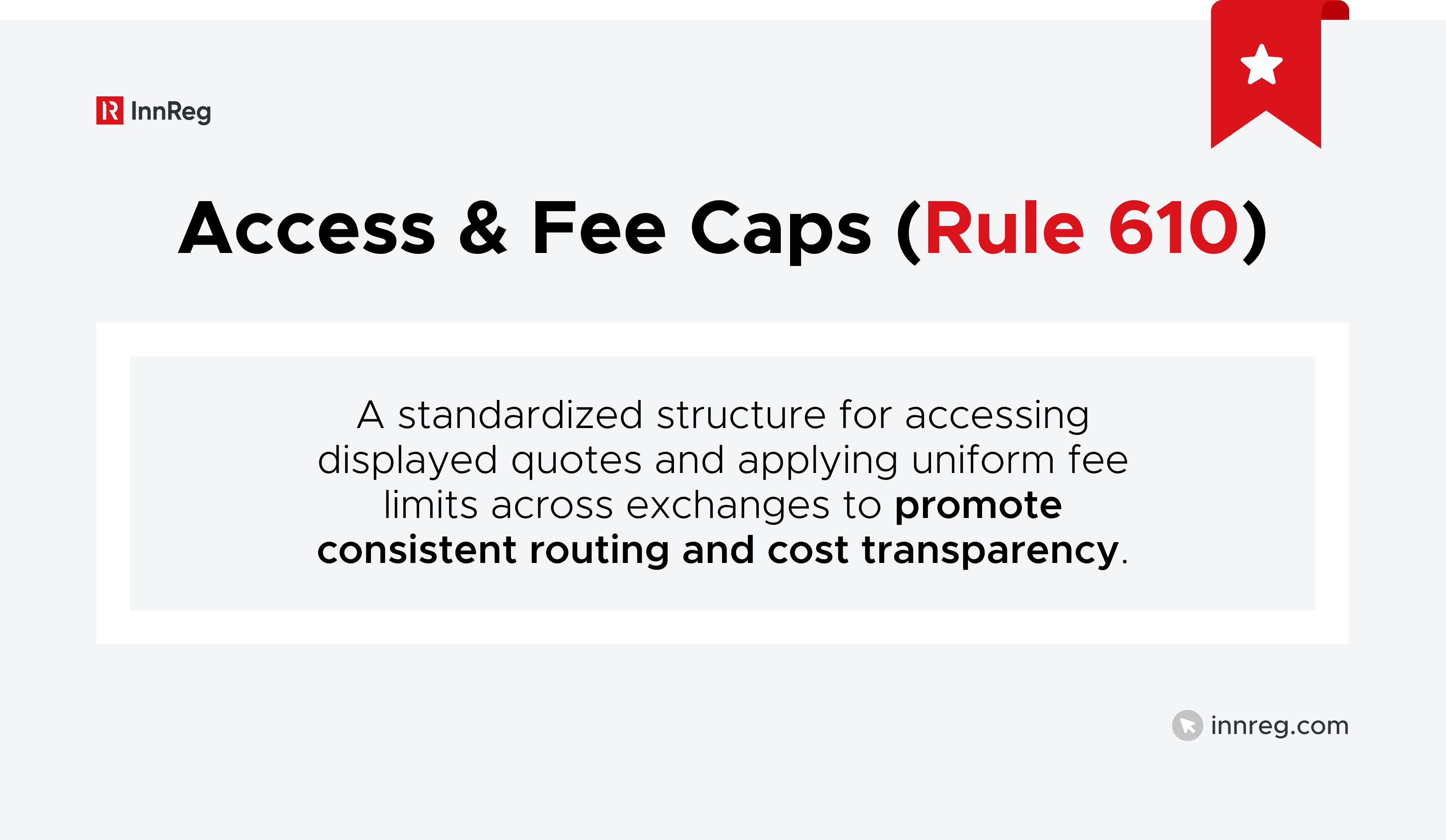
Rule 610 addresses how market participants access quotes and the associated fees. It prohibits discriminatory access practices and places a ceiling on the fees that exchanges can charge when a quote is executed.
Currently, that cap is $0.001 per share (10 mils), for NMS stocks quoting at or above $1.00 (and the fees cannot exceed or accumulate to more than .1% of the quotation price per share for NMS stocks quoting at less than $1.00). The purpose is to limit venue-based incentives that distort routing decisions, where brokers might favor an exchange not for the price but for the rebate or cost structure.
Fintech firms working with smart order routing, algorithmic execution, or direct exchange connections need to account for this. Fee-related behavior can affect routing logic, execution quality, and ultimately regulatory risk, especially if the routing appears to prioritize rebates over price improvement.
Sub-Penny Rule (Rule 612)
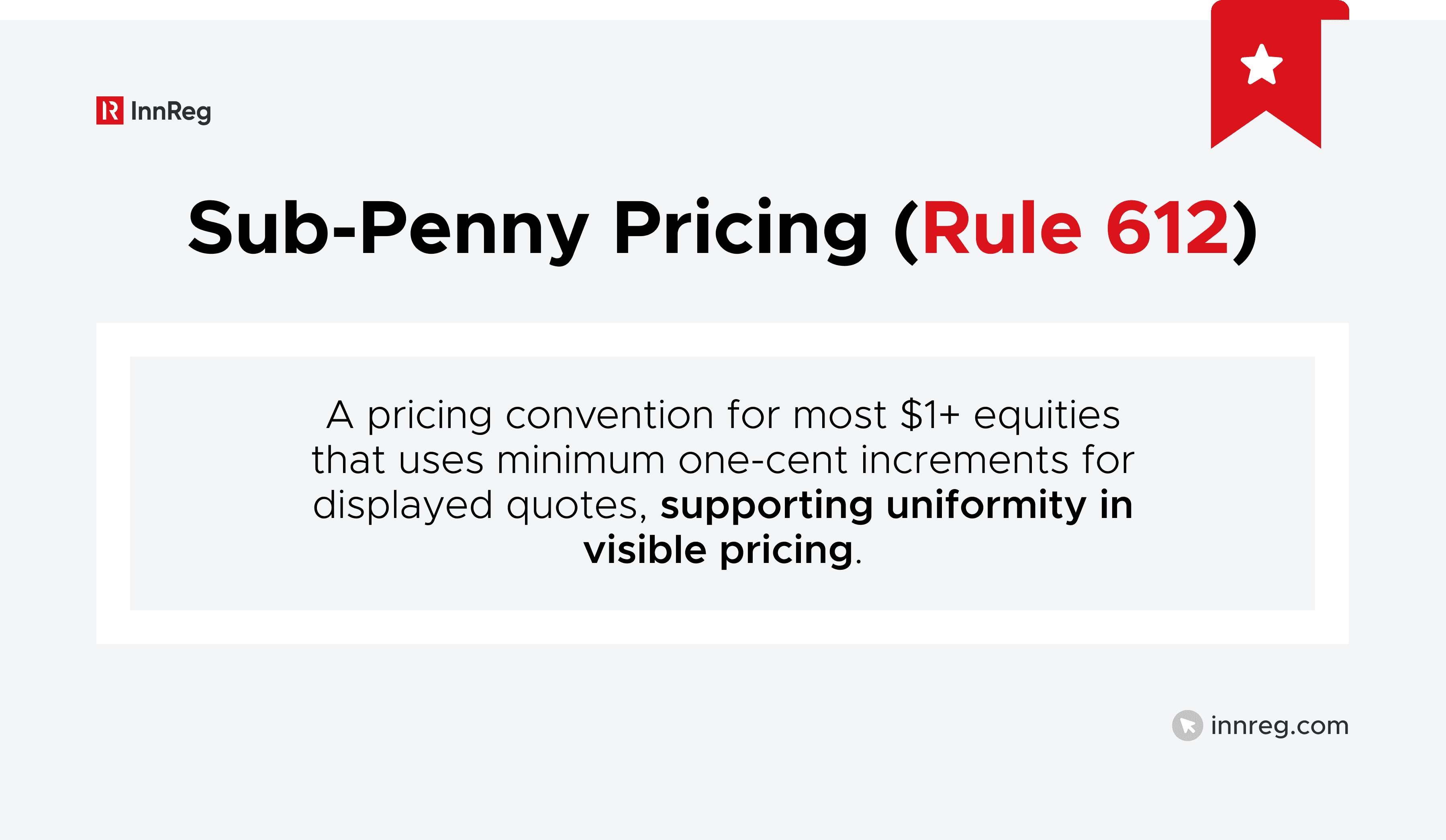
Rule 612 restricts how prices are quoted for stocks trading at $1.00 or more. It prohibits market participants from displaying quotes or accepting orders in increments smaller than one cent, also known as sub-penny pricing.
The goal is to reduce quote clutter and discourage high-frequency traders from jumping ahead of orders by fractions of a cent. For stocks under $1.00, sub-penny quoting is still allowed, but otherwise, displayed quotes must conform to whole-penny increments.
Fintech platforms dealing with fractional shares, internal crossing, or custom pricing logic should validate that none of their systems inadvertently introduce sub-penny quotes for eligible securities. This detail is easily overlooked, especially for teams accustomed to crypto-style pricing, but non-compliance here can draw regulatory scrutiny.

Market Data and the SIP
A key component of Regulation NMS is its requirement that exchanges submit their best bids and offers to a central processor, known as the Securities Information Processor (SIP). The SIP consolidates quote and trade data from all protected venues to produce the National Best Bid and Offer (NBBO), which serves as the benchmark for price transparency.
This structure is intended to give all market participants, regardless of size, equal access to baseline market data. While some firms subscribe to proprietary feeds for speed or depth, the SIP remains the standard reference point for price comparisons, regulatory obligations, and execution quality analysis.
For fintech firms, especially those offering trading functionality or quote displays, relying on accurate NBBO data via a compliant provider is critical. Whether integrated directly or through a vendor, how your platform accesses and uses SIP data factors into both user experience and regulatory oversight.
Why Regulation NMS Needs Modernization
Regulation NMS was built for a different market era. Today’s environment, driven by speed, retail activity, and off-exchange trading, creates exposed gaps that the original rules did not account for.
The sections below highlight what’s changed and why updates are on the table:
See also:
Market Fragmentation and Speed
Equity trading in the US is now split across more than a dozen exchanges and dozens of alternative trading systems (ATSs). Orders can be routed, rerouted, or executed across fragmented venues, often in milliseconds.
This environment benefits from competition but introduces coordination challenges. High-speed firms can exploit latency differences between venues, creating a regulatory gap that was not fully anticipated in 2005.
Fintech platforms must account for this fragmented landscape when building order routing logic or execution partnerships. Speed, routing behavior, and quote visibility are not just technical factors: they have direct compliance and best execution implications.

Need help with broker-dealer compliance?
Fill out the form below and our experts will get back to you.
Rise of Retail Trading and Zero-Commission Models
Retail participation in equity markets has surged, driven by mobile-first platforms, fractional shares, and zero-commission trading models. These shifts have changed how orders are routed and executed, particularly in small-sized, high-volume flows.
Many of these orders are internalized by wholesale market makers, not sent directly to exchanges. This raises questions about price improvement, order routing transparency, and execution quality, especially when payment for order flow (PFOF) is involved.
Fintechs targeting retail audiences must navigate these dynamics carefully. Execution choices that favor monetization over customer outcomes may fall under regulatory scrutiny, especially as the SEC explores reforms tied to retail order handling.
Challenges From Off-Exchange Trading and Dark Pools
A growing share of equity trades now happens away from public exchanges: in dark pools, internalizers, and alternative trading systems. While these venues offer benefits such as reduced market impact, they also reduce quote visibility.
When trades occur off-exchange, they are not included in the public price discovery process, which can impact the quality and transparency of the NBBO. For regulators, this raises questions about fairness and access, especially for retail participants.
Fintech firms that route orders through or operate alongside off-exchange mechanisms need to assess the compliance implications. If internal execution consistently bypasses better-priced public quotes, the risk is not just regulatory. It can erode trust with users and counterparties.

How Regulation NMS Was Modernized in 2024
In 2024, the SEC adopted significant updates to Regulation NMS to modernize equity market structure in response to fragmentation, high-speed trading, and the growth of retail participation.
While these reforms are no longer new, they now define the current operating baseline for equity execution.
Understanding what the 2024 updates introduced is essential for fintechs designing, reviewing, or scaling trading systems today.
New Tick Size Regime
The 2024 update introduced a variable tick size model for stocks priced at $1.00 or more. For stocks with narrower spreads, quoting is now permitted in $0.005 increments instead of being locked at $0.01.
This change is designed to improve execution quality in highly liquid names where a one-penny spread may be too wide. More granular pricing can tighten spreads and reduce costs, but it also means trading systems and routing logic need to support the updated increments.
Fintech teams should confirm that front-end quote displays, back-end pricing logic, and routing infrastructure are ready to process half-penny quotes where applicable. This applies whether execution is direct or via a clearing or routing partner.
Updated Access Fee Caps
The revised rules lower the maximum access fee for displayed quotes from $0.003 to $0.001 per share for stocks priced at $1.00 or more. For stocks under $1.00, the cap drops from 0.3% to 0.1% of the quotation price per share.
This adjustment is aimed at reducing distortions caused by maker-taker incentives, where routing decisions are influenced more by fees and rebates than by price or execution quality. Fee transparency and routing neutrality are now front and center.
Fintech platforms that route orders through multiple venues, or work with execution partners who do, should evaluate how these lower caps affect cost models and routing logic. Platforms offering execution analytics may also need to revise how they present fee-adjusted execution data.
Revised Round Lot and Odd-Lot Definitions
The traditional 100-share round lot standard no longer reflects how many securities are actually traded, especially for high-priced stocks. The updated rule introduced a tiered system, where the definition of a round lot scales with share price.
For example:
Stocks over $250: 40 shares
Over $1,000: 10 shares
Over $10,000: 1 share
This change means more quotes for high-priced securities will be included in the NBBO, improving transparency.
Fintech platforms displaying quotes or calculating execution quality metrics need to align with the updated round lot logic. Odd-lot orders at better prices will also gain visibility through enhanced public data feeds.
See also:
Expanded Market Data Visibility
With the revised rules, odd-lot quotes that improve upon the NBBO will now be displayed in public data feeds. Previously, these smaller orders were invisible to most participants, even if they offered better pricing.
This update increases transparency for both retail and institutional traders, especially in high-priced securities where odd lots are more common. Fintech platforms that show quotes or route orders based on NBBO need to adjust their systems to incorporate this additional layer of data.
Whether sourcing data directly or through vendors, firms should confirm they’re accessing updated SIP feeds that include odd-lot depth and flags. Execution quality tools may also need refinement to reflect this broader visibility.
Regulation NMS Update | Description | Impact on Fintechs |
|---|---|---|
Variable Tick Size ($0.005) | Allows narrower quoting increments for liquid stocks | Trading systems and UIs must handle half-penny pricing where applicable |
Access Fee Cap Reduction | Drops cap from $0.003 to $0.001 per share for $1+ stocks | Changes in routing incentives; cost model updates for execution partners |
Tiered Round Lot Definition | Adjusts the round lot size based on the share price | Quote displays and execution metrics must adopt new round lot logic |
Odd-Lot Quote Visibility | Adds odd-lot quotes to public SIP feeds | Platforms must ingest expanded data and potentially adjust routing logic |
Enhanced SIP Data Requirements | Increases transparency for quotes outside the traditional NBBO | Vendors must support new feeds; platforms may need to revise best execution tools |
Together, these 2024 reforms reshaped how quotes are priced, displayed, and accessed, and they continue to influence how fintech platforms design routing logic, vendor relationships, and execution analytics today.

What Fintech Teams Need to Watch For
Modern Regulation NMS rules touch more than just exchanges and broker-dealers. They directly affect how fintech platforms design order flows, manage compliance risk, and present pricing to users.
How Modern NMS Rules Affect Trading Platforms
Fintech platforms involved in equity execution, directly or through partners, need to align with updated quote display, routing, and pricing mechanics. That includes support for half-penny tick sizes, revised round lot logic, and real-time NBBO integration.
Routing decisions and order handling workflows must reflect the most current market structure rules, not legacy logic from prior frameworks. This applies whether your team is building an internal matching engine, using a clearing broker, or embedding execution via APIs.
These updates may also affect how platforms present price improvement, execution quality, and comparative quote data to users. Small changes in rule compliance can have outsized effects when scaled across thousands of daily transactions.
Role of Broker-Dealer, ATS, and Exchange Classification
Fintechs offering trade execution or internal order matching may fall under classifications like broker-dealer, alternative trading system (ATS), or even exchange, depending on how the platform functions.
These designations matter. Each comes with different registration, reporting, and compliance obligations under SEC and FINRA rules, including how Regulation NMS applies to your operations.
Founders often misjudge where their model lands. If your platform matches buyers and sellers using a set method, even without displaying public quotes, you may be operating as an ATS. Getting this classification right early helps avoid costly restructuring later.
Building NMS Compliance into Fintech Operations
Building around Regulation NMS requires more than policy awareness. Fintech teams must operationalize NMS rules in system design, data handling, and vendor workflows.
System Design and Vendor Selection
Platforms that execute or route equity orders must build systems that reflect current Regulation NMS requirements, not just legacy market logic. That includes handling tick sizes, round lots, and real-time access to protected quotes.
Vendor selection plays a key role. Clearing brokers, routing engines, market data providers, and execution partners must be aligned with NMS updates, or your platform risks indirect non-compliance.
Due diligence should include how vendors handle half-penny quoting, updated SIP feeds, and address fee caps. For fintechs operating lean, working with outsourced compliance advisors familiar with NMS and vendor risk management can streamline decision-making.

Real-Time NBBO and Smart Order Routing
Regulation NMS requires platforms to support real-time access to the National Best Bid and Offer (NBBO). This data is foundational for preventing trade-throughs and evaluating execution quality.
Smart order routing systems should be configured to evaluate best-priced venues across exchanges and ATSs dynamically. That means routing logic needs to integrate fee caps, tick-size constraints, and execution speed, without relying on outdated assumptions.
Whether developed in-house or sourced from a vendor, routing strategies should be periodically reviewed. Execution behavior must reflect the current market structure and avoid patterns that regulators associate with best execution failures.
See also:
Cost-Effective Compliance Strategies for Startups
For early-stage fintechs, building a full in-house compliance team around Regulation NMS can be resource-heavy. Outsourcing to specialists with deep fintech and broker-dealer experience can reduce cost while improving coverage.
Experienced compliance partners can help design workflows, vet vendors, and manage day-to-day obligations tied to NMS, without slowing product development. This is especially useful when scaling rapidly or preparing for registration.
The key is finding partners who are process-driven, tech-neutral, and understand how to apply complex regulations in fast-moving environments. This approach offers flexibility without sacrificing oversight.
InnReg helps fintechs navigate Regulation NMS compliance. Contact us to learn more →
Beyond Regulation NMS: What’s Coming Next
While the 2024 updates to Regulation NMS are significant, they’re part of a broader shift in how the SEC is approaching equity market structure.
Several additional proposals are on the table, and if finalized, they could reshape how fintechs handle order execution, disclosures, and routing logic.
SEC Proposals: Regulation Best Execution and Order Competition Rule
The SEC has proposed a standalone Regulation Best Execution, which would formalize how brokers evaluate execution quality across venues. This would move best execution from a principles-based expectation into a codified, enforceable rule, with documented procedures and review processes.
Another proposal, the Order Competition Rule, would require certain retail orders to be exposed to open auctions before internalization. If adopted, this would directly impact routing strategies used by retail-facing fintechs, particularly those relying on wholesale market makers.
Both proposals reflect a trend toward tighter scrutiny of how orders are handled and priced. Fintechs with execution capabilities, or relying on third parties for execution, should prepare for increased transparency and process documentation.
Shifts in Market Data Structure and Transparency Expectations
The SEC is pushing for greater transparency in how market data is structured, distributed, and consumed, especially amid rising off-exchange trading. Regulation NMS has long relied on the SIP (Securities Information Processor) to deliver consolidated quote data, but that model now lags behind proprietary feeds in both speed and depth.
Recent reforms aim to close that gap. Odd-lot quotes that improve the NBBO are now publicly displayed, and SIP updates are expanding real-time quote visibility. For fintech platforms, relying solely on legacy NBBO feeds is no longer sufficient.
Execution logic and quote displays must reflect these expanded datasets, particularly in high-priced stocks, where odd-lots dominate actual order flow. Failing to incorporate that data can distort execution metrics and expose platforms to compliance risk.

—
The recent Regulation NMS updates mark a shift toward tighter alignment between market structure rules and how trading actually happens today.
For fintechs, these changes impact more than compliance. They shape how platforms route orders, display pricing, and evaluate execution quality.
Looking ahead, the regulatory direction is clear: increased transparency, real-time data expectations, and stricter oversight of routing behavior. Fintech teams building execution workflows, partnering with brokers, or preparing for registration should treat NMS rules as core product inputs.

Maria is a Compliance Consultant at InnReg delivering compliance solutions for fintech clients across broker-dealer, RIA, and money transmitter verticals. She brings prior experience at Finalis, Fenix Securities and PwC, with expertise in AML, CCO support, investment banking operations and securities compliance. She holds FINRA Series 14, 24, and 82 licenses and actively supports regulatory and compliance processes revolving broker-dealer activities.
How Can InnReg Help?
InnReg is a global regulatory compliance and operations consulting team serving financial services companies since 2013.
We are especially effective at launching and scaling fintechs with innovative compliance strategies and delivering cost-effective managed services, assisted by proprietary regtech solutions.
If you need help with broker-dealer compliance, reach out to our regulatory experts today:
Related Articles



Featured LinkedIn Posts