What Does a Registered Options Principal Do?
Key Takeaways
Series 4 registration qualifies professionals to supervise options business activities.
Options principals oversee account approvals, trading activity, and higher-risk strategies.
FINRA Rules 1220, 2360, and 3110 shape options supervision requirements.
Options accounts require customer review, risk assessment, and option principal approval.
Effective supervision relies on WSPs, surveillance, escalation workflows, and recordkeeping.
Options trading brings extra regulatory obligations for broker-dealers. One of the most important is having the right supervisory structure in place to oversee options activity.
The options principal plays a central role in that framework. Firms offering options products need to understand the regulatory expectations attached to the position, the qualifications involved, and the responsibilities that come with it.
This guide covers the role of the options principal, the rules that govern the position, and what firms should know when building and supervising an options business.
At InnReg, we help broker-dealers build and manage options compliance programs. That includes Series 4 supervision, written supervisory procedures, options account approval processes, and ongoing compliance operations.


What Is an Options Principal?
An options principal is a registered supervisor responsible for a broker-dealer's options activities. The role is held by an individual who has passed the Series 4 exam and is authorized to supervise options-related business under FINRA rules.
Unlike registered representatives who execute trades or interact directly with customers, an options principal’s function is supervisory:
Reviewing options accounts
Overseeing options trading activity
Helping the firm meet its regulatory obligations involving options activity
Options can involve complex strategies and higher levels of risk than many traditional investments. That’s why regulators expect firms to have qualified personnel overseeing how options products are offered, approved, and supervised.
At many broker-dealers, the options principal works closely with compliance, operations, legal, and business teams on the firm's options program. Responsibilities vary by business model, but the role comes back to supervision and risk oversight.
Why Broker-Dealers Need an Options Principal
An options principal helps firms manage risk in several areas:
Customer account approvals: Firms decide whether a customer should be permitted to trade options and at what level of authorization.
Supervision of options activity: Trading gets monitored for unusual patterns, excessive risk-taking, and compliance with options rules.
Review of higher-risk strategies: Certain options strategies carry elevated risk and warrant closer supervisory attention.
Compliance with FINRA requirements: Firms follow specific rules on options accounts, disclosures, supervision, and recordkeeping.
Escalation and issue management: Customer complaints, exceptions, and supervisory concerns land with qualified supervisory personnel for review and resolution.
The Difference Between an Options Principal and a General Securities Principal
Options principals and general securities principals both hold supervisory responsibilities at a broker-dealer, but they are different roles. Duties can overlap, and FINRA still requires specific qualifications for anyone supervising options business.
The table below breaks down where the two roles diverge.
Aspect | Options Principal (Series 4) | General Securities Principal (Series 24) |
|---|---|---|
Primary Focus | Options business and options supervision | Overall supervision of securities business activities |
Registration | Series 4 | Series 24 |
Options Account Approvals | Yes | Not allowed |
Options Trading Supervision | Yes | May supervise broader activities, but cannot supervise options trading |
Communications Related to Options | Yes | May review general communications, but cannot supervise options-related communications |
Scope of Responsibility | Specialized | Broad |
In practice, the two roles work closely together. A Series 24 principal may oversee the firm's overall supervisory program, while the options principal handles the unique risks and requirements specific to options trading.
Registered Options Principal Responsibilities
Day-to-day responsibilities depend on the firm's business model, but a few core duties show up across the industry.
1. Supervising the Firm’s Options Business
The first responsibility is the options business as a whole, not just individual trades or accounts. That means helping the firm maintain a supervisory framework that aligns with its options activities and risk profile.
Depending on the firm's structure, the options principal may maintain supervisory procedures, review exception reports, coordinate with compliance teams, and monitor how options-related policies are being followed across the organization. The goal is consistent oversight rather than reacting to issues after the fact.
Learn how InnReg’s compliance and supervision guide supports effective oversight →

2. Reviewing and Approving Options Accounts
Before a customer can trade options, a firm has to determine whether options trading is appropriate for the account. That review confirms the customer is eligible and that the strategies they can access fit their financial situation and investing experience.
An options principal is typically responsible for reviewing and approving new options accounts. They’ll look at the customer's trading history and experience, investment objectives, financial resources, and risk tolerance. That information drives two decisions: whether to approve the account and what level of trading to permit.
3. Overseeing Options Trading Activity
Once customers start trading, firms are expected to monitor activity for risk, unusual patterns, and possible violations of internal policies or regulatory requirements.
An options principal may review trade reports, exception reports, and other supervisory alerts built to flag activity that warrants a closer look. This oversight helps firms detect issues early and determine whether further review or escalation is needed.
See also:
4. Supervising Discretionary Options Accounts
Some customers authorize a firm or financial professional to make trading decisions on their behalf. When options trading occurs in a discretionary account, supervisory expectations run higher since the customer isn't making each call.
An options principal may review discretionary activity to confirm that trading remains consistent with the account's objectives, risk profile, and any applicable firm policies. These accounts typically require closer oversight than non-discretionary ones because someone else is holding the trading authority.

Need help with broker-dealer compliance?
Fill out the form below and our experts will get back to you.
5. Reviewing Options Communications and Marketing
Options-related communications can shape how customers understand the risks and potential rewards of trading. Firms are expected to review marketing materials, educational content, and anything else that describes options products.
An options principal should participate in the review and approval process for options-related communications to help confirm that information is fair, balanced, and not misleading. Communications should accurately describe both the potential benefits and the risks associated with options trading.
6. Monitoring Higher-Risk Options Strategies
While some options strategies are designed to limit potential losses, others can expose investors to substantial risk if they're not fully understood or properly managed.
Because of this, firms often apply additional supervision to higher-risk strategies. An options principal may review trading activity involving uncovered positions, complex multi-leg strategies, or other transactions that present elevated risk. This is an effort to identify situations that may warrant closer review.

7. Managing Escalations, Complaints, and Exceptions
Even with strong supervisory controls in place, issues can arise. Customer complaints, policy exceptions, unusual trading activity, and supervisory alerts may all require additional review.
Typically, an options principal evaluates these situations to determine whether further investigation is needed. They seek to understand what happened, assess potential risks, and decide on an appropriate course of action.
Which Firms Need a Registered Options Principal?
The need for a registered options principal depends on a firm's business model and the types of products it offers. Firms involved in options trading are generally subject to additional supervisory requirements and may need qualified options supervision in place.
Broker-Dealers Offering Options Trading
Once a broker-dealer begins offering options trading, its supervisory obligations become more complex. Options are subject to specific FINRA requirements, and firms are expected to have qualified personnel overseeing options-related activity.
That oversight starts with the firm's supervisory structure. Firms need clear responsibility for functions such as account approvals, trade supervision, and ongoing monitoring of options activity.
As a firm’s options business grows, it should clearly document supervisory responsibilities and secure appropriate registrations. This provides a way for the firm to demonstrate how it is supervising options activities.
Fintech Platforms With Retail Options Access
Retail options trading is no longer limited to traditional brokerage firms. Many fintech platforms now offer options trading through mobile apps and digital-first investing experiences, making options more accessible to a broader range of investors.
That accessibility brings additional supervisory considerations. When customers can open accounts, request options permissions, and place trades online, firms need processes that support appropriate review and oversight at scale.
For fintech broker-dealers, options supervision is often closely tied to platform design, customer onboarding workflows, and surveillance systems. As products evolve and trading activity grows, firms should be prepared to demonstrate how options-related risks are identified, monitored, and escalated when necessary.
Clearing Firms vs. Introducing Firms
A firm's role in the options transaction can also affect how supervisory responsibilities are allocated. While both clearing firms and introducing firms may participate in options activities, their responsibilities aren't always the same.
Clearing firms generally handle functions such as:
Trade settlement
Custody
Recordkeeping
Introducing firms, on the other hand, are often responsible for customer-facing activities, including account opening, communications, and certain supervisory functions.
The exact division of responsibilities depends on the firm's business model and any agreements between the parties. Even when responsibilities are shared, firms should clearly document who is responsible for each aspect of options supervision and maintain appropriate oversight of any outsourced functions.
Self-Directed Trading Apps and Options Supervision
Self-directed trading apps have made options trading more accessible than ever. Investors can apply for options trading, access educational materials, and place trades directly from their devices, often without interacting with a representative.
While the customer directs their own trading decisions, the firm's supervisory responsibilities don't disappear. Firms still need processes for reviewing account applications, assigning options trading levels, monitoring activity, and addressing potential risks.
As trading volumes increase, many firms rely on a combination of technology, surveillance tools, and supervisory reviews to support their compliance programs. The challenge is building a framework that can scale with customer growth while maintaining appropriate oversight of options-related activity.
Options Principal Registration Requirements
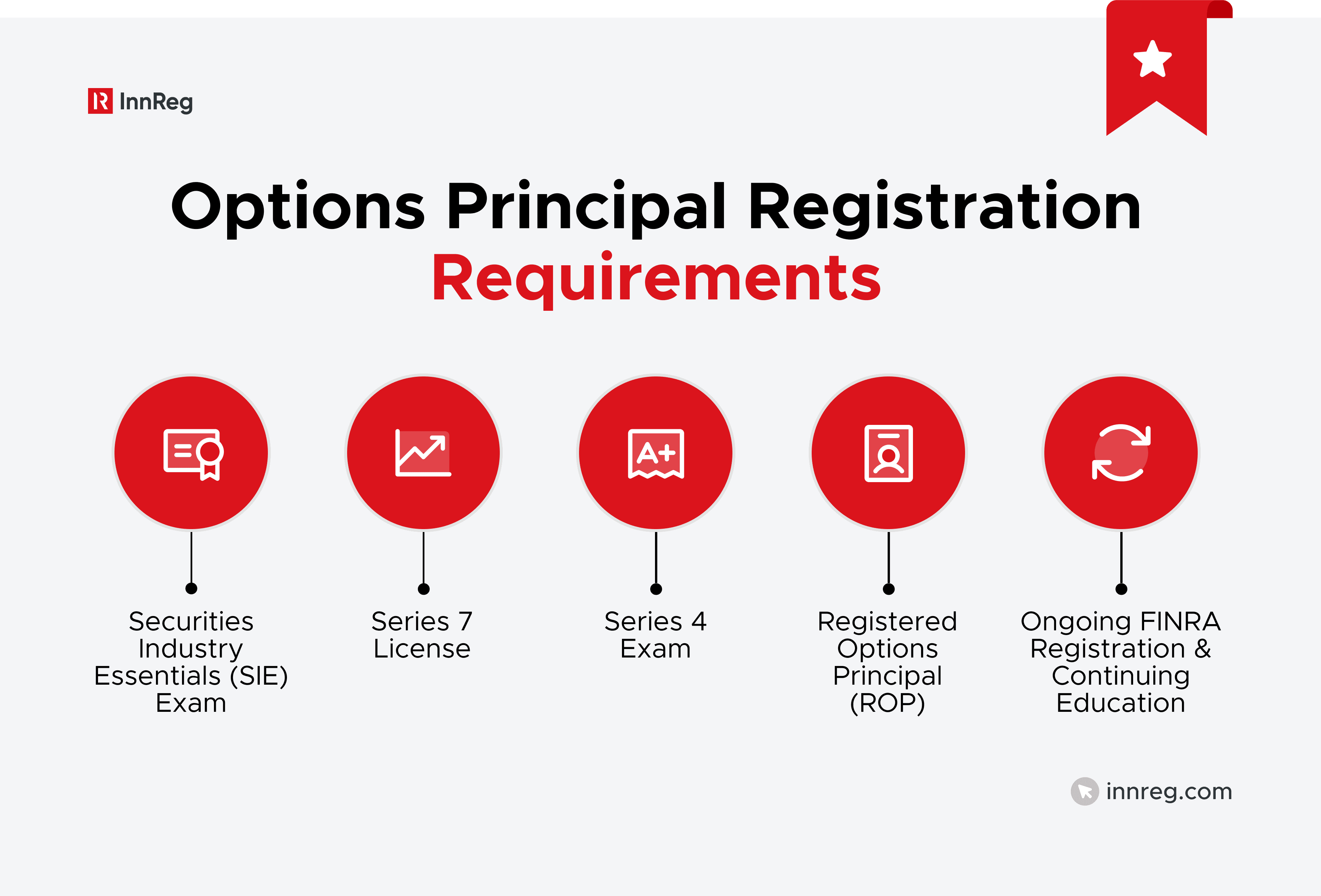
FINRA requires individuals supervising options activities to hold specific registrations and meet ongoing qualification requirements.
The sections below cover the licensing, registration, and continuing education requirements associated with the role.
Series 4 License Requirements
The Series 4 license is the primary requirement to supervise a firm's options business. Passing the Series 4 exam allows a registered representative to become a Registered Options Principal (ROP) and perform options-related supervisory functions.
The exam focuses on topics such as:
Options regulations
Account approval requirements
Supervision
Communications
Risk management
Its purpose is to confirm that candidates understand the rules and responsibilities associated with overseeing options activities.
See also:
SIE and Series 7 Prerequisites
Before an individual can obtain a Series 4 registration, they must first satisfy FINRA's prerequisite licensing requirements. This includes passing both the Securities Industry Essentials (SIE) Exam and the Series 7 exam.
The SIE exam covers fundamental concepts such as securities products, market structure, and regulatory basics. The Series 7 builds on that foundation by testing a candidate's knowledge of a broad range of securities products and activities.
The Series 4 isn't a standalone registration. It serves as an additional qualification for individuals who already hold the registrations needed to work as a general securities representative. Once those prerequisites are met, candidates can sit for the Series 4 exam and pursue registration as a Registered Options Principal.

FINRA Registration Rules
Passing the required exams is only part of the process. To act as an options principal, an individual must also be properly registered with FINRA through a member firm.
Registration is tied to the person's role and responsibilities within the organization. Firms are responsible for making sure supervisory personnel hold the registrations required for the activities they oversee.
Changes in job duties, supervisory responsibilities, or employment status may affect an individual's registration requirements. Firms should periodically review their registration records to confirm that registrations remain accurate and aligned with the firm's supervisory structure.
Continuing Education and Ongoing Obligations
Registration isn't a one-time requirement. Options principals must complete FINRA's continuing education requirements and stay informed about regulatory developments that affect their responsibilities.
As rules, products, and market practices evolve, supervisory personnel are expected to maintain the requisite knowledge to effectively oversee their firm's options activities. Continuing education also helps them stay current with regulatory expectations and industry changes.
Firms also need to monitor registrations, maintain accurate records, and confirm that supervisory responsibilities are assigned to appropriately qualified personnel. Keeping registrations and training up to date is an important part of maintaining an effective supervisory program.
Key FINRA Rules Governing Options Principals
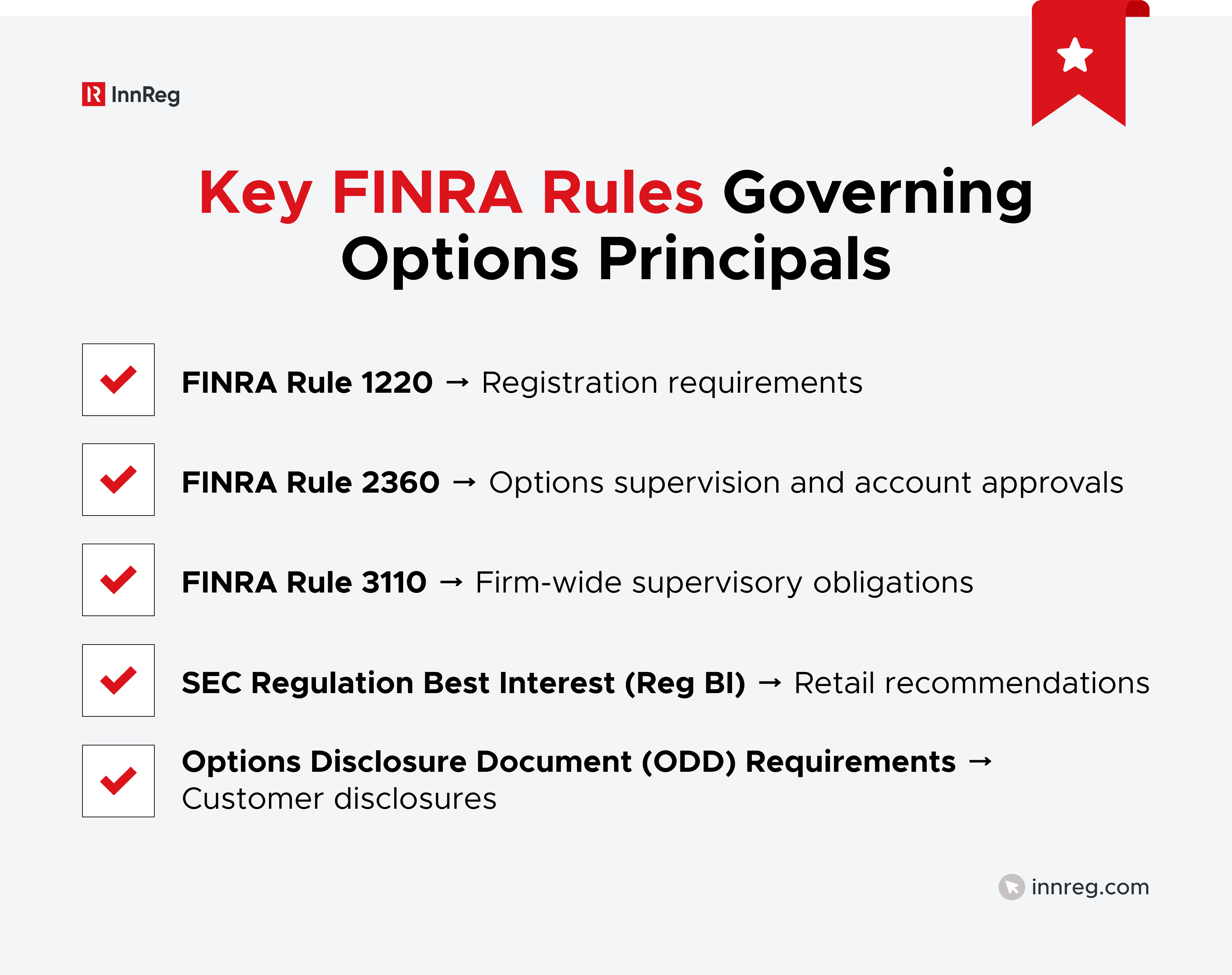
The role of an options principal is closely tied to several FINRA rules that establish how options business should be supervised.
FINRA Rule 1220
FINRA Rule 1220 establishes the registration requirements for individuals working in registered capacities at member firms, including principals responsible for supervising options activities.
For options principals, the rule identifies the qualifications needed to perform options-related supervisory functions. This is the rule that links the role to the Series 4 registration and defines who can supervise a firm's options business.
Learn more about FINRA Rule 1220 →
FINRA Rule 2360
FINRA Rule 2360 establishes requirements related to options account approvals, supervision, communications, disclosures, and recordkeeping.
For options principals, many of the responsibilities discussed throughout this guide stem directly from Rule 2360. The rule outlines how firms should supervise options business and what steps must be taken before customers are permitted to trade options.
Rule 2360 also contains requirements related to options suitability, discretionary accounts, and the delivery of options disclosures. Because of its broad scope, firms that offer options trading should be familiar with Rule 2360 and how it applies to their supervisory procedures.
Learn more about FINRA Rule 2360 →

FINRA Rule 3110
While Rule 2360 focuses specifically on options activities, FINRA Rule 3110 establishes the broader supervisory framework that applies across a member firm's business.
The rule requires firms to maintain a system for supervising their activities and to establish written supervisory procedures designed to achieve compliance with applicable securities laws and regulations. For options principals, Rule 3110 provides the foundation for how options supervision should be structured, documented, and carried out.
Rule 3110 also addresses areas such as supervisory reviews, inspections, and the assignment of supervisory responsibilities. A firm's options supervisory program should align with its broader supervisory framework rather than operate as a standalone function.
Learn more about FINRA Rule 3110 →
See also:
SEC Regulation Best Interest and Options Supervision
Options trading can present significant risks for retail investors, which is one reason firms should consider how their options offerings align with their obligations under SEC Regulation Best Interest (Reg BI).
Reg BI requires broker-dealers and their associated persons to act in the retail customer's best interest when making recommendations involving securities transactions or investment strategies. When options recommendations are involved, firms should be prepared to demonstrate how those recommendations align with the customer's investment profile and objectives.
Learn more about Regulation Best Interest (Reg BI) →
While self-directed trading activity may not involve a recommendation, firms should still consider how their supervisory processes, disclosures, and customer interactions support compliance with regulatory requirements. Options principals often help firms oversee these activities and identify areas that may warrant additional review.
The Options Disclosure Document (ODD) Requirement
Before a customer can begin trading options, firms must provide the Options Disclosure Document (ODD). Published by The Options Clearing Corporation (OCC), this document explains the characteristics and risks associated with standardized options.
The ODD helps investors make informed decisions by outlining:
How options work
The risks involved
The potential outcomes of different strategies
Customers should receive the document before options trading is approved for their account.
Firms should maintain and document ODD delivery procedures. Providing the document is a longstanding requirement under FINRA's options rules and essential to the following account approval process.
The Options Account Approval Process
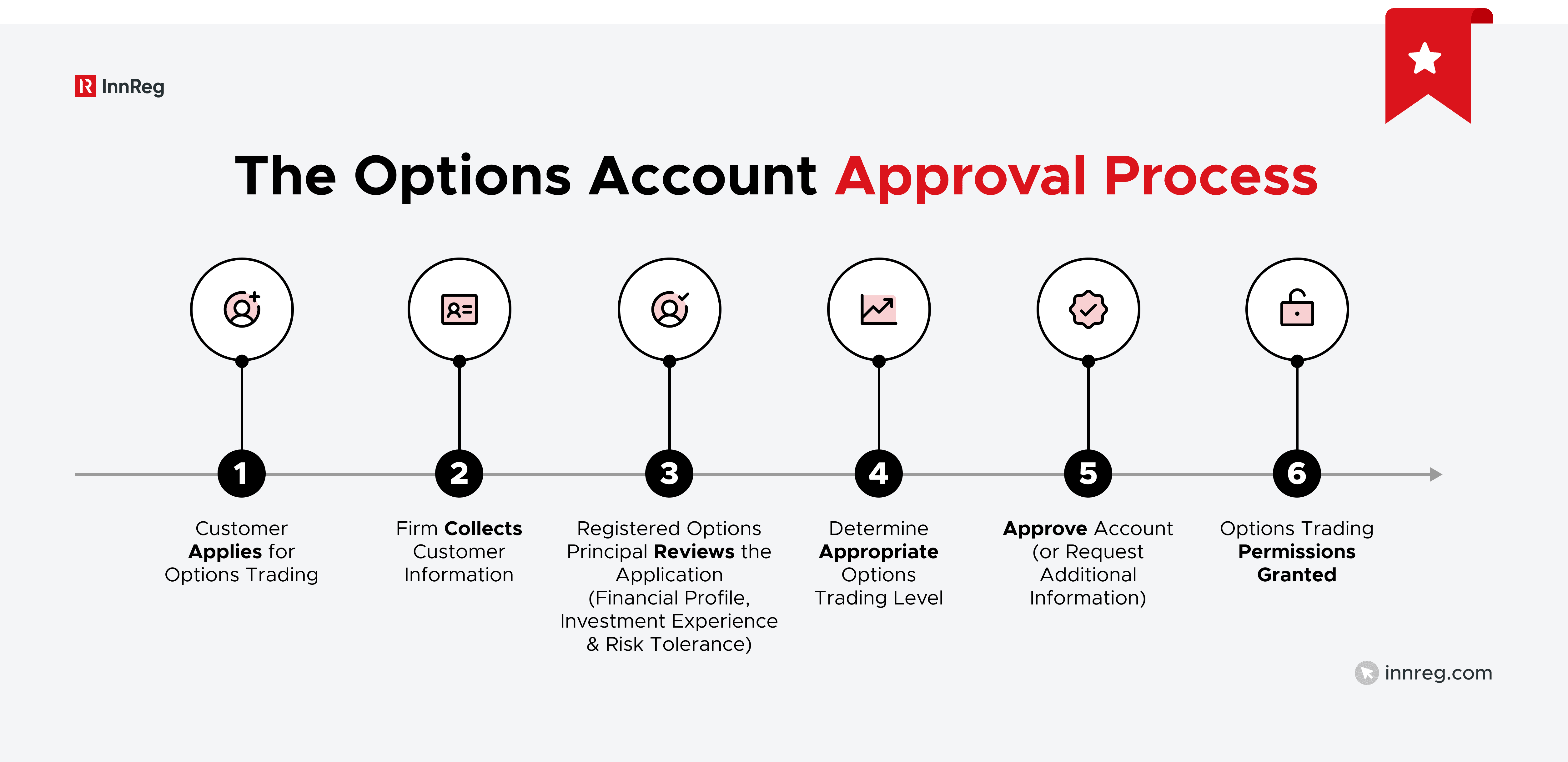
Firms are expected to gather customer information, evaluate risk, and follow a documented review process before granting options trading permissions.
The sections below walk through the key components.
What Firms Must Review Before Approval
Before approving an options account, firms should evaluate whether options trading is appropriate based on the customer's profile and the requested level of trading access being requested.
The review typically includes factors such as the:
Trading experience
Overall understanding of options
Customer's investment objectives
Financial situation
Risk tolerance
This information helps firms assess whether the requested options activity aligns with the customer's circumstances.
Customer Information Required Under FINRA Rules
To evaluate an options application, firms must collect certain information about the customer. FINRA's options rules require firms to obtain information that's relevant to the account approval decision.
This information often includes the customer's age, investment objectives, financial status, investment experience, risk tolerance, and other details that help the firm understand the customer's profile. The quality of the approval process depends on the quality of the information collected.
Firms should have procedures for gathering, reviewing, and maintaining customer information as part of their options approval process.
Options Trading Levels and Risk-Based Permissions
Firms don't give every customer access to every options strategy. Instead, options trading permissions are often assigned in levels, with each level providing access to different types of strategies based on the customer's experience and risk profile.
The goal is to match trading permissions with the customer's financial circumstances, investment objectives, and understanding of options. As the complexity and risk of a strategy increase, firms generally apply a more rigorous review process.
While firms may structure their approval levels differently, the framework often looks something like this:
Options Level | Examples of Permitted Strategies |
|---|---|
Level 1 | Covered calls, protective puts |
Level 2 | Long calls and puts |
Level 3 | Spreads and other defined-risk strategies |
Level 4 | Uncovered options and higher-risk strategies |
Customers seeking access to more advanced strategies may need to provide additional information or undergo further review before approval is granted.
When a Registered Options Principal Must Approve an Account
FINRA rules require options accounts to be reviewed and approved by a registered options principal before options trading can begin. This approval is a key supervisory control designed to ensure a qualified supervisor evaluates whether the account is appropriate for options activity.
The review should be based on the information collected during the application process, including the:
Trading experience
Customer's financial situation
Investment objectives
Risk tolerance
Approval decisions should be supported by the facts and circumstances of each account rather than a one-size-fits-all approach.
If a customer later requests access to more advanced options strategies, additional review and approval may be required.
Building an Effective Options Supervisory Program
Approving accounts is only one part of options supervision. Firms also need policies, procedures, monitoring processes, and documentation controls that support ongoing oversight of their options business.
Building an effective supervisory program requires all of these pieces to work together.
1. Written Supervisory Procedures
Written Supervisory Procedures (WSPs) form the foundation of an effective options supervisory program. They document:
How the firm supervises its options business
Who is responsible for key activities
What processes should be followed to meet regulatory requirements
A firm's WSPs should reflect its actual operations rather than a generic template. The procedures should clearly outline how the firm handles areas such as account approvals, trade surveillance, communications review, escalations, and recordkeeping.
Learn more about Written Supervisory Procedures →
2. Surveillance and Escalation Workflows
Supervision doesn't end once an account is approved or a trade is executed. Firms need processes for monitoring activity, identifying potential issues, and determining when additional review is necessary.
Surveillance workflows often rely on exception reports, automated alerts, transaction reviews, and other monitoring tools to flag activity that falls outside established parameters. The goal is to identify potential concerns early and route them to the appropriate personnel for review.
When issues are identified, firms should have clear escalation procedures in place. Well-defined workflows help teams respond consistently, document decisions, and maintain accountability throughout the review process.
3. Documentation and Recordkeeping Practices
Strong supervision depends on strong documentation. Firms should maintain records that demonstrate how supervisory decisions were made, what information was reviewed, and how potential issues were addressed.
This may include:
Account approval records
Surveillance reviews
Escalation logs
Communications approvals
Exception reports
Other supervisory documentation
Complete and organized records help create a clear audit trail and support the firm's compliance efforts.
Recordkeeping is also a key focus during regulatory examinations. When documentation is missing or inconsistent, it can be difficult for firms to demonstrate that supervisory processes were followed as intended.
4. Coordination Between Compliance, Legal, and Operations
Options supervision rarely falls on a single person or department. Effective oversight often requires coordination between compliance, legal, operations, risk, and business teams.
Each group plays a different role. Compliance may oversee supervisory controls, legal may help interpret regulatory requirements, and operations may support account reviews, recordkeeping, and trade processing. Clear communication between teams helps firms address issues more efficiently and maintain consistent supervision across the organization.
5. Outsourced Compliance Support for Options Businesses
Building and maintaining an options supervisory program requires specialized expertise, ongoing oversight, and dedicated resources. For some firms, particularly startups and growing broker-dealers, maintaining that capability entirely in-house can be challenging.
As a result, some firms choose to outsource portions of their compliance function or engage experienced professionals to support options supervision. This can provide access to specialized regulatory expertise without the cost of building a large internal compliance team.
An outsourced compliance partner like InnReg may assist with areas such as necessary principals, supervisory procedures, account approval processes, surveillance programs, regulatory examinations, and ongoing compliance operations. The key is verifying that supervisory responsibilities remain clearly defined and that the firm maintains appropriate oversight of any outsourced activities.

—
Options trading brings additional risks, regulatory requirements, and supervisory responsibilities. That's why FINRA requires firms engaged in options business to have qualified oversight in place.
The options principal sits at the center of that oversight framework, helping firms supervise options activity, approve accounts, and maintain compliance with applicable rules. For broker-dealers offering options trading, understanding the role isn't just about registration requirements. It's about building a supervisory program that can support the firm's business as it grows.

Bruno is a Principal Compliance Officer at InnReg advising fintech clients across broker-dealer, RIA, and money transmitter verticals. He brings prior experience at Santander Brasil and Passfolio, with expertise in regulatory strategy, supervisory systems, and compliance execution. He holds FINRA Series 4, 7, 24, 63, and 99 licenses.
How Can InnReg Help?
InnReg is a global regulatory compliance and operations consulting team serving financial services companies since 2013.
We are especially effective at launching and scaling fintechs with innovative compliance strategies and delivering cost-effective managed services, assisted by proprietary regtech solutions.
If you need help with broker-dealer compliance, reach out to our regulatory experts today:
Related Articles




Featured LinkedIn Posts