Top Registered Investment Advisor Firms in the US
Top RIAs play a major role in the US wealth management industry, particularly as investors are increasingly looking for fiduciary advisors, personalized portfolio management, and long-term financial planning.
While many firms operate as Registered Investment Advisors (RIAs), only a small group stands out because of their scale, investment capabilities, client service models, and ability to adapt to changing market and regulatory conditions.
This article breaks down some of the top RIAs in the US. For each firm, we will look at its assets under management (AUM), client focus, investment approach, and key considerations that investors and industry professionals should understand before evaluating them.
At InnReg, we help RIAs navigate complex compliance and regulatory requirements. From SEC registration and compliance program development to outsourced compliance operations, our team supports firms building and scaling advisory businesses in the US and globally.


1. Vanguard Personal Advisor Services
Vanguard Personal Advisor Services is one of the largest and most recognizable RIAs in the US. The firm combines automated portfolio management with access to human financial advisors, positioning itself between traditional wealth management and robo-advisory services.
Vanguard’s advisory platform is closely tied to the company’s emphasis on index investing and cost-conscious portfolio management. The service primarily caters to investors looking for long-term financial planning and diversified investment exposure without relying heavily on active trading strategies.
The company manages trillions of dollars globally through its broader investment business, with hundreds of billions tied specifically to advisory services. Its size has helped Vanguard build significant operational efficiency and maintain relatively low advisory costs.
Its advisory offering has continued to grow as investors move toward fee-conscious wealth management models. Vanguard is widely viewed as one of the most influential firms in shaping modern low-cost advisory services in the US market.

A big part of Vanguard’s advisory business revolves around people planning for retirement or trying to build long-term wealth without taking on a highly customized private wealth structure. The platform has historically attracted investors with larger balances, though that changed as digital advisory services became more common across the industry.
The investment process is relatively restrained compared to some independent advisory firms. Portfolios are usually built with Vanguard funds and exchange-traded funds (ETFs) and managed with a long-term view in mind. Instead of leaning heavily into active trading or niche asset classes, the focus stays on diversification and staying invested through different market environments.
Compliance Perspective
Operating at this level also means dealing with extensive regulatory obligations. Large RIAs typically maintain sizeable compliance functions responsible for areas like fiduciary supervision, client disclosures, cybersecurity controls, advertising reviews, and ongoing regulatory reporting.
Vanguard’s operating model has influenced much of the modern digital advisory market. Many fintech wealth platforms now use similar combinations of centralized operations, technology-supported servicing, and scalable compliance processes as they grow their advisory businesses.
2. Fidelity Wealth Management
Fidelity’s advisory business operates inside a much larger financial institution that also handles brokerage, retirement plans, custody services, and investment products. Because of that, the firm reaches far beyond the traditional independent RIA model.
Many clients come into the platform through retirement accounts or brokerage relationships before using advisory services later. That creates a different operating structure compared to firms built purely around standalone wealth management relationships.
Technology has become a major part of the company’s advisory strategy as well. Fidelity continues expanding digital planning tools and online servicing capabilities as more investors expect wealth management to function through apps, dashboards, and integrated digital platforms.
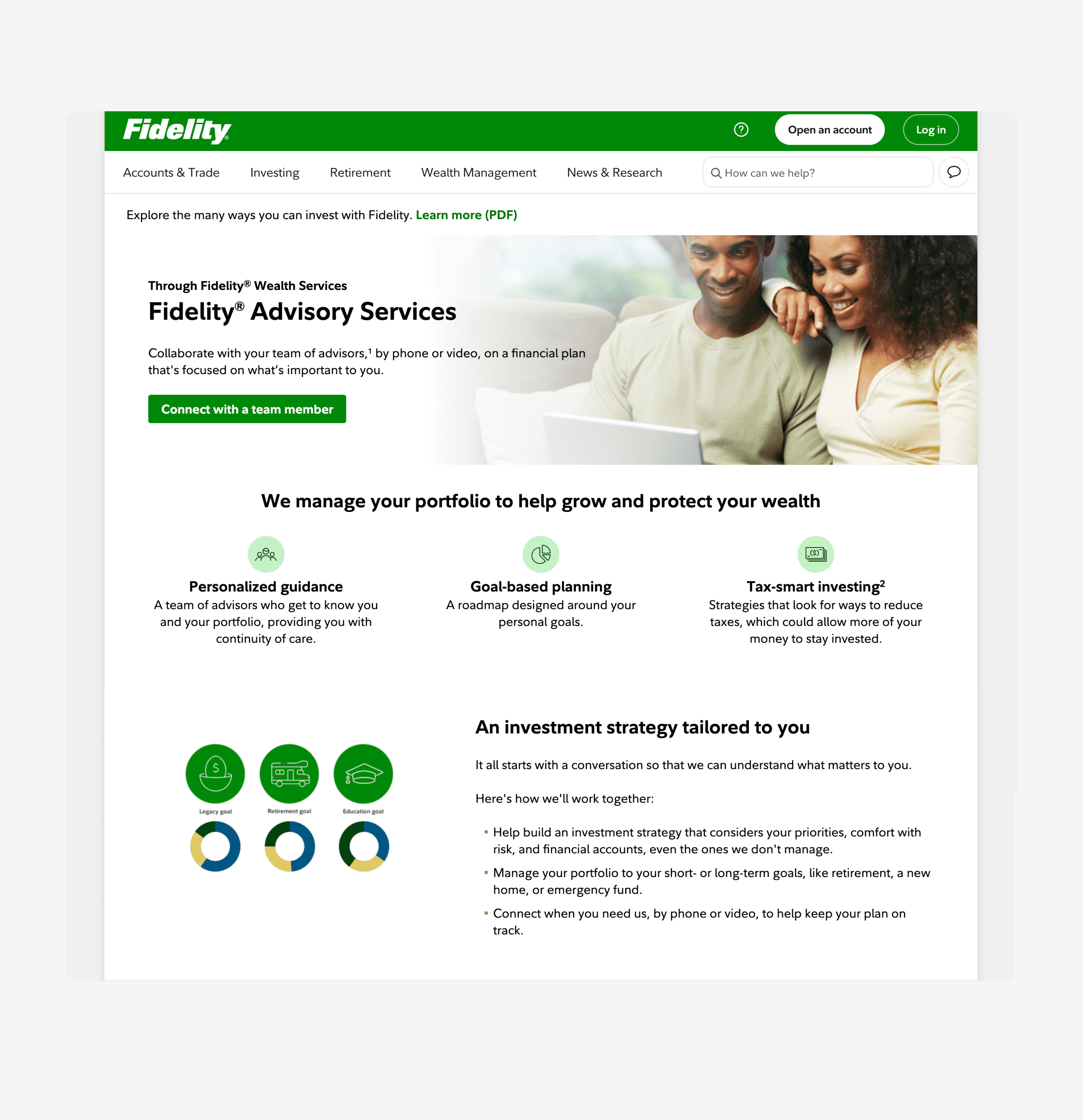
Fidelity serves a broad client base ranging from retail investors opening retirement accounts to higher-net-worth households seeking more comprehensive planning services. The platform is particularly well known for retirement-focused investing, workplace retirement plans, and long-term portfolio management.
Fidelity’s advisory platform is designed to support multiple types of investors, so the experience can vary significantly across the client base. Some relationships are built around digital portfolio management, while others involve ongoing collaboration with advisors and wealth planning teams.
Its investment approach is also more flexible than that of firms strictly focused on passive allocation strategies. Fidelity combines diversified portfolio construction with access to internal research, managed products, ETFs, and actively managed investment options, depending on the client program.
Compliance Perspective
Fidelity operates across several layers of the financial services industry at the same time, including brokerage, custody, advisory services, and asset management. That type of structure comes with extensive regulatory expectations and ongoing compliance responsibilities tied to disclosures, cybersecurity, fiduciary oversight, and supervisory procedures.
The company also has a strong presence within the fintech advisory ecosystem. Many newer investment platforms and digital wealth firms use Fidelity’s infrastructure and custody services as part of their underlying operating model.
3. Schwab Private Client / Schwab Wealth Advisory
Charles Schwab’s advisory business operates within one of the largest brokerage and custody platforms in the US financial industry. Through Schwab Private Client and Schwab Wealth Advisory, the firm provides portfolio management and financial planning services while also maintaining a massive presence in self-directed investing, custodial services, and trading infrastructure.
That broader ecosystem gives Schwab a very different operating model compared to many independent RIAs. A significant number of advisory relationships begin through brokerage accounts, retirement products, or custody services before expanding into managed portfolios and wealth planning arrangements.
Schwab also plays a major role behind the scenes of the RIA industry itself. Many independent advisory firms rely on Schwab for custody, trading, and operational infrastructure, making the company influential both as a direct advisor and service provider to other RIAs.

Schwab’s advisory platform covers a fairly wide section of the investing market, from basic managed portfolios for retail clients to more comprehensive planning relationships for wealthier households. Retirement planning and long-term investing remain major parts of the business.
The structure of the advisory relationship often changes based on the service model involved. Some clients primarily use digital investing tools, while others maintain more direct relationships with advisors and planning teams.
Investment management across the platform includes a mix of Schwab products, third-party strategies, ETFs, and mutual funds. The firm is generally less tied to one specific investment philosophy than some advisory businesses focused mainly on passive index investing.
Compliance Perspective
Schwab operates across several regulated areas of the financial industry simultaneously, creating a fairly complex compliance and operational structure. Large firms with this type of model are generally expected to maintain extensive oversight around disclosures, fiduciary obligations, cybersecurity programs, client communications, and supervisory controls.
Schwab’s footprint isn’t limited to its own advisory platform. A large number of RIAs, fintech investment firms, and digital advisors use Schwab’s custody and trading infrastructure as part of their underlying operating model.
For fintech founders and compliance professionals, Schwab provides a practical example of how large-scale advisory businesses combine technology systems, operational support, and regulatory oversight within a single platform.
4. Edelman Financial Engines
Edelman Financial Engines is one of the largest independent RIAs in the US, built through a combination of traditional financial planning services and large-scale workplace retirement relationships.
The firm was formed through the merger of Edelman Financial Services and Financial Engines, bringing together retail wealth management with one of the country’s largest retirement advisory platforms.
A major part of the company’s business revolves around retirement planning and workplace investing. Through partnerships tied to employer-sponsored retirement plans, the firm reaches a large number of investors who later transition into broader advisory and wealth management relationships.
Its scale within retirement-focused advisory services has made Edelman Financial Engines one of the more visible names in the mass-affluent wealth management market. The firm combines digital planning tools with advisor support, positioning itself between fully automated investment platforms and traditional private wealth firms.

The firm primarily serves retail investors, retirees, and mass-affluent households looking for long-term planning and retirement-focused investment management. Many client relationships begin through workplace retirement plans before expanding into broader financial planning discussions.
The advisory experience can look very different across the client base. Some investors mainly rely on digital portfolio management and retirement planning tools, while others work directly with advisory teams on more detailed planning and retirement income decisions.
Its investment approach is largely centered on diversification and long-term retirement investing. Portfolios are typically supported through a combination of managed account programs, ETFs, mutual funds, and financial planning software tied to different service models.
Compliance Perspective
Because the business operates across retirement advice, advisory services, and large-scale investor servicing, Edelman Financial Engines works within a heavily regulated environment tied to both investment advisory obligations and retirement plan oversight.
The firm also reflects a larger shift happening across the advisory industry, where digital planning tools are increasingly combined with direct advisor support. Many newer wealth platforms now operate with similar hybrid structures as investors expect both online access and ongoing human guidance within the same relationship.
From an operational standpoint, the company shows how retirement-focused advisory businesses use centralized systems, planning technology, and standardized servicing processes to manage large client bases at scale.
5. Fisher Investments
Fisher Investments operates as one of the larger independent advisory firms in the country and is known for its direct-to-client approach. Much of the company’s growth came through investor education efforts, media visibility, and broad marketing campaigns following the firm’s launch in 1979.
The advisory business primarily focuses on portfolio management for affluent individuals, retirees, and institutional clients. Over time, the firm expanded beyond the US market and now serves investors across several international regions.
Unlike many RIAs that position financial planning as the center of the relationship, Fisher Investments has historically placed a stronger emphasis on discretionary portfolio management and market-driven investment strategy. The firm is well known for its macroeconomic market analysis and active investment management approach.

A significant portion of Fisher Investments’ client base consists of retirees and higher-net-worth households looking for ongoing portfolio management and retirement-focused investing. The firm also works with institutional investors, including pension plans and other large organizations.
Client interactions at Fisher Investments are usually centered around direct advisor engagement rather than automated portfolio management tools. Investors commonly work with advisory teams on an ongoing basis instead of navigating most of the relationship through digital investing interfaces.
Its investment process is also more tactical than that of firms focused mainly on passive investing. Portfolio positioning can shift with economic conditions, sector analysis, and broader market trends rather than holding to relatively fixed allocation models over long periods.
Compliance Perspective
Like other large SEC-registered RIAs, Fisher Investments operates with substantial compliance and supervisory responsibilities across areas such as disclosures, fiduciary standards, cybersecurity programs, and investment management oversight.
The firm’s long-standing focus on investor marketing and media visibility has also made communications supervision an important part of its broader compliance framework over time.
For founders building wealthtech or advisory products, Fisher Investments is an example of a large-scale advisory business that relies more heavily on advisor relationships and centralized portfolio management than digital automation.

6. Creative Planning
Creative Planning has become one of the fastest-growing RIAs in the US, expanding through a combination of acquisitions, advisor recruitment, and broad wealth management services. Founded in 1983, the firm evolved from a regional advisory business into a large national platform serving both individual and institutional clients.
The company is known for combining investment management with tax planning, estate planning, retirement planning, and business advisory services under a single wealth management structure. That integrated approach has helped Creative Planning stand out among RIAs focused more narrowly on portfolio management alone.
Over the last several years, the firm has also expanded aggressively through acquisitions of smaller RIAs and advisory practices. This broader consolidation strategy reflects a larger trend across the wealth management industry as firms seek greater scale, operational efficiency, and broader service offerings.

Creative Planning primarily works with high-net-worth households, business owners, retirees, and families seeking long-term financial planning and investment management support. The firm also advises institutional clients and employer-sponsored retirement plans in certain segments of the business.
Most client relationships at Creative Planning extend beyond portfolio management alone. Advisors frequently work with clients on retirement income planning, tax matters, estate considerations, and broader long-term financial decisions alongside investment oversight.
Its investment approach is usually tied closely to the overall planning relationship. Depending on the client’s needs, portfolios may include ETFs, mutual funds, separately managed accounts, alternative assets, and outside investment managers.
Compliance Perspective
Creative Planning became much more operationally complex as it expanded into new markets and absorbed additional advisory firms. Managing a business spread across multiple offices and advisory teams typically requires larger supervisory structures covering disclosures, advisor oversight, cybersecurity controls, and internal compliance procedures.
Learn how InnReg helps RIAs develop compliance policies and procedures →
The firm’s growth path is consistent with a trend across much of the RIA industry over the last several years. More advisory firms have moved toward acquisitions and larger platform models as regulatory expectations and operating costs continue rising.
For fintech founders, the company is a useful example of what happens operationally when an advisory business grows through acquisition activity instead of remaining a smaller standalone practice.
7. Mercer Advisors
Mercer Advisors developed from a smaller advisory firm into a large national RIA by expanding its advisor network, adding planning capabilities, and acquiring independent wealth management firms across the country. Since its founding in the 1980s, the business has broadened far beyond traditional investment management and now serves affluent households, families, and institutional clients through a wider wealth management structure.
The firm is known for combining investment advice with tax planning, estate considerations, retirement planning, and family office-style services. That broader planning model has become increasingly common as larger RIAs compete for deeper and longer-term client relationships.
Much of their recent growth has come through acquisitions. Mercer Advisors has purchased numerous smaller RIAs over the years and has attracted private equity investment, reflecting the growing institutional interest in large advisory platforms and consolidation across the wealth management industry.
Mercer Advisors primarily works with high-net-worth individuals, retirees, business owners, and families looking for comprehensive wealth management support. In addition to investment management, many client relationships also include long-term planning needs.
The firm’s advisory relationships are usually centered around broader financial planning conversations instead of portfolio management alone. Clients often work with advisors on retirement income, taxes, estate structures, and long-term wealth transfer planning alongside ongoing investment management.
Its portfolio strategies are generally tied closely to those larger planning objectives. Depending on the client relationship, accounts may include ETFs, mutual funds, managed portfolios, alternative investments, and outside investment managers.
Compliance Perspective
Operating across multiple offices and advisory teams typically means more layers of supervision, larger compliance functions, and more formal oversight around disclosures, cybersecurity, and advisor activity.
The company’s expansion strategy also says a lot about where the RIA industry has been heading. Larger firms have continued buying smaller practices as compliance costs, technology spending, and operational demands have become more difficult for independent firms to handle on their own.
For firms building in wealthtech, Mercer Advisors is a good example of how growth through acquisitions changes the operational side of an advisory business, especially around centralized systems and compliance oversight.
See also:
8. Hightower Advisors
Hightower Advisors took a different path from many traditional RIAs by building around independent advisory practices and breakaway advisors instead of relying solely on a centralized advisory firm model. The company launched in 2008 as more advisors began moving away from large brokerage and wirehouse structures.
Its platform eventually grew into a national advisory network serving affluent households and institutional clients across multiple markets. While individual advisory firms often maintain a degree of independence, Hightower provides centralized operational support, technology resources, and business infrastructure across the network.
That partnership-based structure has made Hightower one of the more recognizable firms within the independent advisor and breakaway RIA space. Its model appeals to advisors seeking more independence while still relying on centralized resources for operations, compliance support, technology, and business management.

Hightower’s client base primarily includes affluent households, business owners, retirees, and institutional relationships seeking long-term wealth management support. Because many advisory practices within the network operate somewhat independently, the client experience can vary depending on the specific advisory team involved.
A lot of the advisory work across the Hightower network involves more than managing portfolios. Clients often turn to advisory teams for strategizing about retirement decisions, estate issues, taxes, and business transition planning alongside their investment accounts.
The investment side can look very different depending on which advisory practice is involved. Some teams stay close to long-term passive investing, while others take a more active approach or use outside managers and alternative strategies more regularly.
Compliance Perspective
The structure of Hightower’s business creates a different type of operational and compliance environment compared to more centralized RIAs. Supporting multiple advisory practices under a broader platform typically requires extensive oversight around disclosures, advisor supervision, cybersecurity controls, and compliance coordination across different offices and teams.
Hightower also reflects how much the independent advisor space has expanded over the last decade. More advisors have moved away from large brokerage environments in favor of RIA platforms that provide greater control over client relationships and business operations.
—
The RIA industry has grown more diverse. Some firms scaled through low-cost investing and digital platforms, while others acquired smaller advisors, added planning services, or focused heavily on advisor-client relationships. The result is a market with very different business models operating under the same regulatory framework.
One thing many of these firms have in common is operational scale. As advisory businesses grow larger, areas like compliance oversight, cybersecurity, disclosures, and supervision become much harder to manage. That has pushed many RIAs to invest more heavily in centralized systems, technology infrastructure, and internal compliance operations.
For companies operating in fintech and wealth management, these firms offer a useful look at how advisory businesses continue adjusting to changing investor behavior alongside rising regulatory and operational pressure.

How Can InnReg Help?
InnReg is a global regulatory compliance and operations consulting team serving financial services companies since 2013.
We are especially effective at launching and scaling fintechs with innovative compliance strategies and delivering cost-effective managed services, assisted by proprietary regtech solutions.
If you need help with RIA compliance, reach out to our regulatory experts today:
Related Articles




Featured LinkedIn Posts