Broker-Dealer Examples: How Different Broker-Dealers Operate
Key Takeaways
A broker-dealer participates in securities transactions by acting as a broker, dealer, or both.
Broker-dealers can operate under many models, including introducing, clearing, ATS, and market-making firms.
Most fintech companies rely on broker-dealer infrastructure to support investing and securities-related products.
The SEC, FINRA, and state regulators oversee many broker-dealer activities in the United States.
Broker-dealers are typically subject to capital, AML, recordkeeping, and supervisory requirements.
Broker-dealers can look very different depending on the business model. A national brokerage firm, an introducing broker-dealer, a clearing firm, a market maker, an ATS operator, and a fintech investing platform may all fall under the broker-dealer framework, but they do not operate the same way.
In practice, broker-dealer status is shaped by what the firm does, who it serves, how it gets paid, whether it handles customer assets, and how it participates in securities transactions.
This article breaks down common broker-dealer examples by business model, with a focus on how each model works, where fintech companies often fit, and what regulatory considerations founders, legal teams, and compliance officers should understand before building or expanding a securities-related business.
At InnReg, we help broker-dealers and fintech companies navigate securities regulation. From registration and licensing to compliance program development and ongoing compliance operations, our team supports firms across a wide range of broker-dealer business models.

What Is a Broker-Dealer?
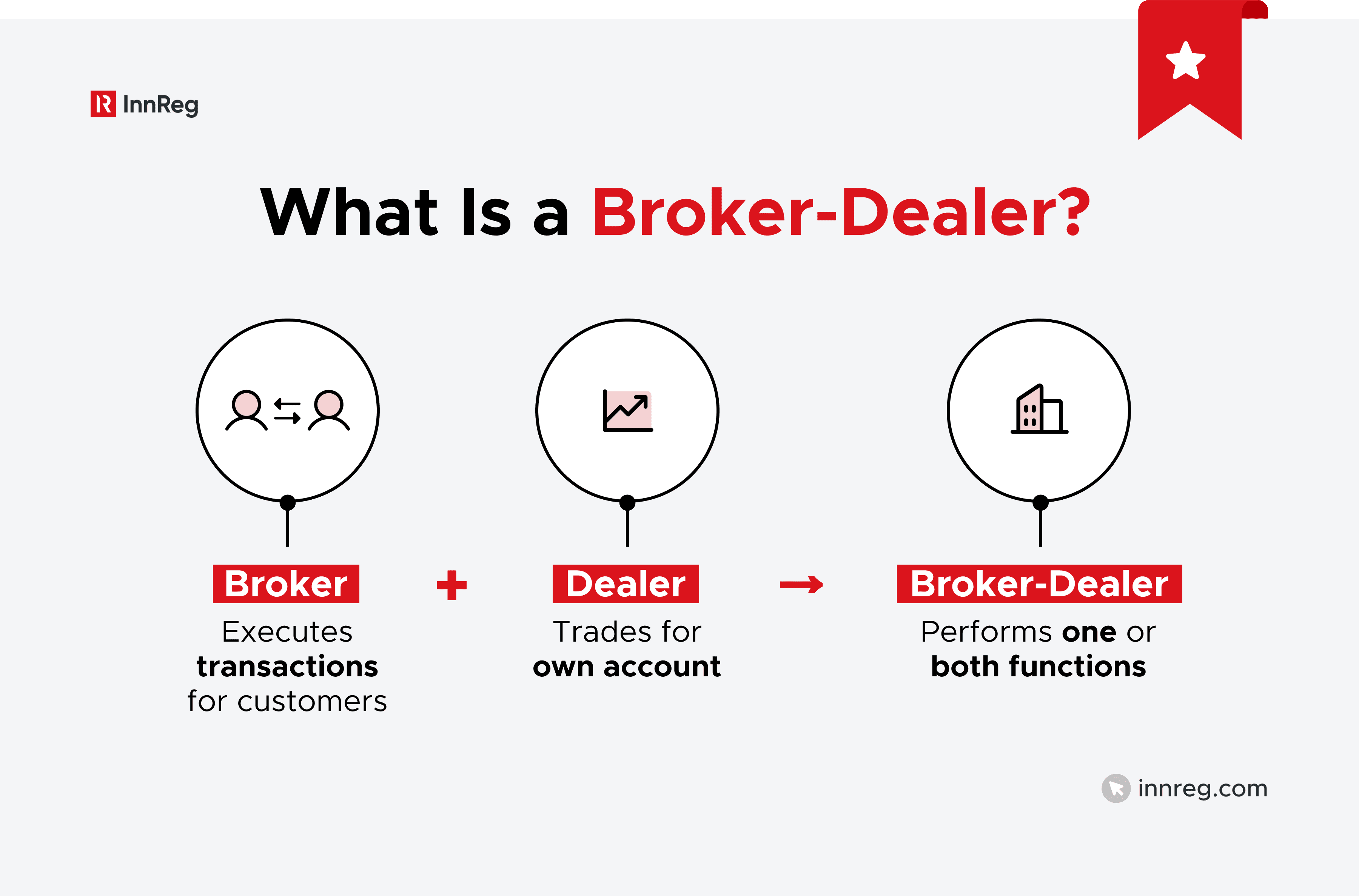
A broker-dealer is a firm or individual that participates in securities transactions. The term combines two distinct activities. A broker executes securities transactions on behalf of customers, while a dealer buys and sells securities for its own account.
In practice, many firms perform both functions and therefore operate as broker-dealers. Depending on their business model, they may help retail investors buy stocks, facilitate institutional trading, underwrite securities offerings, operate alternative trading systems, or support other market participants.
In the United States, broker-dealers are generally regulated by the Securities and Exchange Commission (SEC), the Financial Industry Regulatory Authority (FINRA), and state securities regulators. Firms must comply with a range of requirements covering supervision, recordkeeping, customer protection, financial responsibility, anti-money laundering controls, and other regulatory obligations.
While the term "broker-dealer" is often associated with traditional brokerage firms, the category is much broader. Many modern fintech platforms that offer securities-related products rely on broker-dealer structures, either through their own registrations or through partnerships with existing broker-dealers.
Broker-Dealer Examples by Business Model
Broker-dealers can have very different roles in the securities markets. Some work directly with investors, while others focus on institutional trading, market making, underwriting, clearing, or technology-driven services.
Those differences are not just operational. A broker-dealer's business model often influences the regulatory requirements it must meet. As a result, two registered broker-dealers may look very different in practice.
The most common broker-dealer models include:
1. Full-Service Broker-Dealer
A full-service broker-dealer does much more than execute trades.
These firms often provide investment guidance, research, financial planning services, and ongoing support to clients. In many cases, the client relationship extends well beyond buying and selling securities.
The business is built around advice, service, and long-term client engagement. Revenue may come from commissions, account fees, asset-based fees, or other service-related charges.
Traditional wealth management firms are common examples of this broker-dealer model.
2. Discount Broker-Dealer
A discount broker-dealer focuses on trade execution while offering fewer personalized services than a full-service firm.
The model became popular by giving investors access to the securities markets at a lower cost. Rather than relying heavily on investment recommendations or financial planning, discount broker-dealers are designed for investors who prefer to make their own decisions.
Many firms generate revenue through account fees, interest income, payment for order flow, securities lending, or premium platform features. The emphasis is typically on accessibility, scale, and efficient trade execution.
Online brokerage platforms are among the most common examples of this model.
3. Online Broker-Dealer
The online broker-dealer model moved brokerage services from physical offices to digital platforms.
Instead of visiting a branch or working primarily through a representative, customers interact with the firm through web and mobile applications. Account opening, trading, reporting, and customer support are often delivered through technology.
The platform itself becomes a core part of the product offering. As a result, these firms frequently invest heavily in user experience, automation, and digital onboarding capabilities.
Many modern investing apps operate under this model.

4. Introducing Broker-Dealer
An introducing broker-dealer focuses on serving customers while outsourcing clearing and custody functions to a clearing firm. Customers may interact entirely with the introducing broker-dealer, even though another regulated entity is responsible for holding assets and processing transactions behind the scenes.
The model separates the client-facing side of the business from the operational infrastructure required to support securities transactions. Both traditional brokerage firms and newer fintech entrants commonly use it.
Learn more about introducing broker-dealers →
5. Clearing Broker-Dealer
A clearing broker-dealer provides the operational infrastructure that supports securities transactions.
When trades are executed, the clearing broker-dealer is typically responsible for clearing and settling transactions, holding customer assets, and maintaining customer accounts. Many introducing broker-dealers rely on clearing firms to perform these functions.
Since they hold customer assets and process transactions, clearing broker-dealers generally operate under more extensive regulatory and operational requirements than introducing firms. Most investors never interact directly with a clearing broker, but many brokerage services would not function without one.
See also:
6. Prime Broker
Prime brokers mainly serve institutional clients such as hedge funds, asset managers, and other sophisticated market participants.
Rather than focusing on retail investors, prime brokers provide a collection of services that support large-scale trading and investment activities. These services may include custody, securities lending, trade execution, financing, and operational support.
Many institutional investment firms use prime brokers to consolidate activities that would otherwise require relationships with multiple service providers. As a result, the prime brokerage model is closely tied to the institutional side of the securities industry.

Need help with broker-dealer compliance?
Fill out the form below and our experts will get back to you.
7. Institutional Broker-Dealer
An institutional broker-dealer focuses on serving professional market participants rather than individual investors.
Its clients may include asset managers, pension funds, insurance companies, hedge funds, corporations, and other financial institutions. These firms typically handle larger and more complex transactions than those commonly seen in retail brokerage.
Services often include trade execution, market access, research, capital markets support, and trading-related services. Because institutional clients operate at a different scale, institutional broker-dealers are generally built around high-volume transactions and sophisticated trading activity.
8. Retail Broker-Dealer
Retail broker-dealers are built around individual investors.
Whether the customer is saving for retirement, building a long-term portfolio, or making occasional trades, the firm's services are designed for personal investing rather than institutional trading activity.
The retail market covers a broad range of investors with different levels of experience and financial sophistication. As a result, retail broker-dealers may offer educational resources, customer support, research tools, or investment products tailored to individual needs.
Many of the broker-dealers familiar to the general public fall into this category.

9. Market Maker Broker-Dealer
Every securities transaction requires someone willing to buy and someone willing to sell. Market makers help bridge that gap.
A market maker broker-dealer continuously quotes prices at which it is willing to purchase or sell securities. By doing so, these firms contribute to market liquidity and can make trading more efficient.
Unlike many other broker-dealers, market makers often participate directly in the market rather than primarily servicing customer accounts.
10. Proprietary Trading Broker-Dealer
Some broker-dealers participate in the market mainly as traders rather than service providers.
A proprietary trading broker-dealer uses its own funds to buy and sell securities, seeking to profit from market opportunities. The firm is risking its own capital rather than facilitating transactions for clients.
Depending on the strategy, trading may occur across equities, options, fixed income securities, or other financial instruments.
11. Investment Banking Broker-Dealer
When a company wants to raise capital or pursue a significant transaction, a broker-dealer may be involved behind the scenes.
Investment banking broker-dealers support activities such as securities offerings, private placements, and mergers and acquisitions. Their clients are generally businesses and issuers rather than individual investors.
The work often involves structuring transactions, coordinating with investors, and helping companies access capital markets.
12. Alternative Trading System (ATS) Broker-Dealer
An Alternative Trading System (ATS) is a trading venue that matches buyers and sellers of securities outside of a traditional securities exchange.
Unlike national securities exchanges, an ATS typically operates through a registered broker-dealer and is regulated under a separate framework established by SEC Regulation ATS. Many ATSs focus on specific market segments, asset classes, or trading strategies.
ATSs are commonly used for trading private securities, fixed-income products, and other assets that may not fit the model of a traditional exchange. The broker-dealer operating the ATS is generally responsible for meeting the applicable regulatory and compliance requirements.
Learn more about ATS regulations and requirements →
See also:
13. Crowdfunding Broker-Dealer
The rise of online fundraising created a new role for some broker-dealers.
Instead of serving traders or wealth management clients, these firms work with companies looking to raise capital through investment platforms. Their activities are tied to securities offerings rather than ongoing brokerage relationships.
Many crowdfunding broker-dealers operate in markets focused on startups, emerging businesses, and private investment opportunities.

14. Digital Asset Broker-Dealer
The term digital asset broker-dealer can mean different things depending on the business model.
Some firms focus on tokenized securities and other blockchain-based financial products. Others provide services connected to the custody, trading, or settlement of digital securities. What matters from a regulatory perspective is whether the asset or activity falls within the securities framework and SEC/FINRA oversight.
For that reason, digital asset broker-dealers often operate where securities regulation and emerging technologies intersect.
15. Embedded Finance and Fintech Broker-Dealer
Many fintech companies offer investment features without looking like traditional brokerage firms.
A banking app may offer stock trading. A rewards platform may provide access to investments. A financial wellness product may include securities-related functionality. Behind these experiences, a broker-dealer often plays a role in supporting regulated activities.
Some fintech companies operate their own broker-dealers, while others partner with existing firms. As embedded investing continues to grow, broker-dealer infrastructure has become an important component of many modern financial products.
—
Broker-Dealer Type | What It Does |
|---|---|
Full-Service Broker-Dealer | Provides investment guidance and brokerage services |
Discount Broker-Dealer | Executes trades with limited advisory services |
Online Broker-Dealer | Delivers brokerage services through digital platforms |
Introducing Broker-Dealer | Serves customers while outsourcing clearing and custody |
Clearing Broker-Dealer | Clears and settles trades and holds customer assets |
Prime Broker | Supports hedge funds and institutional investors |
Institutional Broker-Dealer | Serves professional market participants |
Retail Broker-Dealer | Serves individual investors |
Market Maker Broker-Dealer | Provides liquidity by buying and selling securities |
Proprietary Trading Broker-Dealer | Trades securities using the firm's own capital |
Investment Banking Broker-Dealer | Helps companies raise capital and complete transactions |
ATS Broker-Dealer | Operates an alternative securities trading venue |
Crowdfunding Broker-Dealer | Supports online securities fundraising |
Digital Asset Broker-Dealer | Facilitates activities involving digital securities |
Embedded Finance Broker-Dealer | Powers investment features within fintech products |
Which Broker-Dealer Model Do Most Fintech Companies Use?
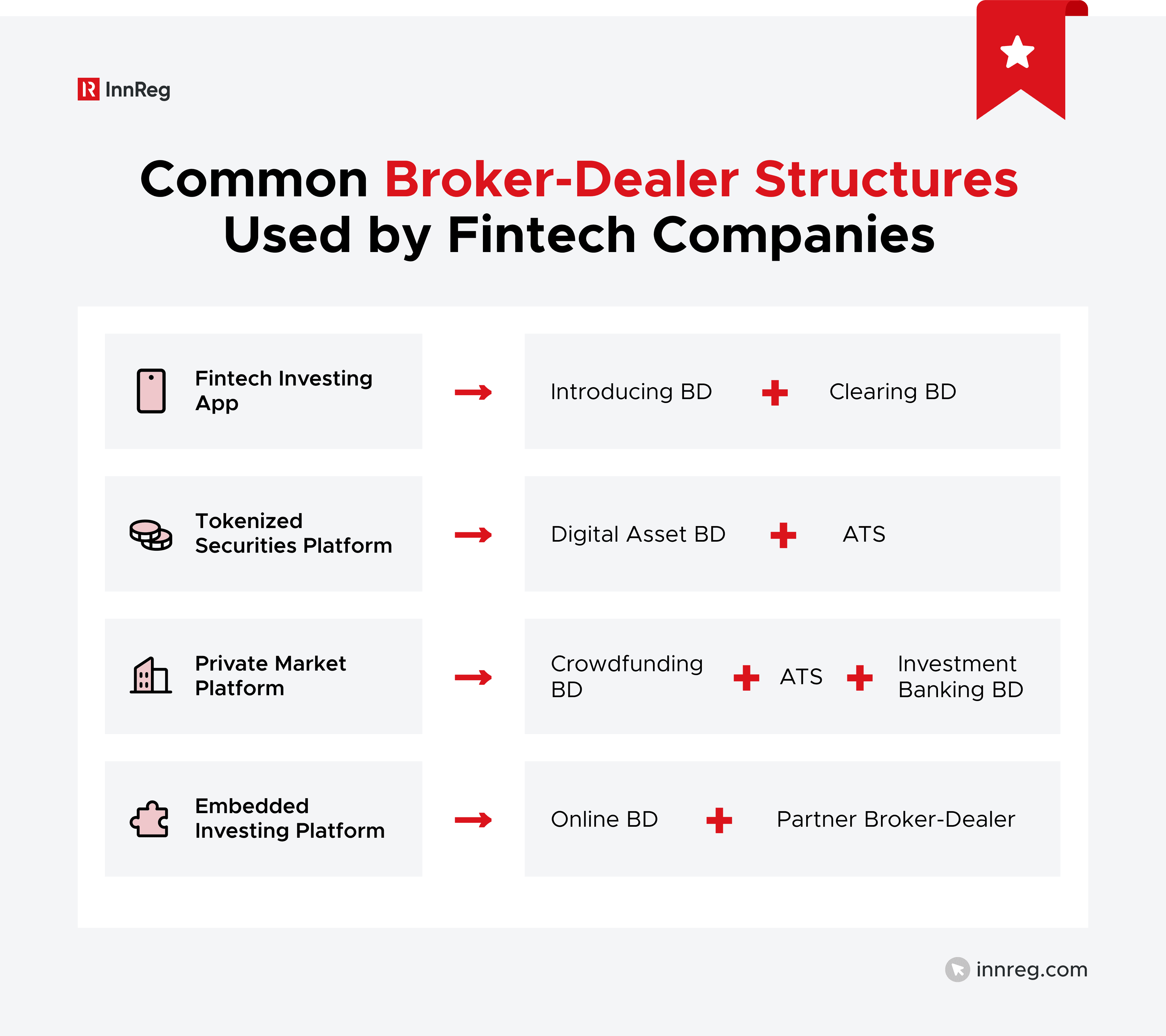
Most fintech companies do not operate like traditional brokerage firms. Instead, they often combine brokerage services with technology platforms, embedded investing features, or specialized investment products.
Fintech Investing Apps
Many investing apps blend elements of the online broker-dealer and introducing broker-dealer models.
The customer interacts with a digital platform that handles account opening, trading functionality, and the overall user experience. Behind the scenes, the fintech company often relies on third-party broker-dealers and clearing firms to support regulated brokerage activities.
That lets fintech companies focus on product development and customer acquisition while building on existing brokerage infrastructure.
Alternative Asset Platforms
Platforms offering access to private funds, real estate investments, collectibles, private credit, and other alternative assets often rely on broker-dealer infrastructure.
Depending on the business model, the broker-dealer may support investor onboarding, transaction processing, capital-raising activities, or secondary market transactions. Many of these platforms combine elements of investment banking, crowdfunding, ATS, and introducing broker-dealer models.
The structure used depends largely on the type of asset being offered and how investors access the investment opportunity.
Tokenized Securities Platforms
Platforms offering tokenized securities often pair traditional securities regulation with blockchain-based technology.
Depending on the structure, broker-dealers may handle issuance, trading, custody arrangements, investor onboarding, or secondary market activity involving tokenized securities. Some platforms also incorporate ATS functionality to facilitate transactions between investors.
Although the technology differs from traditional markets, many of the underlying regulatory concepts remain the same because the assets are still treated as securities.
Private Market Platforms
Private market platforms connect investors with opportunities that aren’t available on public securities exchanges.
These platforms often facilitate investments in private companies, private funds, special purpose vehicles (SPVs), and other privately offered securities. Broker-dealers may support investor onboarding, capital-raising activities, transaction processing, and secondary liquidity solutions.
Many private market platforms combine elements of crowdfunding, investment banking, ATS, and introducing broker-dealer models, depending on how investors access opportunities and transact on the platform.
Embedded Investing Platforms
Many businesses integrate securities-related functionality into existing products to expand customer engagement and add new financial services. Broker-dealers often handle the regulated activities associated with these offerings, allowing the investing experience to be incorporated into a broader platform.
The result is a model where investing becomes one component of a larger customer experience rather than the primary product.
—
Common Misconceptions About Broker-Dealers
Because broker-dealers can operate under quite different business models, misconceptions are common. The same registration category can apply to businesses that look very different in practice.
The examples below address several areas that often cause confusion:
Not Every Trading App Is a Broker-Dealer
It is easy to assume that any app offering access to investments must be a broker-dealer. But that’s not always the case.
Many fintech companies partner with registered broker-dealers to provide securities-related services while focusing on technology, customer experience, or distribution. The regulatory analysis depends on the firm's activities and role in securities transactions.
As a result, two investing apps may look nearly identical to customers while operating under entirely different regulatory structures.
Broker-Dealers and RIAs Are Not the Same
Broker-dealers and registered investment advisors (RIAs) are both regulated financial services businesses, but they operate under different regulatory frameworks.
In general, broker-dealers facilitate securities transactions, while RIAs provide investment advice for compensation. Some firms are registered as both, but many are registered under only one category.
The distinction can affect licensing requirements, compliance obligations, supervision, and how services are delivered to clients.
A Broker-Dealer Does Not Need to Clear Its Own Trades
Many people assume that every broker-dealer must hold customer assets and settle transactions itself. That’s often not true.
Many broker-dealers operate as introducing firms and rely on separate clearing broker-dealers to handle custody, clearing, and settlement functions. This arrangement is common throughout the securities industry and is particularly prevalent among fintech companies and newer brokerage businesses.
As a result, a broker-dealer can provide brokerage services without building its own clearing infrastructure.
Broker-Dealer Registration Does Not Automatically Permit Every Business Activity
Obtaining broker-dealer registration is not the end of the regulatory analysis.
A firm's permitted activities often depend on its business lines, regulatory approvals, memberships, disclosures, supervisory framework, and operational capabilities. A broker-dealer registered for one type of activity may not automatically be able to engage in another.
As a business grows, additional regulatory considerations may arise, particularly when introducing new products, services, asset classes, or trading activities.
Digital Asset Businesses May Still Need Broker-Dealer Registration
Some founders mistakenly assume that operating in the digital asset space automatically places a business outside the traditional securities framework. It doesn’t
Whether broker-dealer registration is required depends on the specific assets, activities, and business model involved. If a digital asset is treated as a security, securities laws and broker-dealer considerations may still apply.
As digital asset markets continue to evolve, businesses often need to evaluate their regulatory obligations based on the characteristics of the product rather than the technology being used.
Regulatory Requirements That Apply to Most Broker-Dealer Models
Although broker-dealer business models can look quite different, most share a common set of regulatory obligations. The exact requirements depend on a firm's activities and structure, but the areas below apply to nearly every broker-dealer.
SEC Registration | Registers the firm with the SEC and discloses its business activities |
|---|---|
FINRA Membership | Allows the firm to conduct securities business under FINRA oversight |
State Registration | Addresses state-level registration and notice filing obligations (when applicable) |
Capital Requirements | Requires firms to maintain minimum financial resources |
Customer Protection Rules | Governs the protection of customer funds and securities |
AML and Financial Crime Compliance | Addresses money laundering and other financial crime risks |
Books and Records Requirements | Requires documentation and retention of business records |
Supervisory Systems and Written Procedures | Establishes oversight processes and compliance controls |
SEC Registration
Broker-dealers generally begin the regulatory process by registering with the SEC.
The registration framework is designed to provide regulators with information about the firm's business, ownership structure, leadership team, and what it plans to do. Without the appropriate registration, a firm may not be permitted to engage in many securities-related activities.
For many companies, SEC registration is the foundation for additional regulatory approvals and memberships.
Learn more about the broker-dealer registration process →
FINRA Membership
Most broker-dealers must also become members of FINRA.
FINRA reviews a firm's business plan, supervisory framework, financial condition, operational readiness, and compliance program as part of the membership process. Membership is often required before a broker-dealer can begin conducting securities business.
After approval, firms remain subject to ongoing FINRA oversight, examinations, and regulatory requirements.
Learn more about FINRA registration →
State Registration Requirements
SEC registration and FINRA membership are important parts of the regulatory framework, but state requirements may also apply.
Many broker-dealers must register, make notice filings, or satisfy other obligations in the states where they conduct securities business. State securities regulators remain an important part of the broker-dealer oversight structure.
The applicable requirements often depend on where customers, representatives, and business activities are located.
Capital Requirements
Broker-dealers are generally required to maintain minimum levels of capital based on their business activities and regulatory classification.
The purpose of these requirements is to support the firm's financial stability and ability to meet its obligations. Capital requirements can vary significantly depending on the broker-dealer's business model, services, and operational structure.
For that reason, capital planning is often an important consideration when evaluating a broker-dealer registration strategy or expanding into new business lines.
Customer Protection Rules
Broker-dealers are often subject to rules governing the protection of customer funds and securities.
The applicable requirements can vary depending on the firm's activities, particularly whether it handles customer assets directly. Customer protection remains one of the foundational concepts underlying broker-dealer regulation.
AML and Financial Crime Compliance
Broker-dealers are expected to identify and manage risks related to money laundering, fraud, sanctions violations, and other forms of financial crime.
The exact controls can differ by business model. A retail brokerage serving thousands of customers may face different risks than an institutional trading firm or a private market platform. The compliance program is generally expected to reflect the firm's actual activities and risk profile.
As products, customer bases, and transaction flows change, AML considerations often evolve alongside them.
Books and Records Requirements
Broker-dealers are generally required to maintain records relating to their business activities, customer accounts, communications, transactions, and compliance processes.
Recordkeeping plays an important role in regulatory oversight. Regulators often rely on firm records to evaluate how activities were conducted and whether regulatory obligations were met.
The scope of required records can vary based on the firm's business model, products, and operations.
Supervisory Systems and Written Procedures
Every broker-dealer is expected to have a framework for supervising its business.
That framework often includes written policies, supervisory reviews, escalation processes, and controls designed to support regulatory compliance. A firm's supervisory structure is typically tailored to its business model’s risks and activities.
Learn more about written supervisory procedures for broker-dealers →

—
Broker-dealers play many different roles in the securities industry. Some focus on retail investors, others support institutions, facilitate capital raising, operate trading venues, or provide infrastructure behind modern fintech products.
Understanding these differences is important because a broker-dealer's business model often influences its regulatory obligations, operational requirements, and compliance framework. Two firms may share the same registration category while conducting very different activities.
For fintechs, the key question is often which broker-dealer model best aligns with the company's products, customers, and long-term strategy.

Maria is a Compliance Consultant at InnReg delivering compliance solutions for fintech clients across broker-dealer, RIA, and money transmitter verticals. She brings prior experience at Finalis, Fenix Securities and PwC, with expertise in AML, CCO support, investment banking operations and securities compliance. She holds FINRA Series 14, 24, and 82 licenses and actively supports regulatory and compliance processes revolving broker-dealer activities.
How Can InnReg Help?
InnReg is a global regulatory compliance and operations consulting team serving financial services companies since 2013.
We are especially effective at launching and scaling fintechs with innovative compliance strategies and delivering cost-effective managed services, assisted by proprietary regtech solutions.
If you need help with broker-dealer compliance, reach out to our regulatory experts today:
Related Articles



Featured LinkedIn Posts