Nevada Money Transmitter License: Checklist and Requirements
Key Takeaways
Nevada requires licensing for many payment, wallet, remittance, and crypto businesses.
FinCEN registration does not replace Nevada money transmitter licensing requirements.
Nevada provides exemptions for banks, payee agents, processors, and some payroll providers.
Applications require NMLS filings, financials, surety bonds, and flow of funds documentation.
Licensed companies must maintain ongoing reporting, AML, recordkeeping, and examination readiness.
Nevada's payments and fintech sector continues to attract companies offering remittances, digital wallets, payment processing, embedded finance products, and cryptocurrency services. Many of these business models may require a Nevada money transmitter license before they can legally operate in the state.
If you are looking to expand your business model to this US state, this guide is for you. We will explain what the license is, who needs it, what exemptions apply, and how to apply for the license in 2026. Before you enter the Nevada market as a money transmitter, read this blog. Let’s start.
At InnReg, we help fintech companies obtain money transmitter licenses and build compliance programs that support their operations. Our team assists with licensing analysis, NMLS filings, policies and procedures, and ongoing compliance management. Contact us to learn more about InnReg's money transmitter licensing services.


What Is a Nevada Money Transmitter License?
A Nevada money transmitter license is a state license issued by the Nevada Financial Institutions Division (FID) that allows a company to engage in money transmission activities involving Nevada residents.
Under Nevada law, a business generally cannot engage in money transmission, advertise money transmission services, or hold itself out as a money transmitter unless it is licensed or operating as an authorized delegate of a licensed company.
What Activities Trigger Licensing in Nevada
The definition of money transmission is broader than many founders expect. It extends beyond traditional money remittance businesses and can apply to a wide range of modern fintech models, including digital payments, stored value products, and certain cryptocurrency-related services.
Nevada law generally requires a license for businesses engaged in receiving money or monetary value for transmission, issuing payment instruments, or issuing and selling stored value products.
Examples of activities that may trigger licensing include:
Domestic or international money transfers
Consumer remittance services
Digital wallet products
Prepaid card programs
Stored value products
Bill payment services
Certain cryptocurrency exchange or transmission activities
Bitcoin ATM and kiosk operations
The Nevada checklist specifically identifies several activities commonly conducted under a money transmitter license.
Who Regulates Money Transmitters in Nevada?
The Nevada Financial Institutions Division (FID) is responsible for licensing and supervising money transmitters operating in the state.
FID reviews initial applications, evaluates financial condition and ownership structures, oversees ongoing reporting obligations, conducts examinations, and takes enforcement action when it identifies violations of Nevada law.
Applications are submitted through the Nationwide Multistate Licensing System (NMLS), but Nevada remains the decision-maker regarding whether a license will be approved, denied, suspended, or revoked.
State Licensing vs. FinCEN Registration
One of the most common misconceptions among fintech founders is that FinCEN registration replaces state licensing requirements. It does not.
FinCEN registration and Nevada licensing are separate requirements. A company may need both.
At the federal level, many money transmitters qualify as Money Services Businesses (MSBs) and must register with FinCEN while complying with Bank Secrecy Act requirements, such as:
Suspicious Activity Report (SAR) filing
Currency Transaction Report (CTR) filing
Nevada licensing addresses state law requirements. FinCEN registration addresses federal requirements. A company that completes FinCEN registration but fails to obtain a required Nevada money transmitter license may still face state regulatory issues. Likewise, obtaining a Nevada license does not eliminate federal MSB obligations.
Learn what it means to comply with FinCEN regulations here →
Who Needs a Nevada Money Transmitter License?
Nevada's money transmission laws apply to a broader range of businesses than many founders initially expect. In recent years, regulators have been focusing more on how funds move through the business model and whether the company receives money or monetary value for transmission.
Here are typical business models that require a Nevada money transmitter license:
Payment Companies and Remittance Providers
Traditional money transmitters are the most obvious category of businesses that require licensing. This includes companies that receive funds from one person and transmit those funds to another person or location. Examples include:
International remittance providers
Domestic money transfer services
Peer-to-peer payment platforms
Consumer payment applications
Cross-border payment companies
If a company is moving customer funds from one party to another, it will frequently fall within Nevada's money transmission framework.
Digital Wallet and Stored Value Businesses
Digital wallet providers and stored value businesses may also require a Nevada money transmitter license depending on how the product is structured.
For example, a company may hold customer balances that can later be spent, transferred, or redeemed. In many cases, regulators view these activities as the issuance or sale of stored value.
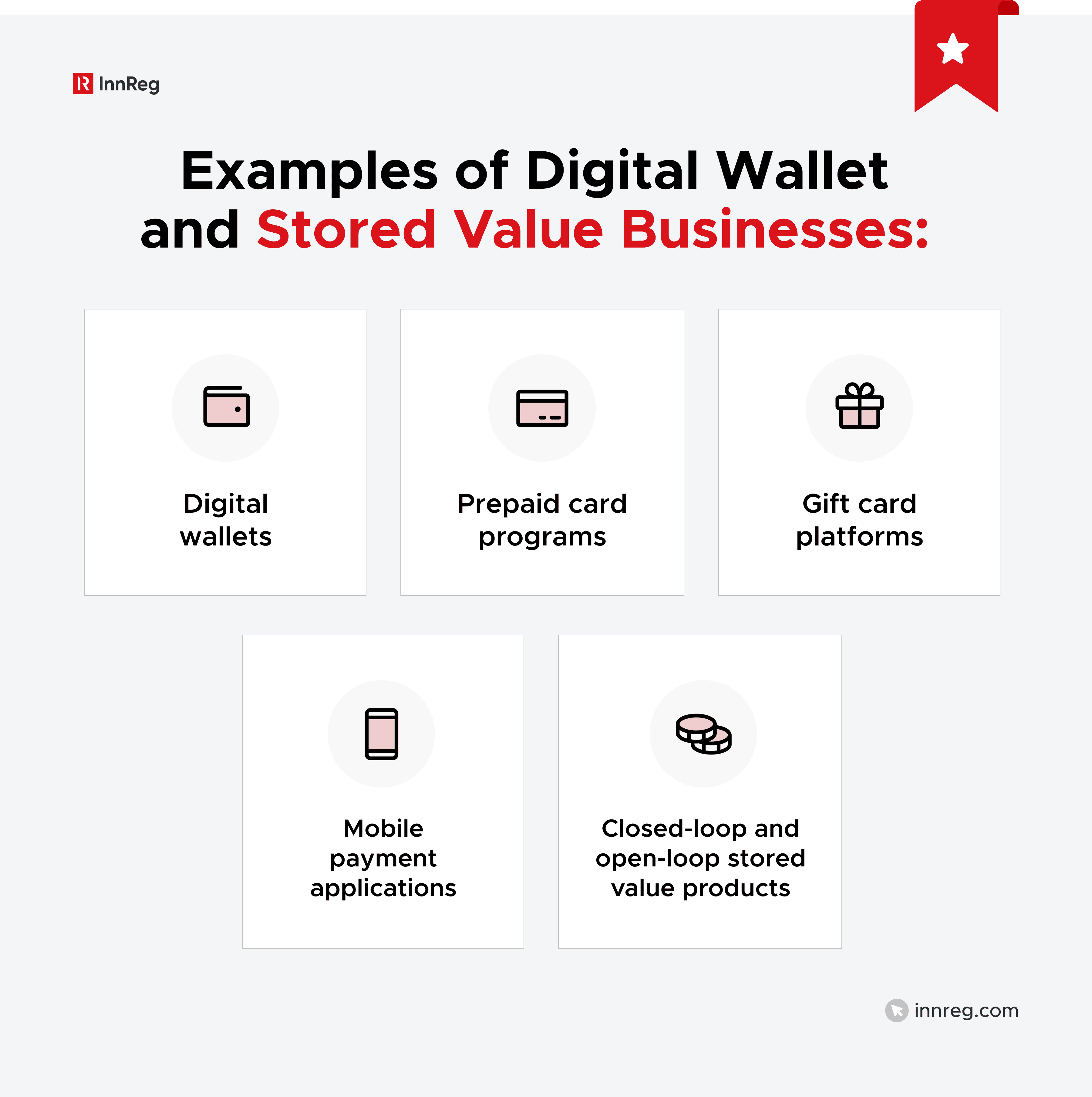
Whether licensing is required often depends on the level of control the company has over customer funds and the specific transaction mechanics.
Embedded Finance and Payment Facilitation Platforms
Embedded finance has created new licensing challenges for technology companies.
A software platform may not consider itself a financial institution, yet it may facilitate payments, move funds between users, collect payments on behalf of merchants, or distribute proceeds to third parties. Depending on the structure, those activities can trigger money transmission requirements.
Common examples include:
Marketplace platforms
Gig economy applications
Vertical SaaS payment providers
Payment facilitators
Platforms offering embedded payment functionality
Many embedded finance businesses assume that partnering with a bank automatically removes licensing obligations. In reality, licensing analysis often depends on the specific allocation of responsibilities among the platform, sponsoring bank, and payment providers.
Companies offering banking as a service (BaaS) products or embedded finance solutions through platform partnerships face particularly nuanced licensing analysis.
Crypto and Fiat Conversion Businesses
Nevada evaluates virtual currency businesses under the same money transmitter framework it applies to payment companies. Whether you need a license comes down to what you do with customer funds and digital assets.
Businesses operating in the cryptocurrency sector should carefully evaluate whether they are receiving, transmitting, exchanging, or controlling customer funds or digital assets.
Potentially regulated activities may include:
Fiat-to-crypto conversion
Crypto-to-fiat conversion
Custodial wallet services
Cryptocurrency exchange services
Crypto payment processing
Not every blockchain-related business requires licensing. However, companies that facilitate the movement or exchange of value often face licensing questions at both the state and federal levels.
Crypto business models keep outrunning the rules written for them. Learn about the top innovative crypto models with our blog here →
Money Transmission Kiosks and Bitcoin ATMs
Nevada's licensing requirements apply regardless of the delivery channel used to provide money transmission services.
The law specifically states that licensing obligations can apply to businesses operating through kiosks, ATMs, internet platforms, telecommunications systems, or other electronic methods.
For that reason, operators of Bitcoin ATMs, cryptocurrency kiosks, cash-to-crypto machines, and self-service money transfer terminals should carefully assess whether a Nevada money transmitter license is required before launching operations in the state.
These businesses have also attracted increasing regulatory scrutiny in recent years due to fraud prevention, anti-money laundering, and consumer protection concerns.

Nevada Money Transmitter License Exemptions
Not every company that handles payments or facilitates financial transactions needs a Nevada money transmitter license. Nevada law contains several exemptions that exclude certain businesses and activities from licensing requirements.
Banks and Financial Institutions
Nevada's money transmission laws generally exempt certain regulated financial institutions that are already subject to oversight under federal or state banking laws.
Examples may include:
Credit unions
Bank holding companies
Certain government-regulated financial institutions
The rationale is straightforward. These organizations are already supervised under separate regulatory frameworks, making an additional money transmitter license unnecessary in many situations.
However, fintech companies that partner with banks should not automatically assume they qualify for the same exemption. Regulators typically evaluate the role played by each party in the transaction.
The Payee Agent Exemption
The payee agent exemption is one of the most frequently discussed exemptions in the payments industry.
In general, the exemption may apply when a business accepts funds on behalf of a merchant under a valid agency relationship, and payment to the agent is legally considered payment to the merchant.
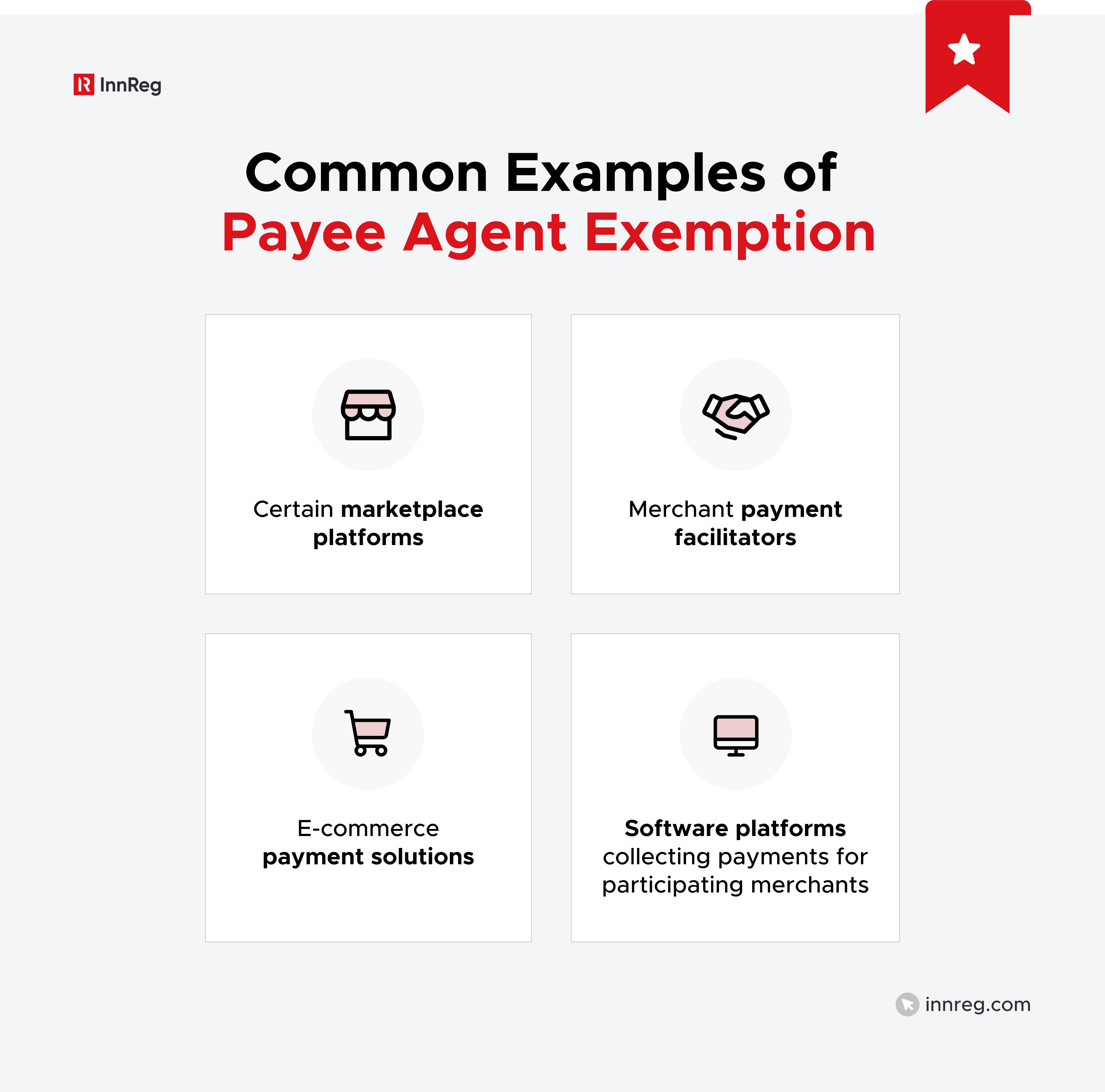
Whether the exemption applies depends heavily on contractual arrangements and transaction mechanics. A platform that assumes it qualifies for the payee agent exemption without reviewing its flow of funds, customer agreements, and merchant contracts may face licensing risks later.
Payment Processor and Network Exemptions
Nevada law also provides exemptions that may apply to certain payment processing activities.
These exemptions are often relevant to businesses that facilitate payment authorization, clearing, settlement, or network operations without taking independent control of customer funds.
Potential examples include:
Card payment networks
Payment gateway providers
Certain merchant processors
ACH processing providers
Technology providers supporting payment infrastructure
Simply describing a company as a payment processor does not automatically create an exemption. Regulators typically focus on the actual services being performed rather than the title used by the business.
For fintech companies, this distinction becomes particularly important when multiple entities participate in the same transaction flow.
Payroll Processing Exemption After AB430
Payroll processing has historically been a licensing issue in many states. Nevada addressed this area through Assembly Bill 430 (AB430), which became effective in 2025.
Under the updated framework, certain payroll processing services may qualify for an exemption from Nevada money transmission licensing requirements if statutory conditions are satisfied.
The change was significant because payroll providers often hold employee compensation funds for limited periods before distributing wages, tax payments, and other payroll obligations.
While the exemption provides additional clarity, payroll businesses should still review:
How payroll funds are received
How long funds are held
The parties involved in the transaction
Whether all exemption conditions are satisfied
Nevada's exemption analysis remains highly dependent on the facts of a particular business model. Companies expanding into payroll, workforce payments, earned wage access, or related services should carefully evaluate whether the exemption applies before concluding that a Nevada money transmitter license is unnecessary.
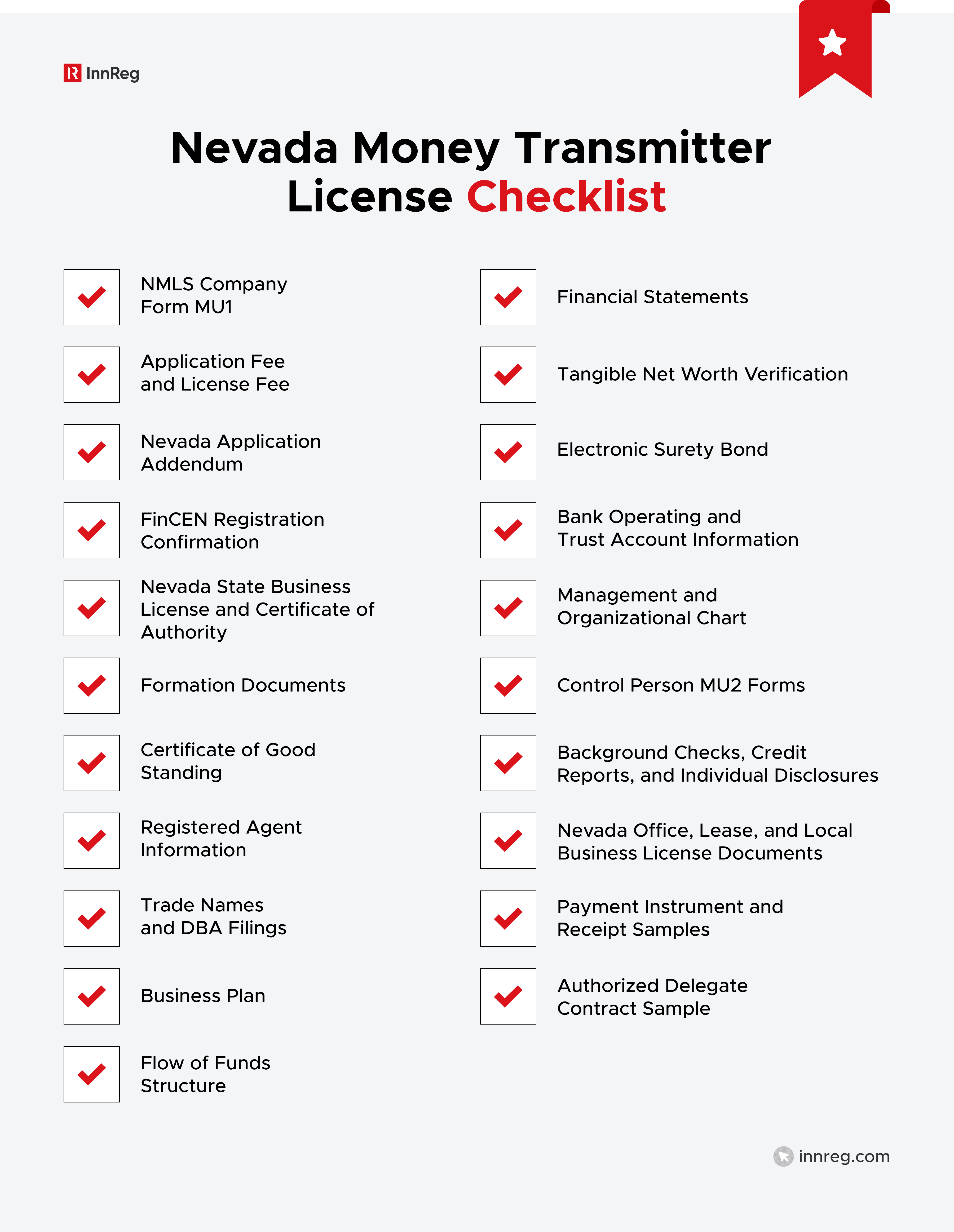
Nevada Money Transmitter License Checklist
Ready to register for the Nevada money transmitter license? This quick checklist will help you get started on the right foot:
NMLS Company Form MU1
The Nevada money transmitter license application is submitted through the Nationwide Multistate Licensing System. Applicants must provide detailed information about their ownership structure, finances, operations, compliance framework, and business activities.
The Company Form (MU1) serves as the foundation of the application. This filing contains information regarding:
Business activities
Ownership structure
Control persons
Office locations
Contact information
Regulatory disclosures
Most Nevada application requirements are submitted through or connected to the MU1 filing.
Application Fee and License Fee
Applicants must pay Nevada's required licensing fees through NMLS. As of the publishing date of this article, Nevada requires:
Fee Type | Amount |
|---|---|
Application Fee | $500 |
Initial License Fee | $400 |
NMLS Processing Fee | $120 |
These fees are generally non-refundable, even if the application is withdrawn or denied.
Nevada Application Addendum
Nevada requires applicants to complete a state-specific application addendum in addition to standard NMLS filings. The addendum collects supplemental information used by the Nevada Financial Institutions Division during its review process. Applicants should verify they are using the most current version of the form at the time of filing.
FinCEN Registration Confirmation
Nevada requires applicants to provide their FinCEN registration information. This includes:
FinCEN registration confirmation number
Filing date
Related Money Services Business (MSB) information
Because many money transmitters are also MSBs under federal law, regulators expect consistency between state and federal filings.
Nevada State Business License and Certificate of Authority
Applicants must demonstrate legal authority to conduct business in Nevada. The list varies by entity type and can include: a Nevada State Business License, foreign qualification registration, certificate of registration, and certificate of authority.
Out-of-state companies typically need to register with the Nevada Secretary of State before pursuing licensing.
Formation Documents
Nevada requires formation documents that correspond to the applicant's legal entity type. The formation documents can include articles of incorporation, articles of organization, operating agreements, corporate bylaws, partnership agreements, and shareholder agreements.
Furthermore, if the company has any amendments or organizational changes, they must also be included in the formation document submission.
Certificate of Good Standing
Applicants must provide a certificate of good standing from their state of formation. The document demonstrates that the company remains active and compliant with applicable corporate filing requirements.
Registered Agent Information
Each applicant must designate a registered agent authorized to receive legal notices and official communications in Nevada. The information submitted through NMLS should match Nevada state records.
Trade Names and DBA Filings
A company operating under a name other than its legal entity name must disclose that trade name in NMLS. Where applicable, the applicant may also need to provide a supporting fictitious business name or DBA registration.
Business Plan
Nevada requires a business plan describing the proposed money transmission operation. At a minimum, the plan should address:
Products and services
Target customers
Marketing strategy
Revenue model
Operating structure
Fee schedule
Regulators frequently use the business plan to understand how the company intends to operate after licensing.
Flow of Funds Structure
The flow of funds document is often one of the most important parts of the application. Applicants must provide a detailed explanation of how money moves through the business from beginning to end.
A strong submission typically identifies:
Who initiates the transaction
Where customer funds are received
How funds move between parties
Which entities control the funds
When the beneficiary receives payment
Nevada regulators rely heavily on the flow of funds analysis to understand licensing obligations and compliance risks.
Financial Statements
Applicants must submit financial statements that satisfy Nevada's requirements. Regulators may request any of the following:
Audited financial statements
Interim financial statements
Public company disclosures
Parent company financial information
Nevada generally expects audited financial statements for licensing purposes.
Tangible Net Worth Verification
Nevada reviews an applicant's financial condition as part of the licensing process. The Division uses submitted financial statements to verify compliance with the state's tangible net worth requirements. We will discuss those requirements in greater detail later in this guide.
Electronic Surety Bond
Nevada requires money transmitter applicants to maintain an electronic surety bond through NMLS. The bond functions as a financial safeguard that can be used to protect consumers and the state if a licensed money transmitter fails to satisfy certain obligations.
The required bond amount is generally the greater of $100,000 or 100% of the applicant's average daily money transmission liability in Nevada during the most recently completed quarter, subject to a maximum bond amount of $500,000.
For early-stage applicants that are not yet conducting Nevada business, regulators often begin with the statutory minimum while evaluating the company's anticipated operations.
Bank Operating and Trust Account Information
Nevada requires disclosure of banking relationships used by the applicant. This includes information regarding operating accounts, trust accounts, custodial accounts, and depository institutions.
Applicants should be prepared to identify the relevant accounts and financial institutions associated with their operations.
Management Chart
A management chart must identify the company's leadership structure. The chart typically includes directors, executive officers, managers, key personnel, and the BSA Officer. Nevada specifically requires identification of the BSA Officer responsible for anti-money laundering compliance.
Learn more about AML compliance in our detailed guide for 2026 →
Organizational Chart
Applicants must provide an organizational chart showing ownership and control relationships. The chart generally includes:
Direct owners
Indirect owners
Parent entities
Subsidiaries
Affiliates
Ownership percentages should be clearly identified throughout the structure.
Control Person MU2 Forms
Individuals who qualify as control persons must complete Individual Form MU2 through NMLS. Control persons commonly include executive officers, directors, significant owners, key individuals, and certain managers. Each MU2 filing becomes part of Nevada's suitability review process.
Background Checks, Credit Reports, and Individual Disclosures
Nevada requires substantial background information for certain individuals associated with the applicant. Requirements scale with the person’s role:
FBI criminal background checks
Credit reports
Personal financial statements
Government-issued identification
Disclosure explanations
Independent investigative reports for certain foreign-resident individuals
Regulators review this information when assessing the fitness and character of key personnel.
Nevada Office, Lease, and Local Business License Documents
Applicants must demonstrate that they have a qualifying business location. Nevada may require:
Executed lease agreements
Proof of ownership
Local business licenses
Occupancy documentation
Note: Virtual office arrangements may not satisfy Nevada's requirements.
Payment Instrument and Receipt Samples
Applicants must submit sample consumer-facing documents when applicable, such as payment instruments, stored value instruments, and transaction receipts. Receipt samples should comply with Nevada's consumer disclosure requirements.
Authorized Delegate Contract Sample
Companies that use authorized delegates must provide a sample delegate agreement. The agreement helps regulators understand:
Responsibilities of each party
Oversight mechanisms
Compliance obligations
Scope of delegated authority
After licensing, authorized delegates must also be reported through Nevada's Uniform Authorized Agent Reporting (UAAR) process.
See also:
Nevada Money Transmitter License Requirements
Submitting an application is only part of the licensing process. Applicants must also satisfy Nevada's financial, operational, and reporting requirements before a license can be approved and throughout the life of the license.
Several of these requirements are ongoing obligations rather than one-time filing items. A company that qualifies for a Nevada money transmitter license must continue meeting these standards after approval:

Need help with money transmitter compliance?
Fill out the form below and our experts will get back to you.
Tangible Net Worth Requirements
Nevada requires licensed money transmitters to maintain a minimum level of financial strength.
Under current law, a licensee must maintain a tangible net worth equal to the greater of:
$100,000; or
A percentage-based calculation tied to the company's total assets.
The asset-based calculation is currently:
3% of the first $100 million in assets
2% of assets exceeding $100 million up to $1 billion
0.5% of assets exceeding $1 billion
Regulators review audited financial statements to evaluate compliance with these requirements.
For startups and early-stage fintech companies, the $100,000 minimum is often the most relevant threshold. As transaction volume and assets grow, the percentage-based calculation may become more significant.
Surety Bond Requirements
Nevada requires money transmitters to maintain an electronic surety bond through NMLS.
The required bond amount is generally the greater of:
$100,000; or
100% of the licensee's average daily money transmission liability in Nevada during the most recently completed quarter.
The maximum bond requirement is currently $500,000.
A surety bond is not an insurance policy for the licensee. Instead, it serves as a financial protection mechanism that may be used if a money transmitter fails to satisfy certain obligations under Nevada law.
Because bond providers typically review financial condition and business operations before issuing coverage, applicants often begin the bonding process well before filing their license application.

Financial Statement Requirements
Nevada expects money transmitter applicants and licensees to provide audited financial statements.
For new applicants, the state generally requires:
Audited financial statements for the two most recent fiscal years
Unaudited financial statements for the most recent fiscal quarter
Additional disclosures for public companies where applicable
The Nevada Financial Institutions Division specifically evaluates the applicant's own financial statements rather than relying solely on parent-company audits.
This can create challenges for newly formed subsidiaries that have not historically maintained standalone audited financials.
If you are getting a regulatory audit, InnReg can help you prepare. Find out how we help you navigate the complexities of regulatory audits with confidence →
Permissible Investment Requirements
Like many states, Nevada requires licensed money transmitters to maintain permissible investments sufficient to cover outstanding transmission obligations.
The purpose of these requirements is to help support a licensee's ability to satisfy customer obligations if financial difficulties arise.
Permissible investments can include:
Cash
Deposits at qualified financial institutions
Certain highly liquid securities
Other assets permitted under Nevada law
Because the rules can be technical, companies often evaluate permissible investment requirements alongside treasury management and safeguarding obligations.
Authorized Delegate Reporting Through UAAR
Many money transmitters rely on third parties to provide services on their behalf. These third parties are commonly referred to as “authorized delegates” and may include:
Retail locations
Agent networks
Kiosk operators
Distribution partners
Nevada requires licensees to report authorized delegates through the Uniform Authorized Agent Reporting (UAAR) system.
Importantly, reporting is not a one-time obligation. Licensees must continue updating delegate information and reporting changes through the prescribed process.
Companies using large distribution networks should plan for the operational burden associated with delegating onboarding, monitoring, and reporting.
Consumer Receipt Requirements
Nevada requires money transmitters to provide transaction receipts and consumer disclosures that comply with applicable state law. Applicants must submit sample receipts as part of the licensing process. Required fields vary by transaction type:
Transaction amount
Fees charged
Date of transaction
Recipient information
Other required disclosures
Consumer-facing documents are often reviewed during both licensing and examination processes.
See also:
Recordkeeping Requirements
Licensed money transmitters must maintain records relating to their operations and transactions.
These records may include:
Transaction histories
Consumer complaints
Financial records
Authorized delegate records
Recordkeeping is not simply an administrative requirement. Regulators frequently review these records during examinations to assess compliance with licensing, consumer protection, and anti-money laundering obligations.
Many fintech companies rely on centralized compliance systems and documented procedures to maintain records in a consistent manner across multiple jurisdictions.

MSB Call Report Requirements
Nevada participates in the Money Services Business Call Report framework administered through NMLS.
Licensed money transmitters are generally required to file periodic MSB call reports that provide regulators with information regarding:
Transaction volume
Outstanding obligations
Financial condition
Business activities
Destination country information, where required
These reports help regulators monitor industry activity and identify potential supervisory concerns. Failure to file required reports can lead to regulatory issues even when a licensee is otherwise operating successfully.
Quarterly and Annual Reporting Requirements
Licensing obligations do not end once approval is granted. Nevada licensees are subject to various ongoing reporting requirements, which may include:
Reporting Obligation | Typical Purpose |
|---|---|
MSB Call Reports | Operational and financial reporting |
Audited Financial Statements | Financial condition monitoring |
Authorized Delegate Updates | Agent network oversight |
Change Notifications | Ownership and management changes |
Examination Requests | Regulatory supervision |
Companies should establish processes for tracking filing deadlines and regulatory reporting obligations early in their compliance program.
For growing fintechs operating in multiple states, reporting requirements often become one of the most resource-intensive aspects of maintaining money transmitter licenses.
Nevada Money Transmitter License Requirements for Crypto Companies
Nevada does not currently maintain a standalone cryptocurrency license similar to New York's BitLicense. Instead, companies engaged in certain virtual currency activities are generally evaluated under the state's money transmission framework.
This means that crypto businesses often face the same licensing questions as traditional payment companies. While every business model requires its own legal analysis, activities that commonly trigger licensing review include:
Custodial Wallet Services: Companies that hold customer cryptocurrency or private keys often face greater licensing scrutiny than non-custodial providers. Regulators generally focus on who controls the assets and whether the business has the ability to move customer funds. Hosted wallet providers, custodians, and similar businesses should carefully assess Nevada licensing obligations before launching services.
Cryptocurrency Exchanges: Certain virtual currency exchange and trading activities may require a Nevada money transmitter license, depending on the business model and the specific money transmission activities performed. Businesses that facilitate the purchase, sale, or exchange of digital assets frequently encounter money transmission analysis at both the state and federal levels. The details of the transaction flow and custody arrangement determine licensing requirements.
Stablecoin and Crypto Payment Products: Many fintech companies now use stablecoins for remittances, treasury operations, and payment processing. While the technology may be different from traditional payment systems, regulators often focus on the movement of value rather than the underlying asset. Businesses that transmit stablecoins or facilitate transfers between users should evaluate whether licensing requirements apply.
Bitcoin ATMs and Crypto Kiosks: Nevada's licensing rules apply regardless of whether money transmission occurs through a website, mobile application, ATM, or kiosk. Operators of Bitcoin ATMs and other self-service crypto machines may require a money transmitter license based on their activities. These businesses also face heightened scrutiny related to anti-money laundering controls, fraud prevention measures, and consumer disclosures.
Federal Compliance Obligations: State licensing is only one part of the regulatory framework for crypto companies. Businesses that qualify as Money Services Businesses (MSBs) may also need to register with FinCEN and comply with federal anti-money laundering requirements. This can include AML programs, transaction monitoring, customer identification procedures, and Suspicious Activity Report filing obligations.
In many cases, the determining factor is whether the company takes possession or control of customer assets during a transaction.
How To Apply for a Nevada Money Transmitter License
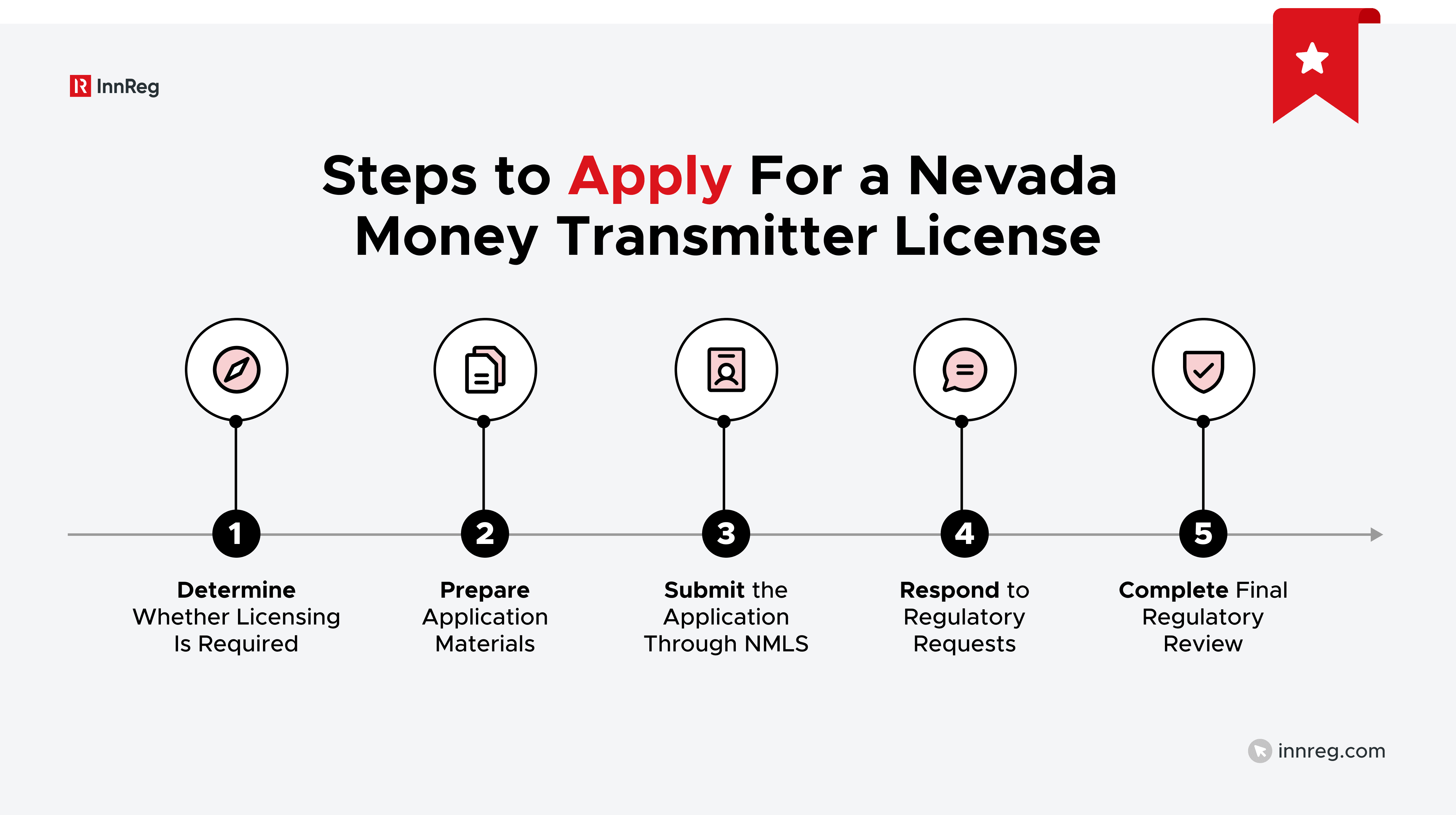
Obtaining a Nevada money transmitter license is a multi-stage process. While the specific timeline varies by applicant, these are the typical steps you should take to apply for a Nevada Money Transmitter license:
Determine Whether Licensing Is Required: Before beginning the application process, companies should analyze whether their activities constitute money transmission under Nevada law. This review often focuses on transaction flows, custody of funds, payment processing activities, cryptocurrency services, and any potentially applicable exemptions.
Prepare Application Materials: Nevada requires extensive supporting documentation, including formation documents, business plans, financial statements, flow of funds descriptions, ownership disclosures, and compliance-related materials. Preparing these documents before filing can reduce delays during regulatory review.
Submit the Application Through NMLS: Applications are submitted through the Nationwide Multistate Licensing System. This typically includes the Company Form MU1, Individual Form MU2 filings, document uploads, fee payments, background check authorizations, and electronic surety bond submission.
Respond to Regulatory Requests: The Nevada Financial Institutions Division frequently requests additional information during the review process. Applicants may be asked to clarify business activities, explain transaction flows, provide supplemental financial information, or submit additional supporting documentation.
Complete Final Regulatory Review: After all materials have been submitted and any deficiencies have been resolved, Nevada conducts its final review. Regulators evaluate the applicant's financial condition, management team, ownership structure, business activities, and compliance readiness before making a licensing decision.
The Nevada Financial Institutions Division advises applicants to allow approximately 60 to 90 days for application review and processing. However, processing times may vary depending on the complexity of the application and the completeness of the materials submitted.
More complex fintech and cryptocurrency business models may require additional review time, particularly if regulators request supplemental information during the application process.
Ongoing Compliance After Licensing
Obtaining a Nevada money transmitter license is only the first step. Licensed companies must continue meeting state and federal compliance obligations throughout the life of the license.
The exact requirements vary depending on the business model, transaction volume, use of authorized delegates, and whether the company qualifies as a Money Services Business (MSB). However, most Nevada money transmitters should expect ongoing responsibilities similar to those outlined below.
Compliance Area | Ongoing Responsibilities |
|---|---|
AML and BSA Compliance | Maintain a written anti-money laundering program, conduct risk assessments, train personnel, and comply with applicable Bank Secrecy Act requirements. |
MSB Call Reports | Submit required Money Services Business Call Reports through NMLS, including transaction and financial information required by regulators. |
Authorized Delegate Updates | Report additions, removals, and changes involving authorized delegates through the Uniform Authorized Agent Reporting (UAAR) system. |
Nevada Financial Reporting | Submit audited financial statements and other financial information required by Nevada regulators. |
Cybersecurity and Safeguards Controls | Maintain information security controls, protect customer information, and monitor cybersecurity risks associated with operations and service providers. |
Transaction Monitoring and SAR Reporting | Monitor transactions for suspicious activity and file Suspicious Activity Reports (SARs) when required under federal law. |
Regulatory Examinations | Respond to examinations conducted by the Nevada Financial Institutions Division and provide requested records, policies, and operational information. |
As a company grows, compliance obligations often become more complex. New products, additional states, authorized delegate networks, and higher transaction volumes can all increase the resources needed to maintain a compliant money transmission program.
InnReg helps money transmitters build and maintain compliance programs that support both regulatory requirements and business growth. Our team regularly assists clients with AML compliance, regulatory reporting, licensing maintenance, examination preparation, policy development, authorized delegate oversight, and day-to-day compliance operations.

Nevada Money Transmitter License FAQs
How Long Does It Take To Get a Nevada Money Transmitter License?
The Nevada Financial Institutions Division states that applications are generally reviewed in the order they are received. The agency advises applicants to allow approximately 60 to 90 days for review and processing, although the actual timeline can vary significantly.
Applications involving cryptocurrency activities, complex ownership structures, multiple control persons, or incomplete documentation often require additional review. Requests for supplemental information can also extend the licensing timeline.
How Much Does a Nevada Money Transmitter License Cost?
As of 2026, Nevada charges a $500 application fee, a $400 initial license fee, and a $120 NMLS processing fee. Applicants should also budget for additional expenses such as audited financial statements, surety bond premiums, legal support, compliance consulting, fingerprinting, and background checks.
For many companies, the filing fees represent only a small portion of the total cost of obtaining a Nevada money transmitter license.
Can You Operate Before Approval?
Generally, no. Nevada law prohibits a person from engaging in money transmission activities, advertising money transmission services, or holding itself out as a money transmitter unless it is properly licensed or operating as an authorized delegate of a licensed entity.
Businesses should evaluate licensing requirements before launching products or accepting customer funds in Nevada.
Does FinCEN Registration Replace Nevada Licensing?
No, FinCEN registration and Nevada licensing are separate requirements. Registering as a Money Services Business (MSB) with FinCEN does not eliminate state licensing obligations.
Many money transmitters must comply with both federal and state requirements. Depending on the business model, this may involve maintaining a Nevada money transmitter license while also complying with federal AML and Bank Secrecy Act requirements.
Do Crypto Companies Need a Nevada Money Transmitter License?
Some do, and some do not. The answer depends on the specific activities being conducted. Businesses involved in virtual currency exchange, custodial wallet services, crypto payment processing, stablecoin transfers, or other activities involving the transmission of value may trigger licensing requirements.
Does Nevada Participate in Multistate Licensing Modernization Efforts?
Yes, Nevada adopted Assembly Bill 21 (AB21), which modernized the state's money transmission laws and aligned many provisions with broader multistate licensing modernization initiatives.
The goal of these efforts is to create greater consistency across state money transmission frameworks while maintaining state-level oversight of licensed entities.
See also:
InnReg Helps Money Transmission Companies Navigate Licensing and Compliance
Obtaining a Nevada money transmitter license involves more than completing an application. For fintech companies, the challenge is often greater because innovative products do not always fit neatly into traditional regulatory categories.
Since 2013, InnReg has worked with payment companies, money transmitters, broker-dealers, registered investment advisors, and other regulated businesses that need practical compliance support at a fraction of the cost of an in-house compliance team.
If you are evaluating a Nevada money transmitter license or expanding your money transmission activities into additional states, InnReg can help you assess your obligations, prepare licensing applications, and develop a compliance framework that supports long-term growth.

Ani is a Senior Compliance Consultant with over 10 years of experience in legal and regulatory compliance across fintech, RegTech, and cross-border payments. She has held roles at Remote and EY, with expertise in AML, GDPR, financial crime, and EU regulatory frameworks. She holds CAMS and CIPP/E certifications.
How Can InnReg Help?
InnReg is a global regulatory compliance and operations consulting team serving financial services companies since 2013.
We are especially effective at launching and scaling fintechs with innovative compliance strategies and delivering cost-effective managed services, assisted by proprietary regtech solutions.
If you need help with money transmitter compliance, reach out to our regulatory experts today:
Related Articles




Featured LinkedIn Posts