What Does a Financial and Operations Principal (FINOP) Do?
Key Takeaways
A FINOP is a required role responsible for financial reporting, capital, and regulatory filings.
Net capital and financial reporting are ongoing responsibilities, not periodic tasks.
The FINOP sits between finance, operations, and compliance, connecting all three.
Fintech models add complexity, especially with products, partners, and data flows.
Outsourcing the FINOP role can work, but the firm remains fully responsible.
Regulators focus on how the role is performed, not just who is assigned.
Most fintech teams don’t start out thinking about roles like a “FINOP.” But if you’re building a broker-dealer, it’s something you’ll need to understand early.
A FINOP is the person responsible for your firm’s financial reporting and regulatory obligations. It’s a required role, and it plays a big part in keeping your business running in line with SEC and FINRA expectations.
In this guide, we’ll walk through what a FINOP does and how the role fits into your business.
At InnReg, we help broker-dealers structure and support the FINOP role, from Series 27 and 28 staffing to financial reporting, net capital oversight, and ongoing compliance operations.


What Is a FINOP?
A Financial and Operations Principal (FINOP) is a registered individual responsible for overseeing a broker-dealer’s financial reporting and operational compliance. The role is defined under FINRA rules and focuses on how a firm handles its:
Financial records
Regulatory filings
Capital position
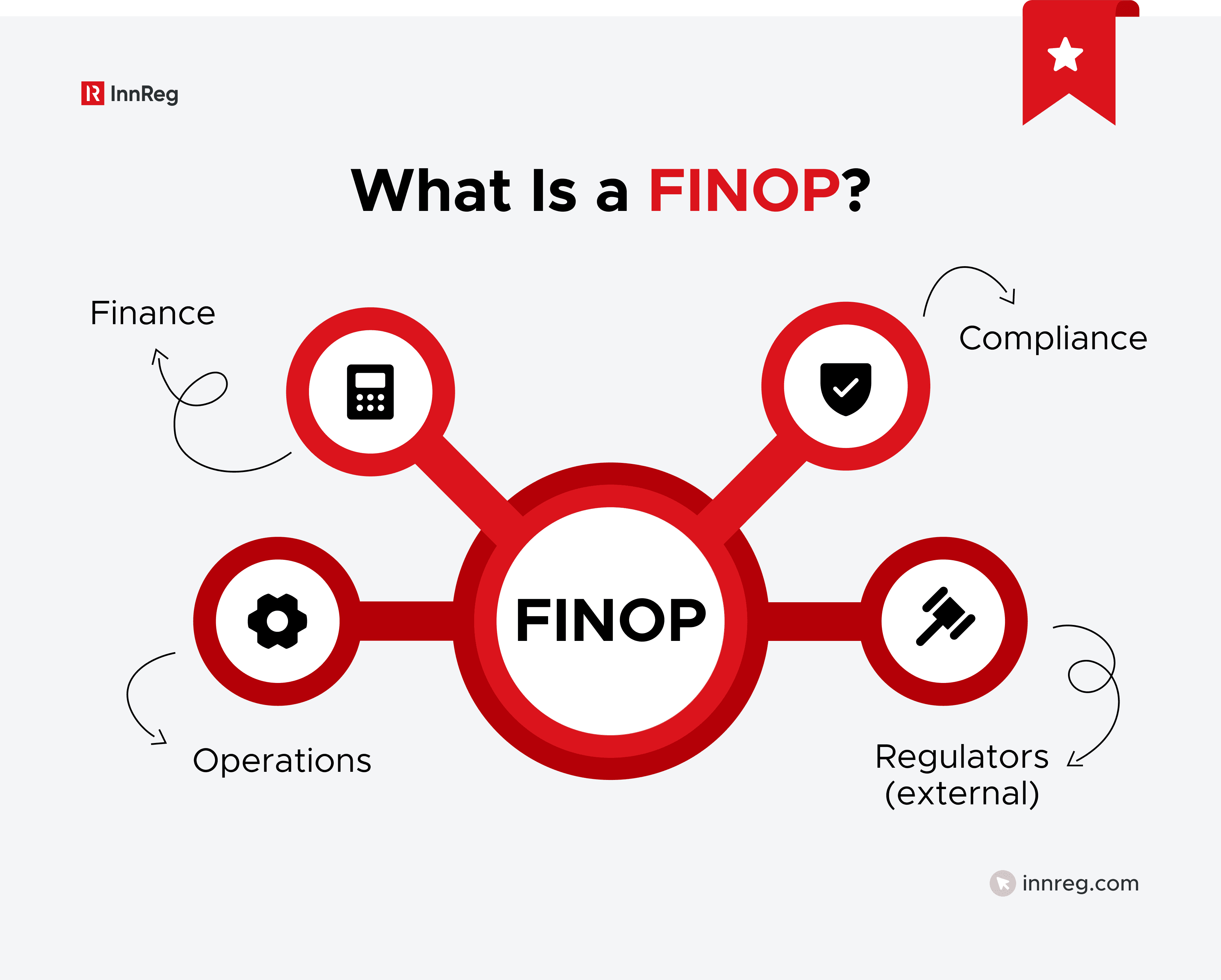
You’ll typically see the FINOP role across broker-dealers, including introducing firms and clearing firms, as well as fintech companies operating within those structures. Any firm subject to SEC and FINRA financial responsibility rules must have a designated FINOP responsible for these obligations.
It’s worth clarifying one common point. In tech, “FinOps” usually refers to cloud cost management. A FINOP is something entirely different. It’s a licensed compliance role tied to regulatory reporting and financial oversight, not expense optimization or budgeting.
Why Does Every Broker-Dealer Need a FINOP?
Every broker-dealer needs a clear owner for financial reporting and capital. That’s the FINOP. Here’s how that shows up across different firms:
It’s a required role: Firms need a FINOP to handle filings, track capital, and maintain financial records. Without clear ownership, these responsibilities fall through quickly, and that creates immediate regulatory risk.
It directly affects how the firm operates: Financial responsibility rules like net capital and customer protection aren’t just reporting requirements. They influence what the firm can do, how it structures activity, and how it manages risk on an ongoing basis.
It comes up early in registration: Firms need to show how financial reporting and capital will be handled before they’re approved. If the role isn’t clearly covered, the process stalls.
It supports ongoing reporting and filings: Broker-dealers have recurring obligations like FOCUS reports and financial statements. These aren’t one-time tasks. They need to be consistent, accurate, and tied back to real activity every time.
It connects finance, operations, and compliance: The FINOP sits across multiple functions, which makes it one of the first roles to spot inconsistencies between how the business runs and how it’s reported.
It becomes more critical as the business grows: More volume, more products, and more partners increase the complexity of reporting and capital calculations. Without strong oversight, small gaps can turn into larger issues.
It’s central during exams and audits: Regulators don’t just review filings. They expect clear explanations of how numbers were calculated and how processes work. The FINOP is the person responsible for standing behind that.
When Is a FINOP Needed?
The FINOP role usually comes into focus at specific points where financial oversight becomes part of your regulatory obligations.
Here are the key scenarios where a FINOP is required:
During broker-dealer registration: When you apply with FINRA, you need to show how your firm will handle financial reporting, net capital, and books and records. That includes naming a FINOP who’s responsible for those functions.
When you begin handling customer transactions or funds: The moment your model involves executing trades, holding funds, or interacting with customer accounts, financial responsibility rules apply. This triggers ongoing requirements like net capital calculations and regulatory filings, which fall under the FINOP.
When introducing clearing or custody relationships: Partnering with a clearing firm or custodian adds another layer of financial and operational complexity. The FINOP needs to understand how money and securities move between parties and how that affects the firm’s reporting and obligations.
When launching new or hybrid products: Fintech models often combine brokerage with crypto, payments, or lending features. These setups can change how transactions are recorded and how capital is calculated. A FINOP is needed to interpret how those products fit within existing rules and reporting frameworks.
When expanding into new entities or jurisdictions: Adding affiliates, subsidiaries, or cross-border operations can create separate reporting lines and financial requirements. The FINOP plays a role in mapping out how those pieces connect and what needs to be reported where.
As reporting and filing obligations increase: Broker-dealers don’t just file once. They submit recurring reports like FOCUS filings and maintain detailed financial records. As activity grows, these requirements become more frequent and more detailed. The FINOP is responsible for keeping those filings accurate and consistent over time.
When preparing for audits or regulatory exams: Financial records are one of the first areas regulators review. If the firm can’t clearly explain its capital position, filings, or books and records, it creates immediate issues. The FINOP is the person expected to walk regulators through that information.
What Does a FINOP Actually Do? Core Responsibilities
The FINOP handles a broker-dealer’s financial reporting, records, and regulatory filings. The role is tied directly to how the firm tracks its capital, submits reports, and manages financial obligations.
Below are the key responsibilities and what each one involves.
1. Financial Reporting and FOCUS Filings
The FINOP is responsible for preparing and submitting the firm’s financial reports, including FOCUS filings. These reports give regulators a clear view of the firm’s financial position and are a core part of ongoing oversight. They need to be:
Accurate
Complete
Backed by the firm’s records
This often means pulling data from multiple systems, reviewing it carefully, and making sure it reflects actual activity before submission. Timing matters just as much as accuracy. Late or inconsistent filings can raise concerns, especially if they point to gaps in how financial data is tracked.
2. Net Capital Monitoring and Calculations
The FINOP tracks the firm’s net capital and makes sure it stays above the required threshold. This isn’t something reviewed occasionally. It needs to be monitored on an ongoing basis because it directly affects whether the firm can continue operating.
This involves:
Calculating capital levels
Adjusting for liabilities
Understanding how business activity impacts those numbers
If capital drops close to the minimum, the firm may need to slow down certain activities or take corrective action.
3. Customer Protection and Reserve Requirements
For firms that hold customer funds or securities, the FINOP is responsible for how those assets are handled and reported. This includes calculating reserve requirements and making sure customer assets are properly segregated where required.
These rules are strict because they’re designed to protect customers if something goes wrong at the firm. The FINOP:
Tracks balances
Reviews movements
Confirms that the firm is meeting its obligations at all times
4. Books and Records Oversight
The FINOP oversees how the firm maintains its financial books and records. These records need to reflect all activity accurately and be ready for review at any time.
This includes maintaining ledgers, reconciliations, and supporting documents in a consistent and organized way. Records that don’t match filings or can’t be clearly explained create issues during exams or audits.
5. Back-Office Operations and Vendor Supervision
The FINOP needs visibility into the firm’s back-office operations, especially when third parties are involved. Many broker-dealers rely on clearing firms, accountants, or other vendors, but responsibility for financial reporting still sits with the firm.
That includes:
Reviewing outputs
Understanding how data flows between systems
Staying close to how transactions are processed
If something looks off, the FINOP is expected to catch it and address it.
Key Regulations That Define FINOP Responsibilities
The FINOP role is shaped by a set of SEC and FINRA rules that govern financial reporting, capital, and recordkeeping. These rules define what the firm needs to track, calculate, and report on an ongoing basis.

1. SEC Rule 15c3-1 (Net Capital Rule)
SEC Rule 15c3-1 sets the minimum amount of liquid capital a broker-dealer must maintain to support its operations. It’s not something reviewed occasionally. The FINOP needs to calculate net capital regularly and understand how trades, expenses, and liabilities impact it day to day.
That includes:
Applying regulatory adjustments
Classifying assets correctly
Excluding items that don’t count toward capital
If capital gets close to the minimum, the firm may need to slow certain activities, reduce risk, or bring in additional capital. Regulators pay close attention to this area because it reflects the firm’s ability to meet its obligations.
2. SEC Rule 15c3-3 (Customer Protection Rule)
SEC Rule 15c3-3 governs how broker-dealers handle customer funds and securities. It’s designed to protect customers by requiring firms to keep those assets separate from the firm’s own accounts. The FINOP is responsible for calculating reserve requirements and tracking how customer balances move over time.
That includes:
Reviewing account activity
Confirming proper segregation of funds
Ensuring reserve calculations are accurate
The rule can get complex, especially with multiple accounts, counterparties, or transaction types.
See also:
3. SEC Rule 17a-5 (FOCUS Reporting)
SEC Rule 17a-5 sets the requirements for broker-dealer financial reporting, including FOCUS filings. These reports give regulators a view into the firm’s financial condition and activity over time. The FINOP is responsible for preparing these reports and making sure the numbers reflect the firm’s actual operations.
This means pulling data from different systems, reconciling it, and validating that everything lines up before submission. The reporting frequency can vary depending on the firm, but the expectation stays the same.

Need help with broker-dealer compliance?
Fill out the form below and our experts will get back to you.
4. FINRA Rule 1220 (Registration and Duties)
FINRA Rule 1220 outlines who needs to be registered as a FINOP and what that role covers within a broker-dealer. It makes it clear that financial oversight isn’t optional or flexible. The firm must assign these responsibilities to a properly licensed individual, not split them across unregistered staff.
This rule also ties the FINOP directly to the firm’s structure. Their responsibilities need to match what the business actually does, including its size, activity, and complexity.
FINOP vs. PFO vs. POO: What’s the Difference?
The FINOP isn’t the only financial or operational role in a broker-dealer. Other principal roles have different responsibilities, and the lines between them can get confusing.
Role | Primary Focus | Key Responsibilities |
|---|---|---|
FINOP | Regulatory financial oversight | Net capital, FOCUS filings, books & records |
PFO | Financial strategy | Budgeting, forecasting, cash flow |
POO | Operations execution | Trade processing, workflows |

Principal Financial Officer (PFO)
The Principal Financial Officer (PFO) is responsible for the firm’s internal financial management, including budgeting, forecasting, and tracking performance over time. This role focuses on how the business is running financially, not how it reports to regulators.
The PFO works with leadership on planning, expenses, and revenue, helping guide business decisions. That can include:
Setting budgets
Reviewing financial results
Managing cash flow
In some firms, this role also overlaps with accounting or finance teams.
The key difference is scope. The PFO looks inward at financial strategy, while the FINOP is focused on regulatory reporting, capital requirements, and compliance obligations. In smaller firms, one person may cover both roles, but the responsibilities are still distinct.
Principal Operations Officer (POO)
The Principal Operations Officer (POO) focuses on how the firm’s operations run day-to-day. This includes areas like trade processing, settlements, and internal workflows. The role is centered on making sure operational processes are functioning correctly and consistently.
The POO is often involved in:
Managing systems
Coordinating with clearing firms
Handling operational issues as they come up
Their work is tied to execution and process flow rather than financial reporting.
The distinction is in what each role owns. The POO handles how transactions and operations move through the firm, while the FINOP focuses on how those activities are reflected in financial records and regulatory filings.
How Responsibilities Overlap in Practice
These roles don’t operate in isolation. The same activity can touch finance, operations, and regulatory reporting at the same time. That’s why the FINOP, PFO, and POO often need to stay closely aligned, even if their responsibilities are different.
For example, a new product launch may impact revenue projections, operational workflows, and capital requirements all at once. Each role looks at it from a different angle, but the underlying data and activity are shared.
If communication breaks down, it can lead to inconsistencies between how the business runs and how it’s reported.
How Smaller Firms Structure These Roles
Smaller firms often don’t have separate people for each role. Budget and team size usually lead to some overlap, so it’s common for one person to handle multiple responsibilities, especially early on.
That might mean a FINOP also takes on parts of the PFO or POO role, depending on their background. The setup can work, but it needs to be clearly defined. Even if roles are combined, regulators still expect each responsibility to be covered and properly documented.
As the firm grows, these roles usually become more specialized.
See also:
How to Become a FINOP (Series 27 vs. Series 28)
Becoming a FINOP requires passing the right licensing exams and being registered through a broker-dealer. The process depends on the type of firm and the scope of financial responsibilities involved.

Series 27 Exam Requirements
The Series 27 is the license required for FINOPs at most broker-dealers. It focuses on financial reporting, net capital rules, customer protection, and books and records. The exam is built around real scenarios, so you’re expected to apply rules, not just recognize them.
A big part of the challenge is how detailed it gets. You’ll need to:
Work through calculations
Understand how different transactions affect capital
Know how reports are put together
It’s not unusual for candidates to spend time getting comfortable with both the rules and the math behind them.
Most people who take the Series 27 already have some background in accounting, finance, or broker-dealer operations as a foundation for the role.
Series 28 for Introducing Broker-Dealers
The Series 28 is a more limited version of the FINOP license, used by introducing broker-dealers that don’t carry customer accounts or hold customer funds. It covers financial reporting and recordkeeping, but with a narrower scope than the Series 27.
Because introducing firms rely on clearing firms for many back-office functions, the financial requirements are less complex. The exam reflects that. It still covers core concepts like net capital and reporting, but without going as deep into areas that don’t apply to the firm’s structure.
For many early-stage firms, this is the starting point. If the business model stays simple, a Series 28 may be enough. If the firm expands into more complex activity, it may need to move to a Series 27 setup.
Sponsorship Requirements
You can’t register as a FINOP on your own. You need to be sponsored by a broker-dealer, which files your registration through FINRA. This ties your license directly to the firm and defines what you’re responsible for.
That also means the firm needs to be comfortable with your experience and scope before assigning the role. Registration isn’t just a formality. It reflects how financial responsibilities are actually handled inside the business.
Outsourced FINOP: How It Works
Not every firm hires a full-time FINOP. Many choose to outsource the role, especially in the early stages. This gives them access to experienced professionals without committing to a full-time hire.
When Firms Outsource the FINOP Function
Firms usually outsource the FINOP role when they don’t have the need or budget for a full-time hire. This is common for early-stage broker-dealers or fintech companies building out their initial compliance structure.
It can also make sense for firms with more complex models. A single internal hire may not cover everything, especially if the business spans multiple products or structures. An outsourced setup can bring in broader experience across reporting, capital, and regulatory interactions.
Even so, the responsibility doesn’t shift away from the firm. The FINOP may be external, but regulators still expect the firm to stay involved and understand how financial obligations are being handled.
Learn more about outsourcing FINOPs →
Regulatory Expectations for Outsourced FINOPs
Outsourcing the FINOP role doesn’t reduce regulatory expectations. The firm is still fully responsible for its financial reporting, filings, and capital position. Regulators expect the outsourced FINOP to be actively involved, not just listed for coverage.
This means the FINOP needs access to the firm’s systems, data, and day-to-day activity. They should understand how transactions flow and how reports are built. If something changes in the business, they’re expected to stay updated and adjust reporting as needed.
What Regulators Look for in Exams
During exams, regulators focus on how the FINOP role is actually carried out. They’re not just reviewing filings. They want to see how the numbers were prepared, where the data came from, and whether the process makes sense.
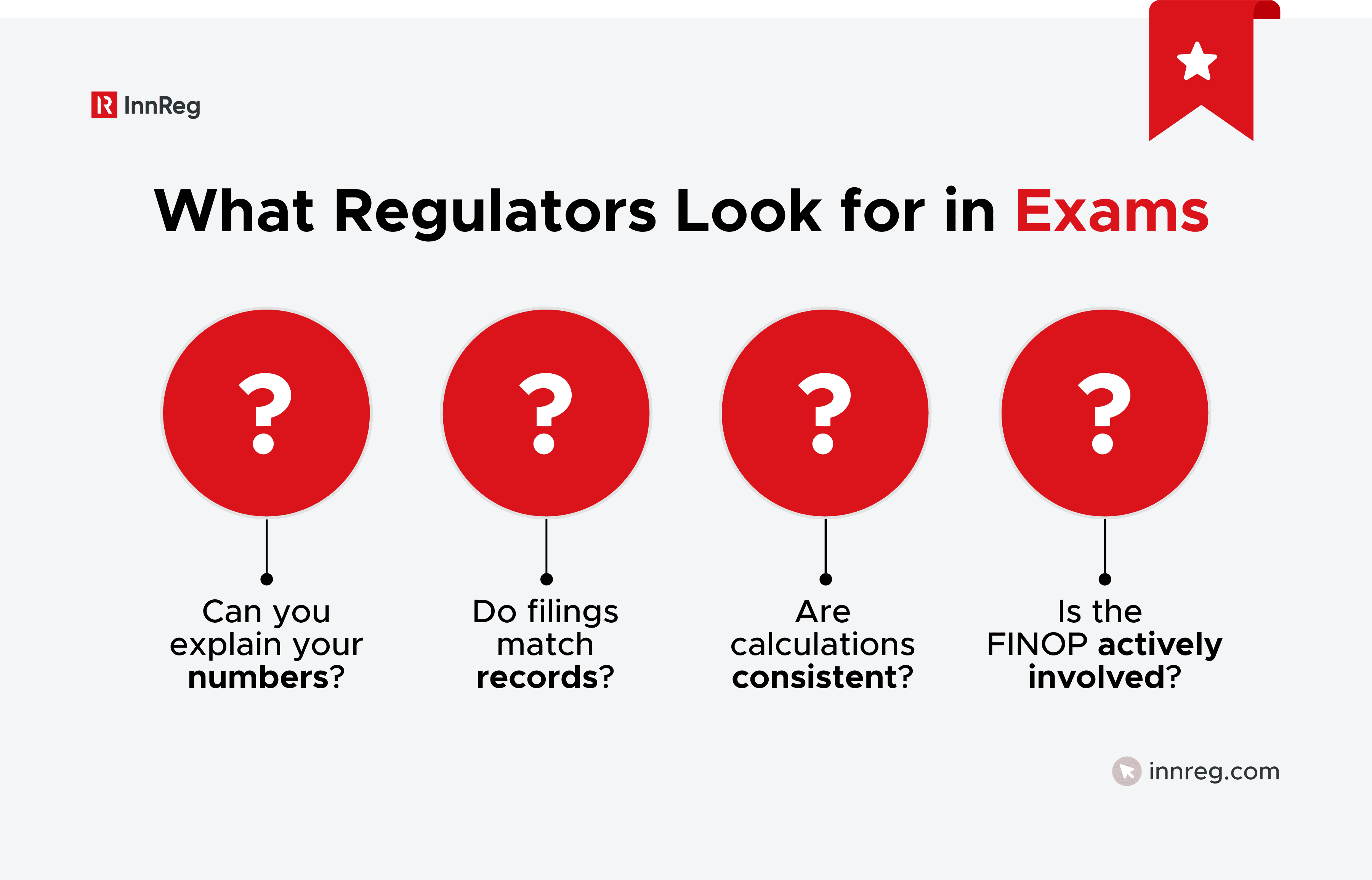
This usually includes reviewing financial reports, supporting records, and how calculations were done. If something doesn’t tie out or can’t be explained clearly, it raises questions. The FINOP is expected to walk through the firm’s financial position and explain decisions with confidence.
Consistency matters just as much as accuracy. Regulators look for patterns across filings, records, and internal processes. If those don’t align, it suggests gaps in how financial oversight is handled.
Common FINOP Challenges for Fintech Companies
The FINOP role gets more complex in fintech environments, where products, systems, and partnerships don’t always fit traditional models. New structures can make it harder to map financial activity into standard reporting and capital frameworks.
As firms grow, these challenges tend to build on each other rather than stay isolated.
Translating complex products into net capital treatment: Fintech products don’t always fit neatly into existing regulatory categories. Combining brokerage, crypto, payments, or lending can make it harder to classify assets and liabilities. This directly affects how net capital is calculated and reported.
Managing vendor and clearing relationships: Many fintech firms rely on multiple partners for clearing, custody, or transaction processing. Each provider has its own data and reporting format. The challenge is pulling everything together into a clear and consistent financial picture.
Keeping real-time visibility into financial position: Activity can move quickly, especially with digital platforms. If data is delayed or spread across systems, it becomes harder to track capital and obligations accurately. Limited visibility increases the risk of reporting issues or late adjustments.
Scaling compliance as operations grow: What works early on often breaks as volume increases. More transactions, more users, and more products create pressure on reporting and controls. The FINOP needs to adapt processes as the business evolves, not rely on the original setup.

—
A FINOP is a required part of running a broker-dealer, but the role is often underestimated. It’s not just about filings. It’s about staying on top of capital, financial data, and reporting as the business changes.
For fintech companies, that complexity builds fast. New products, new partners, and higher volume all affect how financial obligations are handled. Without a clear setup, small gaps in data or oversight can turn into larger issues over time.
The firms that handle this well treat the FINOP role as part of their core operations, not just a requirement to check off. Whether the role is internal or outsourced, what matters is having someone qualified, actively involved, and aligned with how the business actually runs.

Tarik is a Principal Compliance Consultant at InnReg with over 5 years of experience advising fintech clients across broker-dealer, RIA, and money transmitter verticals. He holds FINRA Series 3, 7, 24, 57, 63, 79, and 99 licenses, with expertise in regulatory strategy, supervisory systems, and compliance roadmap implementation.
How Can InnReg Help?
InnReg is a global regulatory compliance and operations consulting team serving financial services companies since 2013.
We are especially effective at launching and scaling fintechs with innovative compliance strategies and delivering cost-effective managed services, assisted by proprietary regtech solutions.
If you need help with broker-dealer compliance, reach out to our regulatory experts today:
Related Articles




Featured LinkedIn Posts