Gold-Backed Tokens Explained: How They Work
Key Takeaways
Gold-backed tokens link blockchain assets to physical gold reserves.
Holder rights depend on ownership, custody, redemption, and insolvency terms.
Reserve verification combines on-chain data, custodian records, inspections, and independent reviews.
Issuers may face securities, commodities, money transmission, AML, sanctions, and custody rules.
Strong controls cover reserves, minting, redemption, disclosures, vendors, cybersecurity, and wind-down planning.
Gold has been used as a store of value for at least 6,000 years of human history. Today, gold-backed tokens bring together gold and blockchain technology, giving market participants a digital way to gain exposure to physical bullion.
The model may appear straightforward, but the structure behind each token can vary considerably. Questions about ownership, custody, reserve verification, redemption, and regulatory treatment often determine whether the product works as described.
This article explains how gold-backed tokens operate, what holders may actually own, how reserves are verified, and how these products compare with other forms of gold exposure. It also covers the main regulatory and compliance considerations for issuers, platforms, and other firms involved in offering or supporting them.
At InnReg, we support companies developing gold-backed tokens and other tokenized assets. From regulatory analysis and licensing to AML programs and ongoing compliance operations, our fintech-focused team can help you build the required framework. Contact us to learn more.


What Are Gold-Backed Tokens?
Gold-backed tokens are blockchain-based digital assets linked to physical gold held by an issuer, custodian, trustee, or another reserve entity. Each token usually represents a stated quantity of bullion, such as one gram or one fine troy ounce.
The term “gold-backed” can describe several different legal structures. A holder may:
own an interest in identified bullion,
share ownership of a pooled reserve, or
hold a contractual claim against the issuer.
The token’s legal terms determine what the holder actually owns and what rights they can exercise. Gold-backed tokens are typically issued on public blockchain networks.
This allows them to be transferred between compatible wallets, listed on trading platforms, or integrated into other digital asset services. The physical gold, however, remains off-chain and depends on traditional custody, recordkeeping, and verification processes.
Tokenization models look different. Learn what the top tokenization models are with this blog →
Potential Benefits of Gold-Backed Tokens
Gold-backed tokens can make gold exposure easier to divide, transfer, and integrate into digital financial systems. Unlike physical bullion, tokens may be transferred without arranging the shipment or reassignment of individual bars or coins.
Potential benefits of gold-backed tokens include:
Fractional access: Investors acquire smaller amounts than they could through standard bullion products.
Digital transferability: Tokens move between compatible wallets and platforms.
Extended trading access: Some platforms allow trading outside traditional market hours.
Programmability: Some tokens can be integrated into payment, custody, settlement, or decentralized finance applications.
Visible token supply: Public blockchains show how many tokens have been issued and how they move between addresses.
Simplified settlement: Ownership records are updated through blockchain transactions rather than physical delivery.
These benefits depend on the surrounding operational structure. Blockchain technology simplifies the transfer of the token, but does not remove the need for reliable custody, reserve management, or regulatory controls.
Gold Ownership vs. Gold Price Exposure
Not every token linked to gold gives the holder ownership of physical bullion. Some products provide a direct or beneficial interest in vaulted gold. Others give the holder a contractual right to receive cash, gold, or another form of value from the issuer.
The following shows the difference between structures of gold-backed tokens and how they connect to real gold:
Structure | What the Holder Owns | Connection to Physical Gold |
|---|---|---|
Allocated gold token | An interest in specifically identified gold bars | Directly linked to designated bullion |
Pooled or fractional gold token | An undivided interest in a larger pool of gold | Backed by shared reserve assets |
Contractual claim token | A claim against the issuer for gold or cash | Gold supports the issuer’s obligation |
Synthetic gold token | No ownership interest in physical gold | Price tracked through derivatives or other mechanisms |
The distinction affects redemption rights, creditor exposure, and the holder’s position if the issuer or custodian fails. For instance, a token that tracks gold through derivatives or another synthetic arrangement creates economic exposure without giving the holder any claim to physical metal.
A contractual claim token works the same way as the entity structures used in tokenized real estate. The token represents a legal right against an entity, not direct ownership of the underlying asset.
How Gold-Backed Tokens Work
Gold-backed tokens connect an on-chain asset with gold held in the physical financial system. The blockchain records token issuance and transfers, while custodians, vault operators, and internal ledgers track the bullion supporting those tokens.
1. The Issuer Acquires Physical Gold
The process begins when the issuer, reserve entity, or another designated party purchases gold that meets the product’s stated standards. These standards typically cover purity, refinery accreditation, bar size, and acceptable storage locations.
Many issuers use bars that meet London Bullion Market Association Good Delivery standards. This relates to the quality and market acceptance of the bullion. It does not, by itself, confirm the token’s regulatory status or the holder’s legal rights.
Tokens should generally not be issued until the gold purchase has settled and the relevant custodian has confirmed receipt. Minting tokens before settlement tends to create a period in which the outstanding supply exceeds the confirmed reserve.
2. The Gold Is Stored With a Custodian
The gold is then placed with a vault operator, bank, trust company, or specialized bullion custodian. Custody records may identify the refiner, serial number, weight, purity, location, and ownership status of each bar.
The custody arrangement should also address whether the gold is allocated, segregated from the issuer’s assets, and free from liens or other claims. Holding gold in a vault does not automatically mean token holders own it or can recover it if the issuer fails.
This is the same control question regulators are working through for digital assets generally. Our breakdown of the RIA Custody Rule covers how "control" gets defined when assets sit off-chain, but ownership records sit on-chain.
The legal agreements between the issuer, reserve entity, custodian, and token holders determine who owns the bullion and how it may be used.
3. Tokens Are Minted
After the gold is received and recorded, the issuer creates the corresponding tokens on a blockchain. The amount minted reflects the quantity of eligible bullion held under the product’s reserve formula.
For example, if one token represents one fine troy ounce of gold, the issuer mints 1,000 tokens after confirming that 1,000 fine troy ounces are held in reserve.
Minting authority is usually controlled through administrative keys or smart contract permissions. Firms should restrict that access, separate approval responsibilities, and maintain records showing why and when each issuance occurred.
Firms that haven't mapped which of these functions require a license should start with our crypto license services overview; minting and redemption activities may trigger money transmitter, virtual currency, or other licensing requirements depending on the token structure and applicable jurisdiction.

4. Tokens Are Transferred or Traded
Once issued, tokens are transferred between compatible blockchain wallets or traded through exchanges, brokers, and other digital asset platforms. The physical gold generally remains in the same vault while ownership records or contractual entitlements move on-chain.
This arrangement supports faster and more fractional transfers than the physical movement of bullion. However, token transferability and issuer redemption are separate processes.
A person may acquire the token through a secondary market without becoming a direct customer of the issuer. The issuer may still require identity verification, sanctions screening, and other onboarding steps before allowing that holder to redeem.
5. Token Supply and Gold Reserves Are Reconciled
The issuer compares the number of outstanding tokens with the amount of eligible gold held in reserve. This requires reconciliation across:
Blockchain supply data
The issuer’s internal ledger
Custodian or vault records
Pending issuances and redemptions
Tokens held by the issuer or its affiliates
Gold awaiting settlement or release
Reconciliation is one of the core operational controls behind a gold-backed token. It helps identify reserve shortages, duplicate minting, timing differences, and recordkeeping errors.
The frequency and method vary by product. Some firms reconcile daily or more often, while independent reserve reporting occurs monthly or quarterly.
See also:
6. Tokens Are Redeemed and Burned
Eligible holders can return tokens to the issuer in exchange for cash, allocated gold, unallocated gold, or physical bullion, depending on the product terms. Redemption may be subject to minimum quantities, fees, geographic limits, processing periods, and customer verification.
Physical delivery can be more restrictive than the token’s marketing suggests. Institutional gold bars are large, so a holder may need enough tokens to redeem an entire bar or pay additional fabrication and delivery costs for smaller quantities.
After the redemption is approved, the corresponding tokens should be removed from circulation through a burning or cancellation process. The gold or cash should not be released while the related token entitlement remains active.
This final step keeps the recorded token supply aligned with the reserve remaining in custody.

Need help with blockchain compliance?
Fill out the form below and our experts will get back to you.
What Do Gold-Backed Token Holders Own?
Owning a gold-backed token does not always mean owning a specific piece of gold. The holder’s rights depend on the legal structure, custody agreements, and redemption terms established by the issuer.
The token itself is only a digital record. The enforceable rights attached to it determine whether the holder owns bullion, shares an interest in a reserve, or has a claim against another party.
Allocated Gold Ownership
Under an allocated structure, the holder’s interest is connected to specifically identified bullion. Custody records typically list the serial number, refiner, weight, purity, and vault location of the relevant bars.
This structure can provide a clearer link between the token and the underlying asset. However, the legal documents must still establish whether the holder has direct title, beneficial ownership, or another form of property interest.
Allocated gold should also be distinguished from gold that is merely recorded on an issuer’s balance sheet. Identification of a bar does not automatically establish that it is legally segregated for token holders.
Fractional or Pooled Gold Interests
A token may represent a fractional or undivided interest in a larger pool of gold. This is common where individual tokens represent much less than the weight of a standard institutional bullion bar.
In this model, the holder may not own a fixed portion of one specific bar. Instead, the holder shares an interest in the reserve as a whole, and the issuer’s records determine how that interest is allocated.
Bar assignments may also change as tokens are minted, transferred, or redeemed. The product terms should explain how ownership records are updated and how fractional interests are handled during redemption.
Contractual Claims Against the Issuer
Some tokens give holders a contractual right to receive gold, cash, or another form of value from the issuer. In that case, the holder does not own the reserve assets directly.
The gold supports the issuer’s obligation, but the holder remains dependent on the issuer’s ability and willingness to meet its contractual commitments. This introduces credit risk and makes creditor priority important.
If the issuer becomes insolvent, the holder may be treated as a secured or unsecured creditor, or a beneficiary of segregated assets. That outcome depends on the legal agreements and applicable insolvency law, not the token’s branding.
Synthetic Gold Exposure
A synthetic gold token tracks the price of gold without giving the holder ownership of physical bullion. The price relationship is created through derivatives, collateral arrangements, algorithms, or exposure to another financial product.
In addition to providing economic exposure to gold price fluctuations, it introduces other risks, such as counterparty failure, collateral shortfalls, liquidation events, and imperfect price tracking.
A synthetic product is not physically backed unless the underlying structure supports that claim. Marketing materials should clearly distinguish price exposure from ownership or redemption rights.
Asset Segregation and Insolvency Risk
Asset segregation keeps the reserve gold and the digital tokens separate from the issuer’s own property. It can also affect whether the assets are available to the issuer’s general creditors during bankruptcy or another insolvency proceeding.
A strong structure addresses:
Which entity legally owns the gold
Whether the gold is held for token holders
Whether it is recorded in segregated accounts
Whether the issuer or custodian can pledge, lend, or rehypothecate it
How customer interests are identified
What happens if the issuer, reserve entity, or custodian fails
Custody statements and reserve reports confirm where gold is held, but they may not resolve ownership or creditor-priority questions. Founders should obtain legal analysis of title, segregation, and insolvency treatment before describing customer assets as protected or bankruptcy-remote.
For a closer look at how this plays out under existing advisor rules, see our guide to SEC Custody Rule 206(4)-2 →
How Do Gold-Backed Tokens Track the Price of Gold?
Gold-backed tokens typically track the market value of the gold represented by each token. If one token corresponds to one fine troy ounce, its price should generally move with the value of that amount of gold.
The relationship is not automatic. Two mechanisms do the work.
Gold Pricing Benchmarks
Issuers and trading platforms rely on recognized gold market benchmarks or pricing feeds to value the reserve and calculate purchases, redemptions, and customer transactions.
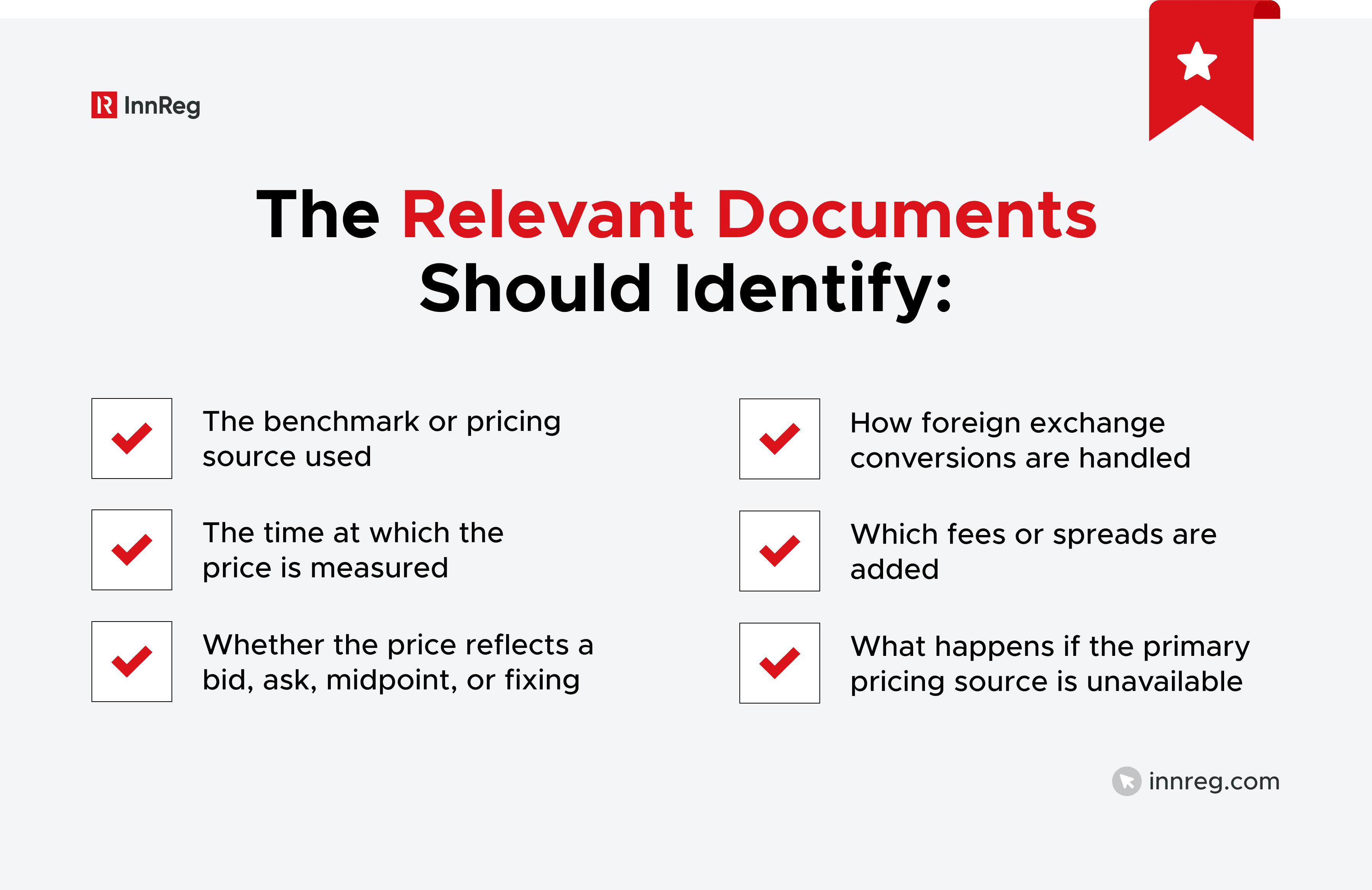
When different platforms use different reference prices, it can produce small price differences even when two tokens represent the same quantity of gold.
Pricing controls also matter for reserve reporting and financial records. Firms should document how prices are sourced, validated, and applied consistently across minting, redemption, accounting, and customer disclosures.
Minting, Redemption, and Arbitrage
Minting and redemption keep a token’s market price close to the value of its underlying gold. When the token trades above that value, eligible market participants can acquire gold-backed tokens from the issuer and sell them on the secondary market.
When the token trades below the value of the underlying gold, they can buy discounted tokens and redeem them with the issuer. These transactions often reduce the difference between the token price and the gold reference price.
For example, suppose one token represents one fine troy ounce of gold:
If gold is valued at $2,500 and the token trades at $2,540, a participant may mint at or near the reference value and sell at the higher market price.
If the token trades at $2,450, a participant may purchase it and redeem it for gold or cash worth closer to $2,500.
This arbitrage mechanism works only when eligible participants mint and redeem at a reasonable cost and within a workable timeframe.
In practice, the token still trades above or below gold because of:
Redemption minimums
Issuer and platform fees
Shipping or fabrication costs
Limited market liquidity
Banking and vault operating hours
Geographic restrictions
Delays in customer verification
Concerns about reserves or the issuer
Disruptions affecting exchanges or blockchain networks
And that’s why a gold-backed token follows the direction of the gold market without matching the reference price exactly at every moment.

How Gold Reserves Are Verified
Reserve verification is central to the credibility of a gold-backed token. The issuer must show that the amount of eligible gold held in custody corresponds to the number of tokens in circulation. So how are gold reserves verified?
On-Chain Supply Data
Public blockchains show how many tokens have been minted, burned, and transferred between addresses. This makes the outstanding token supply more visible than it would be in a closed internal system.
However, blockchain data only covers the digital side of the product. It will show that 100,000 tokens exist, but not whether the issuer holds the corresponding amount of gold.
The issuer should also explain how it treats:
Tokens held in treasury wallets
Tokens on multiple blockchain networks
Wrapped or bridged versions of the token
Frozen or inaccessible tokens
Tokens awaiting redemption
Tokens controlled by affiliates or market makers
On-chain transparency is useful, but it does not independently verify the underlying bullion.
For a broader view of how federal and state regulators are closing this gap between on-chain visibility and off-chain verification, see our US crypto regulation guide →
Gold Bar Lists and Custodian Records
A gold bar list identifies the bullion held in reserve. It typically identifies the refiner, serial number, weight, purity, and vault location of each bar.
Custodian records can provide additional evidence that the gold was received and remains in storage. They may also show whether it is held in an allocated account and which entity is named as the owner or account holder.
These records should be compared with the issuer’s internal ledger and total token supply. Any difference should be investigated, documented, and escalated under the issuer’s reconciliation procedures.
A bar list still has limitations. It may confirm that certain gold exists, but it does not necessarily establish whether the gold is free from liens, legally segregated, or available to token holders in insolvency.
Proof of Reserves
Proof of reserves is a process used to show that reserve assets support customer liabilities or outstanding tokens. The term is used broadly and does not describe a standardized verification method.
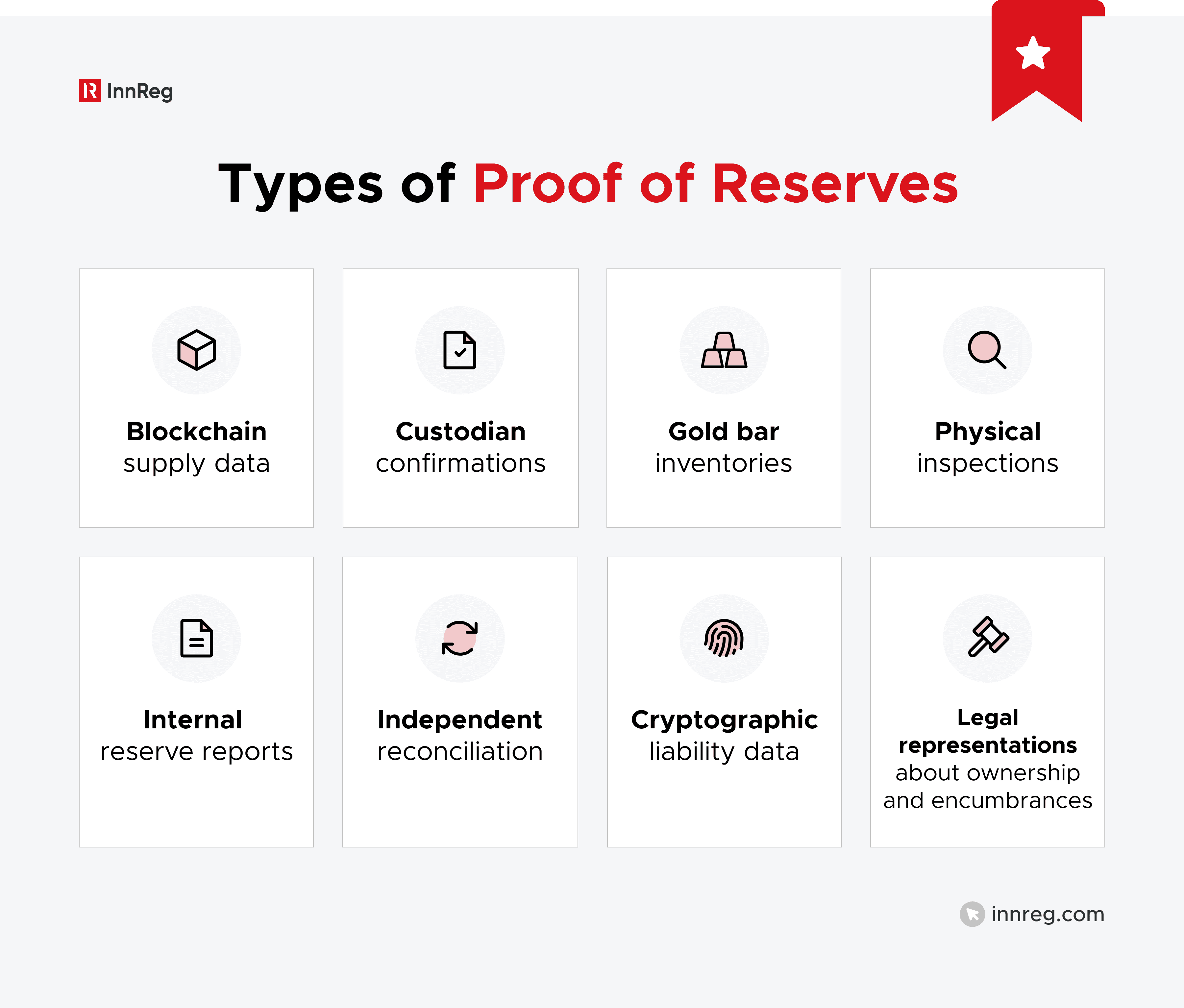
The quality of the evidence depends on its scope, timing, methodology, and independence. A report covering one date will not show whether the reserve was sufficient before or after that date.
See also:
Audits, Attestations, and Assurance Reports
The terms audit, attestation, and assurance report are often used interchangeably in marketing, but they are not the same.
An audit examines financial statements under a recognized accounting framework. An attestation or assurance engagement evaluates specific management assertions, such as whether reported gold exceeded outstanding token obligations on a particular date.
The distinction affects what a reader can reasonably conclude from the report.
Verification Method | What It May Confirm | Common Limitation |
|---|---|---|
On-chain review | Number of tokens issued and outstanding | Does not verify physical gold |
Custodian confirmation | Gold recorded as held by the custodian | May not establish legal ownership or absence of liens |
Physical inspection | Existence and characteristics of inspected bullion | Often sample-based and limited to a specific date |
Reserve attestation | Whether stated reserves match stated liabilities under defined criteria | Usually narrower than a full financial statement audit |
Financial statement audit | Financial position and disclosures under an accounting framework | May not test continuous one-to-one backing |
Legal opinion | Title, segregation, and insolvency treatment | Does not confirm physical existence or operational controls |
Issuers should describe the report accurately, including who prepared it, who performed the independent work, the period or date covered, and any stated limitations.
Calling a point-in-time reserve attestation a “full audit” may overstate the level of review and create consumer protection or regulatory concerns.

What Blockchain Records Cannot Prove
Blockchain records can verify digital activity, but they cannot independently establish facts about assets held outside the network.
They generally cannot prove:
That the physical gold exists
That the reported bars are still in the vault
That token holders legally own the gold
That the bullion is free from liens or pledges
That the issuer has not leased or rehypothecated it
That the custodian is financially sound
That the gold is available for immediate redemption
That customer assets are protected during insolvency
These questions require off-chain evidence, legal documentation, and operational controls. The strongest reserve framework connects transparent blockchain records with credible custody evidence and clearly defined holder rights.
Gold-Backed Tokens vs. Other Gold Investments
Gold-backed tokens are one of several ways to gain exposure to gold. However, there are many ways to expose your portfolio to gold investments. Each structure provides different rights, trading mechanisms, and risk exposures.
As an overview, these are the different types of gold investments and how they differ from gold-backed tokens:
Product | What the Holder Owns | How It Is Held or Traded |
|---|---|---|
Gold-backed token | Rights defined by the token terms, which may include an interest in bullion or a claim against the issuer | Blockchain wallets and digital asset platforms |
Physical gold | Bars, coins, or other bullion products | Stored personally or with a vault provider |
Gold ETF | Shares in a regulated investment fund or trust | Securities exchanges through a brokerage account |
Gold futures | A standardized derivative contract | Regulated futures exchanges |
Synthetic gold product | A contractual or tokenized instrument tracking the gold price | Digital asset or derivatives platforms |
The differences show up in three places: what you own, how you exit, and what happens if the provider fails.
Physical gold gives the holder possession or title to the metal itself, but it can be expensive to store, insure, transport, and divide into smaller units. Transactions may also require authentication and coordination with dealers or vault operators.
Gold ETFs offer exposure through established securities-market infrastructure. Investors can buy and sell shares through brokerage accounts, but they usually own fund shares rather than individual bars. Retail shareholders may also have no practical right to redeem their shares for physical bullion.
Gold futures and other derivatives provide price exposure without requiring the investor to hold the metal. These products may support hedging or trading strategies, but they can involve leverage, margin requirements, contract expiration, and losses that exceed an initial payment in some structures.
Gold-backed tokens combine digital transferability with an off-chain reserve arrangement. They may support fractional transactions and transfers outside conventional market hours. At the same time, the holder remains dependent on the issuer, custodian, legal structure, and redemption process.
A gold-backed token should therefore not be treated as a digital version of physical ownership without reviewing its terms. Founders and compliance teams should describe the product by the rights it grants, not simply by the asset it tracks.
Key Risks of Gold-Backed Tokens
Gold-backed tokens can reduce some of the practical friction associated with buying, storing, and transferring bullion. They also introduce risks that do not exist in the same form with physical gold.
The holder is exposed not only to movements in the gold price, but also to the issuer, custodian, technology, legal structure, and redemption process. Key risks include:
Issuer risk: The issuer may fail to maintain adequate controls, meet redemption obligations, or operate in accordance with its published terms.
Custodian risk: Gold can be lost, misrecorded, subject to a dispute, or held through a custodian whose financial or operational condition deteriorates.
Ownership risk: The holder may have fewer rights to the reserve than the product name or marketing suggests.
Reserve risk: Token supply can exceed eligible gold holdings because of minting errors, settlement delays, valuation issues, or weak reconciliation.
Liquidity risk: A token may be difficult to sell or redeem during periods of market stress, operational disruption, or reduced demand.
Price-tracking risk: The token can trade above or below the value of the gold it represents.
Redemption risk: Minimum quantities, fees, verification requirements, geographic restrictions, or processing delays may limit access to gold or cash.
Smart contract risk: Coding flaws, compromised administrative keys, network failures, or bridge vulnerabilities can affect transfers or token supply.
Regulatory risk: A change in classification, licensing expectations, sanctions rules, or distribution restrictions may affect how the token can be issued or used.
Third-party risk: Banks, exchanges, market makers, vault operators, auditors, logistics providers, and technology vendors can create additional points of failure.
The risks can also compound. For example, a reserve discrepancy triggers market concern, which reduces liquidity, widens the discount to gold, and increases redemption requests at the same time.
Note: Clear disclosures and well-documented controls are critical because token holders often cannot independently assess the complete off-chain structure. They may see the blockchain supply, but they still depend on the issuer for information about custody, reserve quality, legal ownership, and redemption capacity.
Are Gold-Backed Tokens Stablecoins?
Gold-backed tokens are not typically stablecoins in the same sense as fiat-backed payment tokens. They track the value of a stated quantity of gold, so their price in US dollars rises and falls with the gold market.
So in essence, they are commodity-backed tokens because they are designed to remain linked to an external asset. However, that label can create confusion. A token representing one fine troy ounce of gold may remain tied to that quantity of bullion, but it does not maintain a fixed dollar value.
The distinction also matters under financial regulation. Some laws define stablecoins narrowly, focusing on tokens that are redeemable for a fixed amount of monetary value.
Commodity-Backed Tokens vs. Payment Stablecoins
Commodity-backed tokens and payment stablecoins both rely on reserves, minting, redemption, and blockchain transfers. Their reference assets and economic functions are where the difference comes in.
Feature | Commodity-Backed Token | Payment Stablecoin |
|---|---|---|
Reference asset | A commodity such as gold | A fixed amount of monetary value |
Typical redemption unit | A stated weight or quantity of the commodity | A stated amount of fiat currency |
Fiat value | Changes with the commodity price | Designed to remain near a fixed monetary value |
Primary use | Commodity exposure, transfer, settlement, or investment | Payments, settlement, and value transfer |
Main reserve assets | Physical commodities or related claims | Cash and other permitted liquid financial assets |
Regulatory analysis | Commodities, securities, money transmission, custody, and consumer protection | Stablecoin-specific rules, banking, payments, AML, and money transmission |
In the US, the GENIUS Act applies to payment stablecoins. The definition turns on a representation: the issuer holds the token out as maintaining a stable value against a fixed amount of monetary value. A conventional token redeemable for one gram or one fine troy ounce of gold would fall outside that definition because its dollar value is not fixed.
That does not place gold-backed tokens outside financial regulation. Depending on the structure, they may still raise money transmission, commodities, securities, custody, AML, sanctions, and state licensing issues.
Looking to launch your stablecoin services? We can help with licensing →
How Gold-Backed Tokens Are Regulated in the US
There is no single US regulatory framework for gold-backed tokens. The applicable requirements depend on the token’s legal structure, how it is sold and redeemed, and which entities control customer funds, tokens, or physical gold.
One product can fall within several of the following regulatory regimes at the same time:
FinCEN and Bank Secrecy Act Requirements
A gold-backed token issuer or administrator may be treated as a money services business under the Bank Secrecy Act if it accepts and transmits value between people or locations.
FinCEN has addressed a closely related model involving freely transferable digital certificates of ownership in precious metals. It concluded that allowing customers to transfer value from a commodity position to another person could constitute money transmission rather than a simple purchase or sale of gold.
When an entity qualifies as a money transmitter, its obligations may include:
FinCEN registration
A written, risk-based AML program
Customer and beneficial owner due diligence
Transaction and funds-transfer recordkeeping
Independent testing
Employee training
Appointment of an AML compliance officer
A separate FinCEN analysis applies if the business also purchases and sells sufficient quantities of physical bullion as a dealer in precious metals. The analysis turns on how value moves through the product, not simply on whether the token represents a commodity.
State Money Transmission and Virtual Currency Licensing
Federal MSB registration does not replace state licensing. An issuer, administrator, exchange, custodian, or redemption provider may need money transmitter or virtual currency licenses depending on its activities and the states where it conducts business.
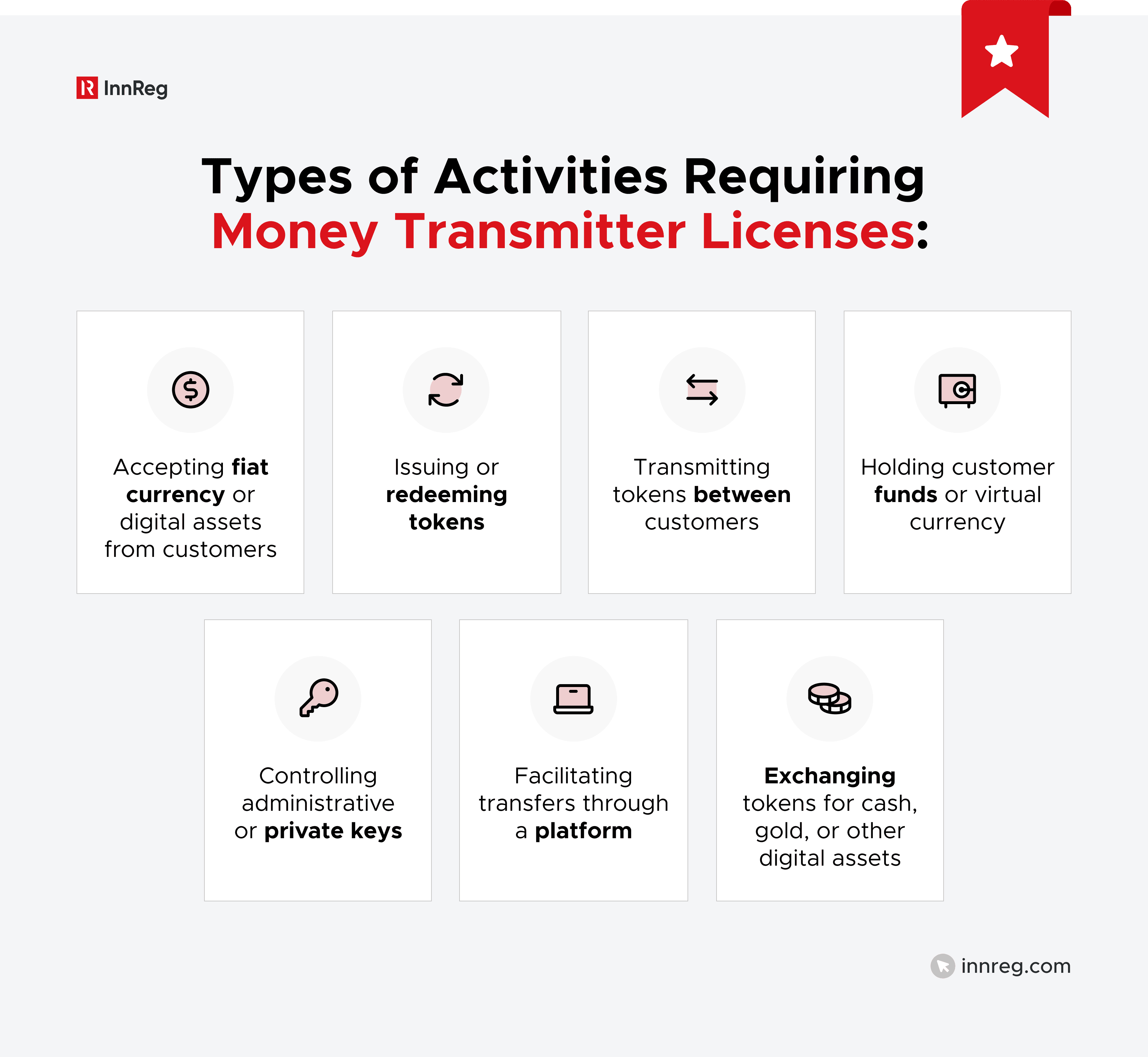
States have adopted more consistent standards through versions of the Money Transmission Modernization Act, but implementation remains state-specific. The model framework covers matters such as licensing, net worth, surety bonds, permissible investments, reporting, and examinations.
New York also required a BitLicense or an appropriate trust charter for covered virtual currency business activity. A license held by one affiliate does not necessarily authorize the regulated virtual currency activities conducted by another entity within the product structure.
SEC Securities Law Considerations
Physical gold is a commodity, but that does not mean every gold-backed token falls outside federal securities laws. The analysis considers both the token’s characteristics and the way it is offered and sold.
A token may raise securities issues when purchasers are led to expect profits from the issuer’s essential managerial efforts. Relevant features can include:
Active management of reserve assets
Lending, leasing, or investing the gold
Payment of yield or revenue shares
Pooling customer funds to develop the business
Promises to increase demand or token value
Managed trading or arbitrage strategies
Reliance on the issuer to create a secondary market
The SEC’s 2026 crypto interpretation states that a cryptoasset that is not itself a security may still be offered or sold as part of an investment contract. The economic arrangement and promotional claims matter more than the product’s label or blockchain format.
A simpler structure involving a fixed entitlement to fully reserved bullion may present a different analysis. Even then, the issuer should review the offering terms, marketing, reserve activities, and ongoing role of the management team.
CFTC Commodity and Derivatives Rules
Gold is a commodity under the Commodity Exchange Act. The CFTC therefore has authority over fraud and manipulation involving gold markets, along with broader jurisdiction over commodity derivatives.
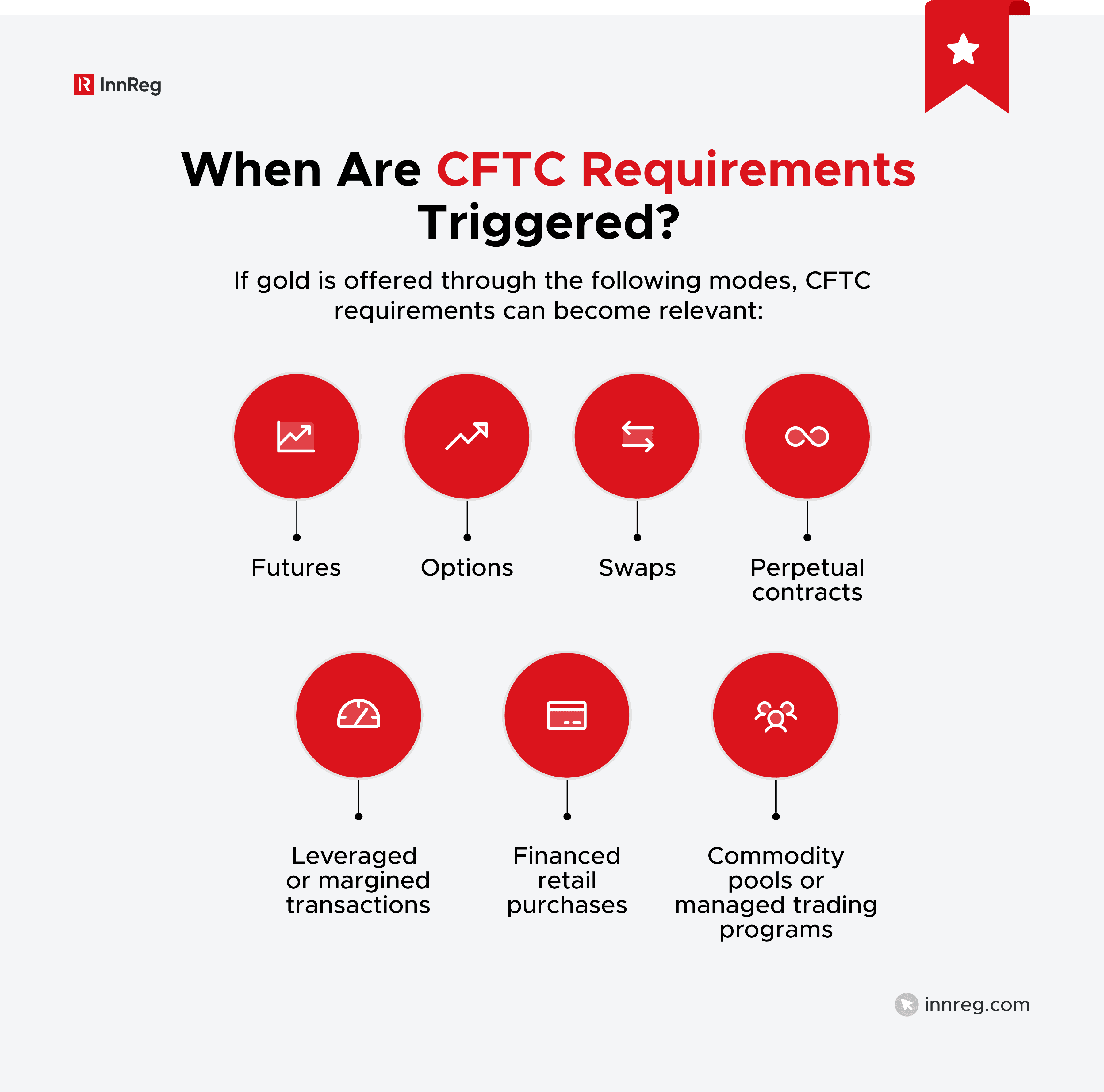
Certain leveraged, margined, or financed commodity transactions with retail customers are regulated as futures transactions unless actual delivery occurs within 28 days. The CFTC takes a functional approach, examining how the transaction is marketed, managed, and performed rather than relying only on contract language.
For example, recording a token in an account controlled by the seller does not establish actual delivery if the customer lacks possession and control. Platforms should assess both the token transfer and the customer’s practical ability to use, move, or redeem the asset.
OFAC Sanctions Compliance
US sanctions requirements apply to virtual currency transactions in the same way they apply to transactions involving fiat currency. Gold-backed token businesses must avoid direct and indirect dealings involving blocked persons, prohibited jurisdictions, or blocked property.
A sanctions compliance program may include:
Customer and beneficial owner screening
Wallet address screening
Transaction monitoring
Geographic and IP address controls
Review of exposure to mixers, bridges, and high-risk services
Escalation of potential sanctions matches
Blocking or freezing procedures
Regulatory reporting
Gold-backed tokens can move through secondary markets and unhosted wallets after issuance. Therefore, screening only the original buyer may leave material gaps.
When virtual currency is blocked, it must be reported to OFAC within 10 business days and annually while it remains blocked. OFAC does not require the asset to be converted into fiat currency.
Banking, Trust, and Custody Regulation
Banks and trust companies involved in issuing or custodying gold-backed tokens may be supervised by the OCC, state banking regulators, or NYDFS. The exact requirements depend on the entity’s charter and approved activities.
Regulatory oversight of an issuer or custodian should be described precisely. It does not mean every feature of the token has received governmental approval, nor does it remove market, reserve, or technology risk.
Custody arrangements should address:
Whether customer assets remain the customers’ beneficial property
How assets are segregated from proprietary holdings
How ownership is recorded
Whether subcustodians are used
How the firm conducts due diligence on vault operators
What happens during insolvency
How customers receive disclosures about the arrangement
NYDFS’s updated custody guidance emphasizes customer beneficial ownership, segregation, books and records, disclosure, and oversight of subcustodians. Although the guidance concerns virtual currency custody, its insolvency and customer-protection principles are relevant when a token structure also depends on off-chain bullion custody.
Custody regulation of the digital token does not, by itself, resolve who owns the physical gold. Both sides of the arrangement require clear contracts, records, and operational controls.
Consumer Protection and Marketing Claims
Claims about backing, ownership, redemption, liquidity, and regulatory status must be accurate and supported by current evidence. This applies across websites, white papers, social media, investor materials, exchange listings, and sales communications.
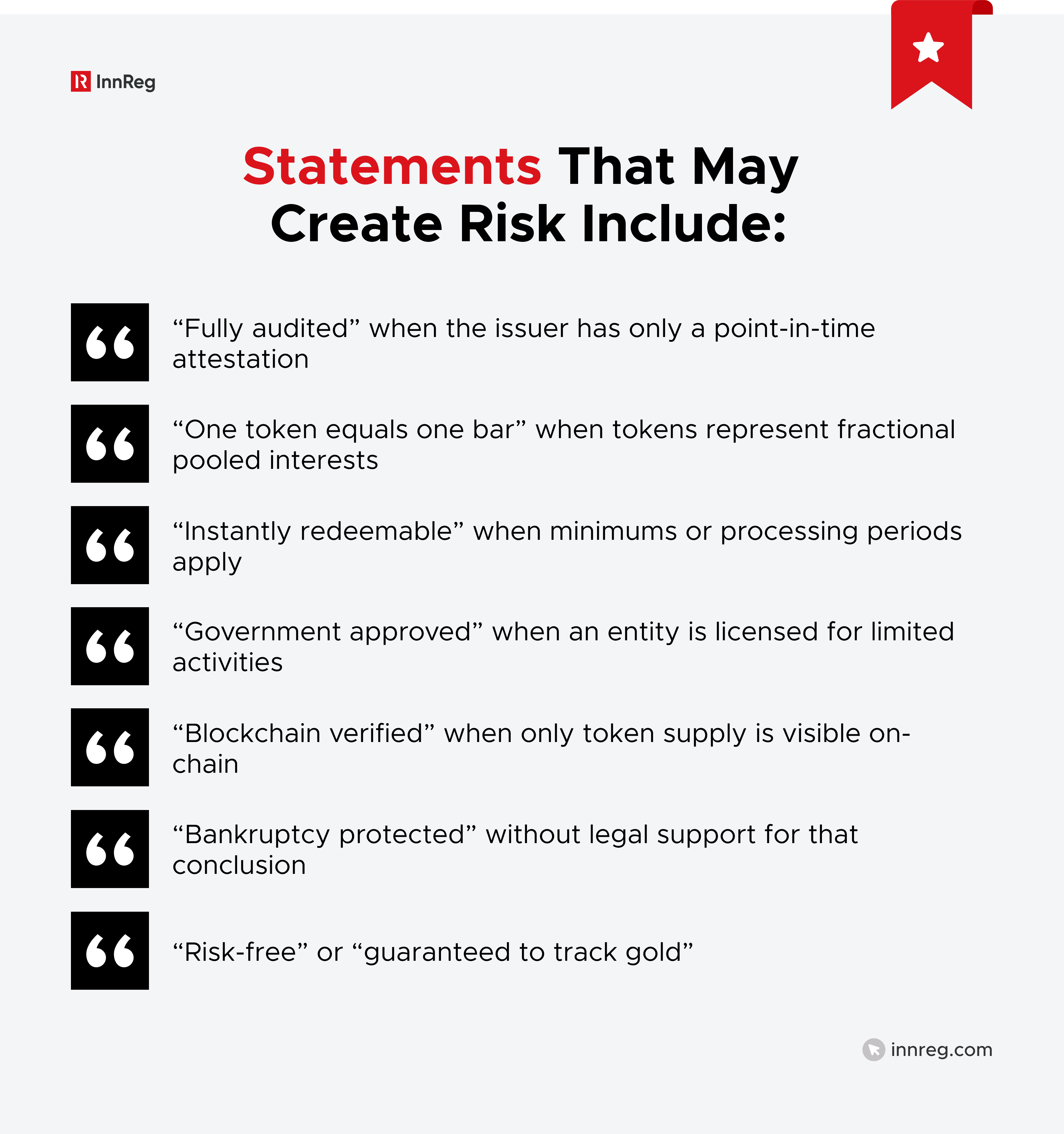
The FTC’s truth-in-advertising framework requires advertising claims to be truthful, not misleading, and supported where appropriate. Other federal and state regulators may also act where reserve, investment, or consumer claims are false or incomplete.
The product terms, operational practices, and marketing materials should tell the same story. A carefully drafted disclosure cannot correct a broader sales message that gives customers a misleading impression of ownership or protection.
Interested in learning about FINRA’s rule on advertising? Read more here →

Regulation Outside the US
Gold-backed tokens offered across borders may be subject to different licensing, disclosure, custody, and marketing rules in each jurisdiction. A structure permitted in one market may require authorization, local registration, or a different product classification elsewhere.
Incorporating the issuing entity in a crypto-friendly jurisdiction does not remove obligations in the markets where the token is promoted or sold.
European Union Treatment Under MiCA
Under the EU Markets in Crypto-Assets Regulation, a token that seeks to maintain a stable value by reference to gold will generally be analyzed as an asset-referenced token, or ART. This applies unless the product qualifies as a financial instrument or falls within another exclusion.
An ART issuer may be subject to requirements covering:
Authorization and establishment in the EU
A regulatory cryptoasset white paper
Governance and fit-and-proper standards
Capital and own-funds requirements
Reserve composition and management
Custody and segregation of reserve assets
Valuation and reconciliation
Redemption rights
Complaints handling
Recovery and redemption planning
Regulatory reporting
Marketing communications
MiCA places substantial emphasis on the reserve supporting the token. Reserve assets must be managed separately from the issuer’s own property, and holders generally receive redemption rights against the issuer.
A platform that lists, exchanges, distributes, or safeguards the token may require separate authorization as a cryptoasset service provider. If the token is classified as a financial instrument instead, the product may fall under EU securities rules rather than MiCA’s ART framework.
The classification should be resolved before launch because it affects both the issuer’s obligations and the permissions required by distribution partners.
United Kingdom Requirements
In the UK, the most immediate consideration for many gold-backed token businesses is the financial promotions regime. Communications inviting or encouraging UK consumers to invest in qualifying cryptoassets must follow an approved regulatory route and meet applicable content requirements.
Promotional materials should clearly explain:
What the token represents
Whether holders own gold or hold a contractual claim
Who holds the reserve assets
How reserves are verified
Who may redeem
Minimum redemption quantities
Fees and processing periods
Geographic restrictions
Issuer, custodian, liquidity, and technology risks
The Financial Conduct Authority has specifically stated that firms making claims that a cryptoasset is backed by a commodity such as gold should hold sufficient evidence to support those claims.
This makes broad language such as “fully backed,” “always redeemable,” or “equivalent to physical gold” particularly sensitive. The promotion should reflect the legal and operational reality of the product, including any limits on ownership, liquidity, or redemption.
The UK is also developing a broader authorization framework for cryptoasset activities. Firms planning to operate there should consider both the rules currently in force and the requirements expected to apply when the new regime takes effect.
Cross-Border Licensing and Distribution
A gold-backed token may involve several jurisdictions at once. The issuer may be incorporated in one country, the gold stored in another, the smart contract deployed from a third, and customers located across multiple markets.
A cross-border review should consider:
Where the issuer and reserve entities are established
Where the gold is purchased and stored
Which law governs title to the bullion
Where customers and beneficial owners are located
Where marketing is directed
Which exchanges, brokers, or custodians distribute the token
Where redemption and physical delivery are available
Whether local AML, sanctions, tax, or consumer rules apply
Whether data may be transferred across borders
Whether local agents or representatives are required
Geofencing alone may not be sufficient where a firm actively markets to customers, uses local partners, or provides support in a restricted jurisdiction.
Tip: Founders should map the complete distribution model before relying on a home-country license. In practice, cross-border token projects often require coordinated advice across digital assets, commodities, securities, payments, custody, and consumer protection rules.
See also:
Compliance Requirements for Gold-Backed Token Issuers
A gold-backed token issuer must manage both the digital asset and the physical reserve supporting it. That requires controls across licensing, custody, reconciliation, customer onboarding, sanctions, disclosures, cybersecurity, and third-party oversight.
Product Classification and Licensing
The first step is determining how the token and each related activity are classified. That analysis should cover issuance, sales, transfers, custody, exchange activity, redemption, and physical delivery.
Questions to ask include whether the issuer accepts or transmits money or virtual currency, whether the token provides ownership of gold or a contractual claim, and where the customers are located. You’ll also want to inquire about product leverage, yield or profit-sharing features, as well as affiliates and vendors performing regulated activities.
The answers may trigger money transmitter, virtual currency, securities, commodities, banking, trust, or cryptoasset licensing requirements.
Licensing should be assessed entity by entity and jurisdiction by jurisdiction. A registration or approval held by one affiliate may not cover the activities performed by another.
Minting, Burning, and Reconciliation Controls
Minting and burning directly affect whether the outstanding token supply matches the reserve. These functions should be subject to restricted access and documented approvals.
Controls may include:
Minting only after confirmed gold settlement
Dual approval for token creation
Separate initiation and approval roles
Limits on minting authority
Multisignature wallets
Hardware security modules
Daily reconciliation
Independent review of blockchain supply
Exception reporting
Investigation deadlines
Escalation thresholds
Periodic access recertification
The reconciliation should compare on-chain supply, internal records, custodian statements, pending redemptions, treasury holdings, and tokens issued across multiple networks.
The issuer should be able to explain every token in circulation and every unit of gold held in reserve. Unresolved differences should be documented, escalated, and corrected under a defined procedure.
Reserve Governance
The issuer should adopt a written reserve policy defining which assets qualify as backing and how they are acquired, valued, held, and monitored.
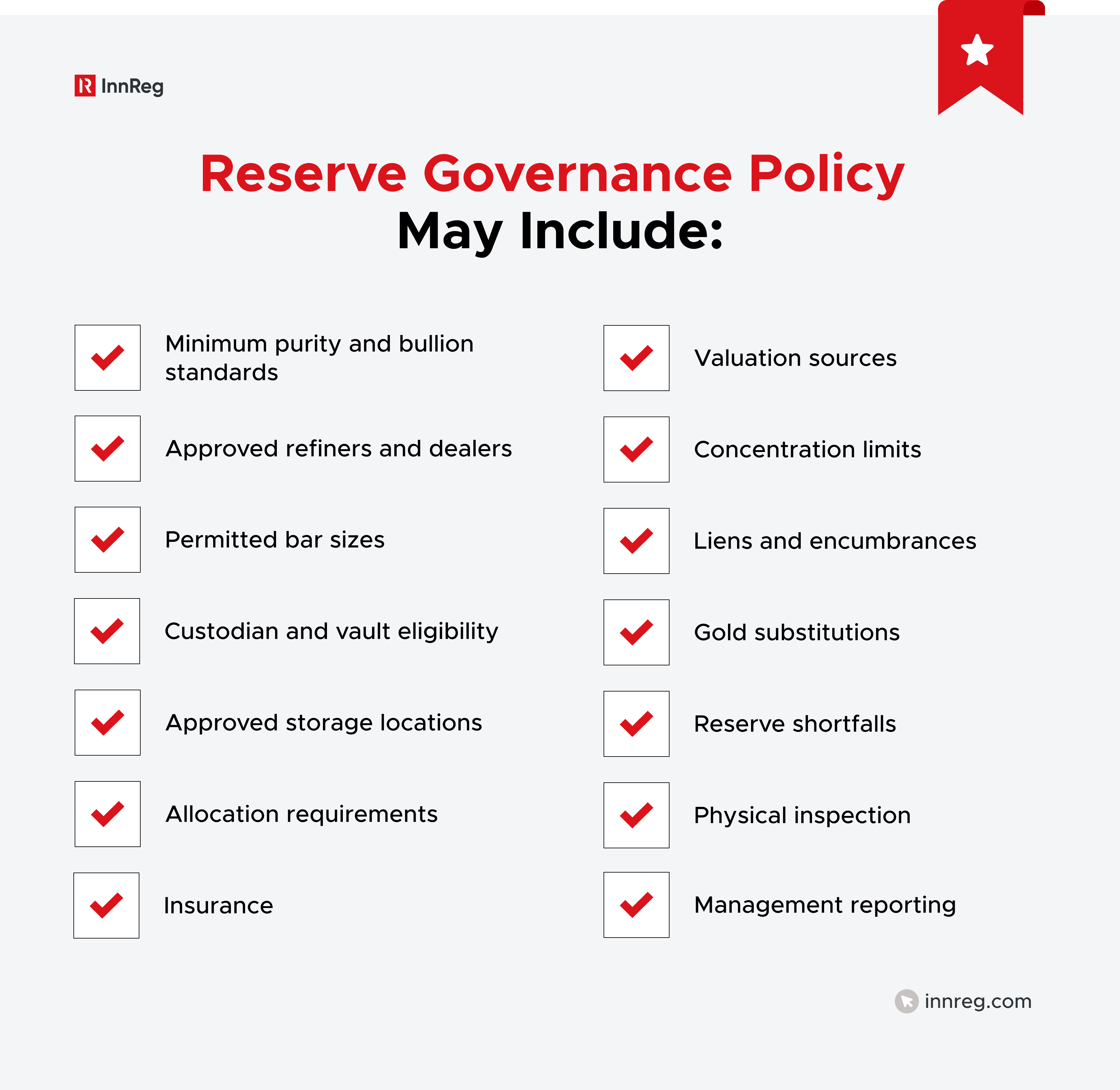
The issuer should also state whether reserve gold may be lent, leased, pledged, or rehypothecated. If those activities are prohibited, the contracts and operational controls should reflect that restriction.
Reserve governance should include escalation procedures for discrepancies, delayed settlement, missing records, disputed ownership, or changes in the custodian’s condition.
Custody and Asset Segregation
Custody arrangements should establish who owns the physical gold and how it is separated from the assets of the issuer, custodian, and other customers.
The underlying agreements should address legal title to the bullion, whether the gold is allocated or pooled, how token-holder interests are recorded, whether assets are held in trust, bailment, custody, or another structure, whether the custodian may use or encumber the gold, and subcustodian arrangements.
Furthermore, these agreements should also address audit and inspection rights, insurance coverage, record access, treatment during insolvency, and return or transfer of assets after termination.
Physical gold custody and digital token custody may involve different entities. The issuer should document how the two systems connect and who is responsible when their records conflict.
A vault receipt alone does not resolve asset segregation or creditor-priority questions. Legal review should support any statement that reserve assets are segregated, protected, or unavailable to general creditors.
Redemption and Liquidity Management
Redemption terms must be clear before a customer acquires the token. The issuer should specify who may redeem, what they receive, and which fees or restrictions apply.
Procedures should cover:
Customer eligibility
Identity verification
Minimum redemption amounts
Cash versus physical settlement
Gold valuation
Processing timelines
Fees and spreads
Fabrication and shipping costs
Geographic restrictions
Banking and vault cutoffs
Sanctions review
Token burning
Complaints and disputes
Redemption suspensions
Thorough liquidity planning considers periods when redemptions increase while banking, bullion, or blockchain services are disrupted. The issuer may also need procedures for selling gold to meet cash redemptions without creating a reserve mismatch. When operational limits apply, marketing cannot describe redemption as immediate or unrestricted.
AML and Customer Due Diligence
Gold-backed tokens may be used across borders, moved through unhosted wallets, traded on secondary markets, and redeemed into a high-value physical commodity. These characteristics can create elevated money laundering and fraud risks.
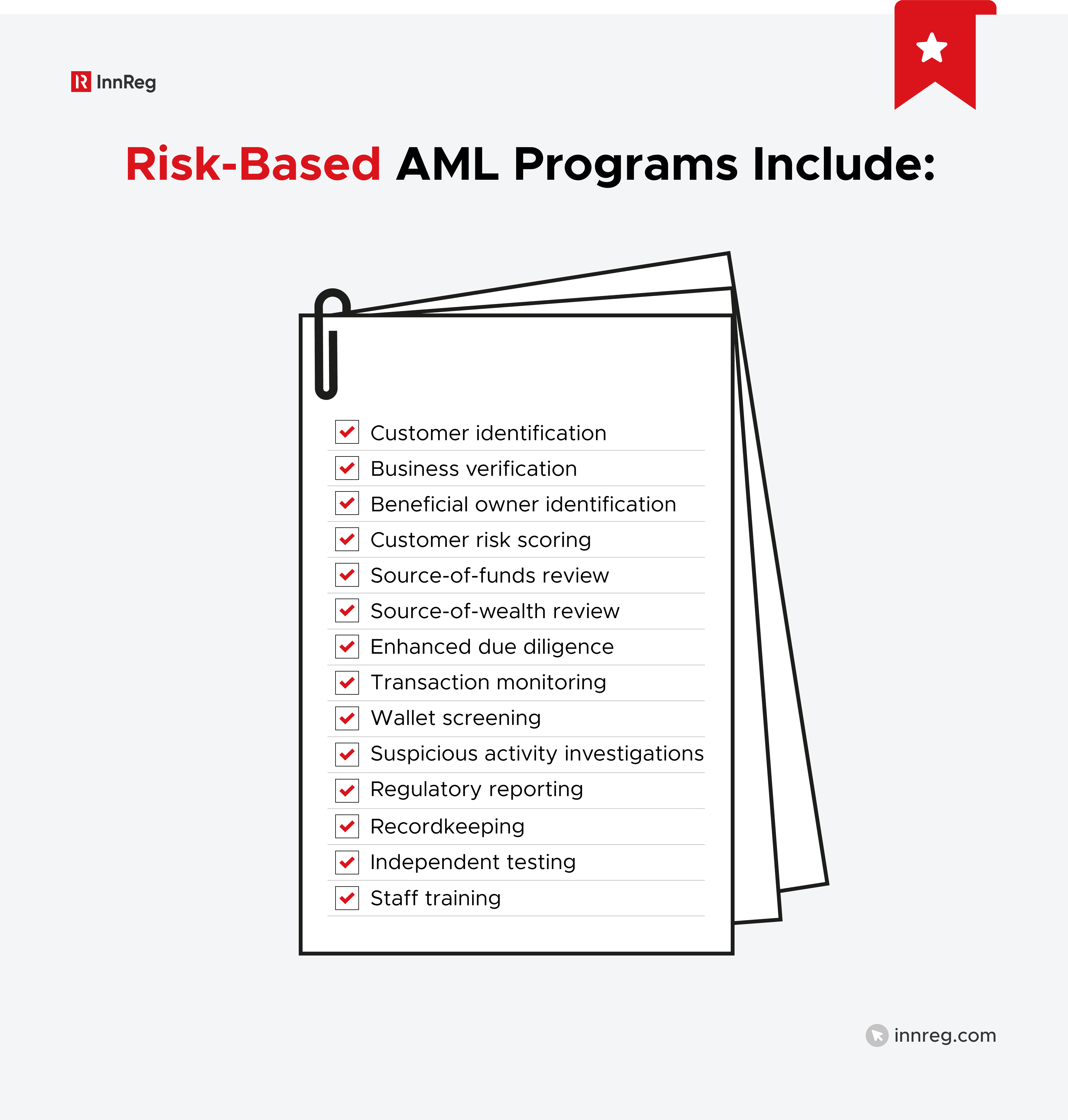
The issuer should define when due diligence is required for purchasers, transferees, redeemers, authorized representatives, and physical delivery recipients.
Secondary transfers create a particular challenge. A person may obtain the token without interacting directly with the issuer, but later seek redemption or another service that requires onboarding.
Don’t know what a Suspicious Activity Report (SAR) is? Learn more from our blog here →
Sanctions and Wallet Screening
Sanctions controls need to cover both customer identity and blockchain activity. Screening only a customer’s name risks missing exposure through wallets, counterparties, or transaction paths. Relevant controls typically include customer and beneficial owner screening, wallet address screening, geographic restrictions, IP address monitoring, transaction tracing, review of mixers, bridges, and high-risk services.
Controls around exposure thresholds, escalation of potential matches, blocking procedures, regulatory reporting, and ongoing rescreening are also part of this screening process.
The issuer is expected to document how administrative controls are used when a token reaches a blocked address. Depending on the smart contract, the firm may be able to freeze, blacklist, or restrict transfers.
Regulators expect a, issuer’s compliance policy and technical capabilities to align. A firm should not represent that it can freeze sanctioned assets if its smart contract does not support that action.
Smart Contract Governance
The smart contract controls token issuance, transfers, burning, and sometimes freezing or upgrades. Issuers should treat governance over those functions as a core operational responsibility.
The framework should address:
Who may mint and burn tokens
Who controls administrative keys
Multisignature approval requirements
Contract upgrades
Emergency pauses
Address freezes
Key storage
Key recovery
Access reviews
Code audits
Vulnerability testing
Change management
Chain migrations
Forks and network disruptions
Incident escalation
Issuers are also expected to disclose administrative powers to customers. A token should not be described as immutable or fully decentralized if the issuer can pause transfers, blacklist wallets, modify the contract, or create additional supply.
Market Integrity Monitoring
Issuers and trading platforms should monitor for activity that may distort the token’s price, volume, or relationship with the underlying gold.
Monitoring should cover wash trading, artificial volume, spoofing and layering, manipulative market-making, and related-party transactions. Issuers should also closely monitor activities such as oracle manipulation, unusual premiums or discounts, and improper minting or redemption activity.
Regulators expect the monitoring model to reflect where the token trades and what data the issuer can access. Where third-party exchanges control the secondary market, the issuer may need information-sharing, escalation, or delisting procedures.
Material deviations from the gold reference price should be reviewed for operational, liquidity, reserve, or market-conduct issues.
Third-Party Risk Management
Gold-backed token issuers often depend on several vendors to operate the product. A failure by one provider can affect reserves, customer access, disclosures, or regulatory compliance.
To define third-party risk around gold-backed tokens, you could start by scrutinizing bullion dealers, refiners, vault operators, custodians, exchanges, banks, blockchain providers, accountants, identity verification providers, insurers, logistics providers, and even smart contract auditors.
Due diligence typically covers licensing, ownership, financial condition, operational capacity, security, sanctions exposure, insurance, subcontracting, incident history, and business continuity.
Contracts are expected to address service levels, audit rights, access to records, incident reporting, data protection, termination, and transition support.
Outsourcing an activity does not remove the issuer’s responsibility for overseeing it. Firms should maintain a current vendor inventory, risk ratings, review schedule, and documented escalation process.
Disclosures and Claims Substantiation
Disclosures must explain the product in language that is accurate, consistent, and understandable. Legal terms, reserve reports, marketing materials, and exchange descriptions should not present conflicting versions of the structure.
Material disclosures may include what each token represents, what the holder owns, and where the gold is stored, lent, or pledged. Information about how reserves are verified, minimum quantities, redemption eligibility, fees and processing periods, insolvency risk, administrative powers and geographic restrictions are also to be included.
The issuer should review claims such as, “fully backed,” “audited,” “redeemable,” or “bankruptcy protected,” against current evidence. The issuer is also expected to maintain records supporting material public statements and establish a process for updating disclosures when the product, reserve, custodian, or legal structure changes.
Incident Response and Wind-Down Planning
The issuer should prepare for events that may interrupt minting, transfers, reserve access, or redemptions. Incident response must cover both digital and physical infrastructure.
Relevant scenarios include:
Smart contract compromise
Administrative key loss
Unauthorized minting
Reserve shortfall
Custodian failure
Missing or disputed bullion
Bank account restriction
Blockchain outage
Data breach
Sanctions event
Major vendor failure
Regulatory order
Sudden redemption pressure
A compliant response plan identifies decision-makers, escalation paths, customer communications, regulatory reporting obligations, containment steps, and recovery procedures.
Regulators expect a separate wind-down plan that explains how issuers will stop minting, reconcile reserves, notify holders, and redeem or resolve outstanding tokens.
A workable exit process is part of the product design. It should be documented before the issuer faces financial, operational, or regulatory pressure.
Frequently Asked Questions
Does a Gold-Backed Token Represent Real Gold?
A gold-backed token can represent real physical gold, but the exact relationship depends on the product’s legal structure. Some tokens give holders ownership or a beneficial interest in vaulted bullion. Others provide only a contractual claim against the issuer.
Before treating a token as direct gold ownership, review:
The token terms
Custody agreements
Reserve reports
Redemption rights
Asset segregation provisions
Insolvency treatment
A statement that a token is “backed by gold” does not, by itself, establish that the holder legally owns the underlying bullion.
Can Gold-Backed Tokens Be Redeemed for Physical Gold?
Some gold-backed tokens can be redeemed for physical gold, but redemption is usually subject to conditions. These tyically include customer verification, minimum token quantities, geographic restrictions, processing periods, and delivery fees.
Physical redemption can also require enough tokens to cover a full institutional gold bar. Smaller deliveries may involve fabrication, insurance, shipping, customs, or third-party dealer costs.
Can a Gold-Backed Token Be a Security?
Yes, a gold-backed token can be treated as a security if its structure or offering meets the applicable legal test. Gold itself is generally a commodity, but the token transaction may still involve an investment contract or another regulated security.
What Is the Difference Between Allocated and Unallocated Gold?
Allocated gold consists of specific bullion held for an identified owner or customer account. Unallocated gold is generally a claim against a bullion provider for a quantity of metal.
Allocated custody records identify individual bars by serial number, weight, purity, and refiner. The owner’s interest is connected to designated physical bullion.
With unallocated gold, the customer usually does not own particular bars. The customer instead relies on the account provider to deliver metal or settle the claim. This creates greater exposure to the provider’s creditworthiness and insolvency.
Why Can a Gold-Backed Token Trade Below the Gold Price?
A gold-backed token can trade below the value of its underlying gold when buyers are unwilling or unable to redeem the price difference efficiently. The discount may result from limited secondary-market liquidity, high redemption minimums, verification delays, geographic restrictions, reserve uncertainty, banking and vault operating hours, or even blockchain disruptions.
What Happens if the Issuer or Custodian Fails?
The outcome depends on who legally owns the gold, how it is held, and whether it is segregated from the failed entity’s assets.
If the bullion is properly segregated and held for token holders, customers may have a stronger claim to its return. If the gold belongs to the issuer or supports only a contractual obligation, holders may need to pursue claims through insolvency proceedings.
—
Gold-backed tokens sit at the intersection of blockchain, commodities, custody, and financial regulation. A strong product structure depends on clear ownership rights, reliable reserve controls, workable redemption terms, and the right licensing and compliance framework.
If you want help with compliance as you move into gold-backed tokens, InnReg can help. InnReg helps fintechs navigate tokenization registration, crypto licensing, AML program development, and outsourced compliance operations.
Our team can support your project from regulatory analysis through launch and ongoing compliance, giving you access to fintech-focused expertise without the cost of building a full in-house department. Reach out today to one of our experts and start the conversation!

Adriana is a Principal Consultant at InnReg with 8 years of compliance experience specializing in VASP licensing and regulatory frameworks across Europe and LATAM. She has held senior compliance roles at leading global crypto and financial institutions, including Gate.io, Binance, Santander Bank, and BNP Paribas, with deep expertise in KYC/AML operations, MiCA adaptation, and building compliance programs from the ground up.
How Can InnReg Help?
InnReg is a global regulatory compliance and operations consulting team serving financial services companies since 2013.
We are especially effective at launching and scaling fintechs with innovative compliance strategies and delivering cost-effective managed services, assisted by proprietary regtech solutions.
If you need help with blockchain compliance, reach out to our regulatory experts today:
Related Articles




Featured LinkedIn Posts