SEC Rule 144A: A Guide to Private Resales of Securities
Key Takeaways
Rule 144A enables private securities resales without SEC registration.
Only Qualified Institutional Buyers can participate in most Rule 144A transactions.
Rule 144A is widely used in institutional capital markets.
The rule supports liquidity for privately issued securities.
Compliance requires QIB verification, disclosures, and transfer controls.
Private securities offerings don't follow the same rules as public markets. As more companies seek alternative ways to raise capital and private markets continue to grow, understanding the rules that govern these transactions is becoming more important.
SEC Rule 144A is a key part of that framework. While it's widely used across the securities industry, many professionals only encounter it when a transaction, client, or compliance review brings it to the forefront.
This guide explains SEC Rule 144A in clear, practical terms, helping you understand where it fits within the broader securities regulatory landscape.
At InnReg, we work with broker-dealers, fintechs, and other regulated firms involved in SEC Rule 144A transactions, private offerings, and institutional securities activities. Our team provides practical compliance support, from licensing and policies to day-to-day compliance management.


What Is SEC Rule 144A?
SEC Rule 144A is a securities rule that allows certain privately issued securities to be bought and sold without going through the same registration process used in public markets.
You can think of it as a framework that helps create liquidity in the private securities market. Instead of limiting securities to the original purchasers, Rule 144A creates a path for those securities to change hands under specific conditions.
While the rule is widely used across the securities industry, it's often misunderstood. Many people assume it governs private offerings themselves, but its primary focus is on what happens after the securities have already been issued.
Why SEC Rule 144A Exists
Before Rule 144A, selling privately placed securities was often a headache. If an investor purchased securities in a private transaction and later decided to sell them, the opportunities to do so were often limited. As a result, investors were typically less willing to participate in private offerings, which made it harder for companies to raise capital.
Rule 144A was introduced to make those transactions easier. By creating a clearer path for certain resales, the SEC helped open the door to more activity among institutional investors.
The rule wasn't designed to make private securities available to the general public. Instead, it created a way for eligible institutional investors to buy and sell those securities more easily while keeping the market limited to experienced participants.
How SEC Rule 144A Changed Private Capital Markets
Rule 144A arrived at a time when companies were looking for more ways to access capital outside traditional public markets.
As the rule gained traction, private offerings became a more attractive option for many issuers. Large organizations could raise significant amounts of capital without immediately pursuing a public offering, while investors gained access to a broader range of opportunities.
Over time, Rule 144A helped support the growth of today's private capital markets. It's now commonly used in transactions involving corporate debt, foreign issuers, structured products, and other securities sold to institutional investors.
Who Typically Uses SEC Rule 144A?
Rule 144A is primarily used by organizations that participate in institutional capital markets. While the exact structure of each transaction varies, the rule commonly appears in transactions involving:
Companies raising capital from large institutional investors
Foreign issuers seeking access to US capital markets
Investment banks and broker-dealers that structure and facilitate securities transactions
Institutional investors purchasing and trading privately offered securities
Private equity firms and investment funds participating in large financing transactions
Rule 144A is especially common in markets where large amounts of capital are being raised, and sophisticated investors are involved.
How SEC Rule 144A Works
Rule 144A creates a framework that allows certain securities to be resold between qualified institutional investors. While no two transactions are exactly alike, most Rule 144A offerings follow a similar process involving issuers, financial intermediaries, and institutional investors.
The Structure of a Rule 144A Transaction
Rule 144A transactions involve a few additional steps compared to a typical public stock purchase, but the basic idea is fairly simple.
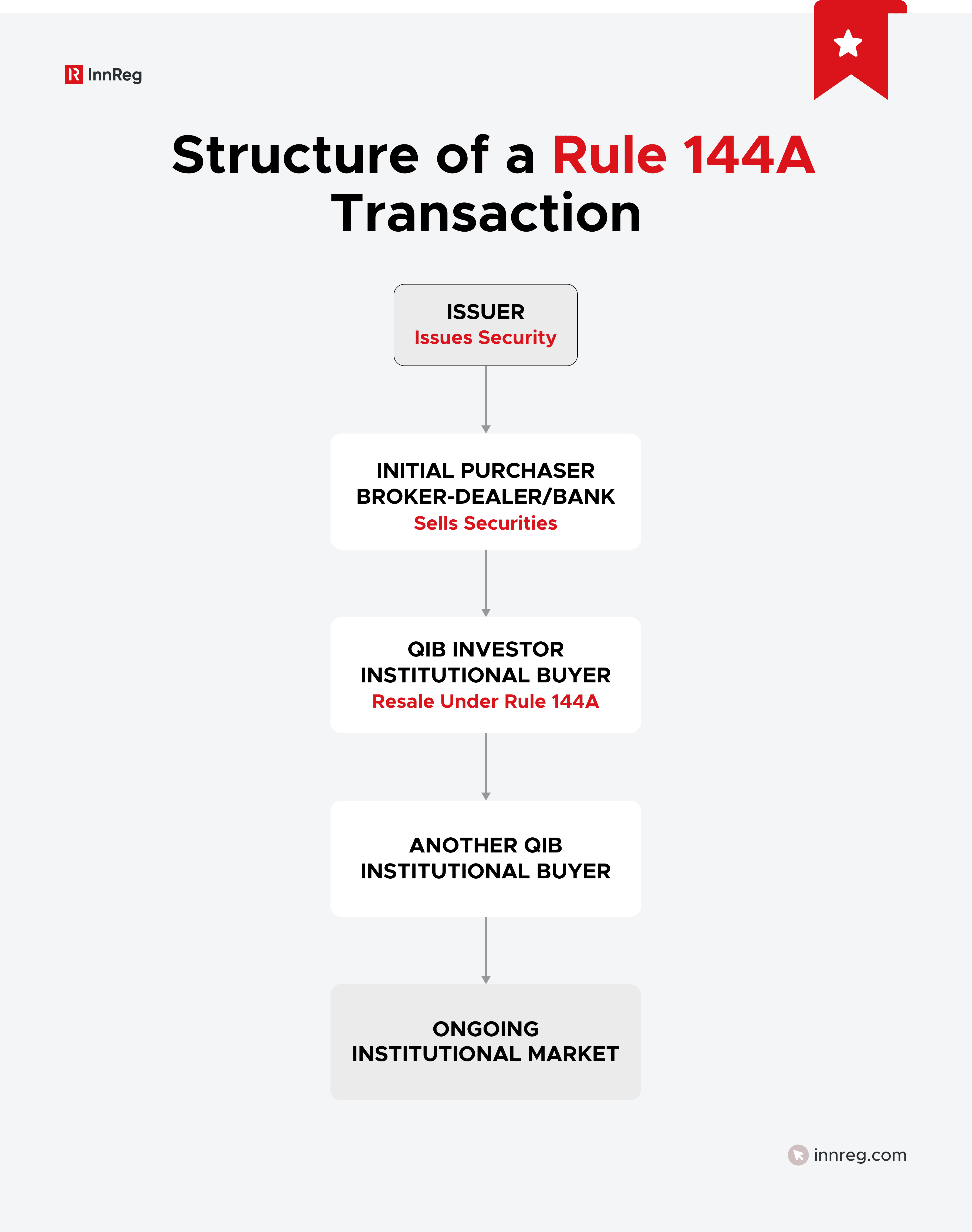
A security is issued, purchased by eligible investors, and later resold to other qualified buyers under a specific set of rules. The purpose is to facilitate these transactions without requiring the same registration process used for public securities.
Although the details can vary, most Rule 144A transactions follow a similar process from issuance to resale.
Primary Offerings vs. Private Resales
One of the most common misconceptions about Rule 144A is that it governs the original sale of securities. In reality, the rule is primarily focused on what happens after securities have already been issued.
A primary offering is the initial sale of securities by the issuer. A private resale happens when those securities are later sold to another eligible buyer.
Here's a simple breakdown of the difference:
Primary Offering | Private Resale |
|---|---|
The issuer sells securities to investors for the first time | An existing holder sells securities to another investor |
Capital typically goes to the issuer | Capital typically goes to the seller |
Represents the initial issuance of the securities | Occurs after the securities have already been issued |
Often structured under a separate exemption or offering framework | May occur under the Rule 144A framework when eligibility requirements are met |
The Role of Initial Purchasers and Broker-Dealers
Rule 144A transactions don't happen in a vacuum. Financial intermediaries are often essential in bringing buyers and sellers together.
In many transactions, initial purchasers acquire securities from the issuer and then offer them to eligible institutional investors. This is where broker-dealers may help:
Structure the transaction
Coordinate communications
Support the distribution process
For issuers, these firms can provide access to established investor networks and capital markets expertise. For investors, they help facilitate transactions and provide information about available opportunities.
How Securities Move Between Institutional Investors
Once securities enter the Rule 144A market, they don't necessarily stay with the original buyer.
An investor may decide to sell its position for many reasons. It may want to rebalance its portfolio, free up capital for other investments, or respond to changing market conditions. When that happens, the securities can be sold to another eligible buyer under the Rule 144A framework.
This ability to buy and sell securities after the initial transaction is one reason Rule 144A has become so widely used. It gives investors more flexibility while keeping transactions within a limited market.
While these transactions take place outside public exchanges, securities can continue changing hands among qualified buyers over time, creating an active market for many Rule 144A securities.
Qualified Institutional Buyers (QIBs) Under SEC Rule 144A
QIB status is one of the most important requirements under Rule 144A. The sections below explain who qualifies, the eligibility requirements involved, and some of the most common misconceptions surrounding QIB status.
What Is a Qualified Institutional Buyer?
A Qualified Institutional Buyer, or QIB, is a category of investor recognized under SEC Rule 144A.
The SEC created this category to identify organizations that have substantial investment experience and resources. Rule 144A limits many transactions to these investors because they're generally considered capable of evaluating the risks and opportunities associated with complex securities transactions.
QIBs are typically large institutions rather than individual investors. Common examples include insurance companies, investment companies (registered under the Investment Company Act), business development companies, and banks.
SEC Thresholds and Eligibility Requirements
QIB status isn't based on an organization's name or industry. Instead, the SEC uses financial thresholds to determine whether an institution qualifies.
For most entities, the primary requirement is owning and investing at least $100 million in securities on a discretionary basis. Certain broker-dealers may qualify under different standards, including additional net worth requirements.
The SEC uses these thresholds to distinguish large institutional investors from smaller market participants. The idea is that organizations with substantial investment portfolios are generally better positioned to evaluate investment opportunities and risks on their own.
Meeting the QIB threshold isn't optional for Rule 144A transactions. Before participating, organizations typically need to confirm that they satisfy the applicable eligibility requirements.
Types of Entities That Qualify as QIBs
A wide range of institutions can qualify as QIBs if they meet the applicable eligibility requirements.
Some of the most common examples include:
Investment companies
Insurance companies
Banks and savings institutions
Plans established and maintained by a state, political subdivisions, or any agency or instrumentality of a state or its political subdivisions for the benefit of its employees
Employee benefit plans (within the meaning of title I of the Employee Retirement Income Security Act of 1974)
Business development companies
Certain trust funds
Certain dealers
Not every organization within these categories automatically qualifies as a QIB. Eligibility depends on meeting the SEC's requirements for the specific type of entity involved.
Common Misunderstandings About QIB Status
QIB status is often misunderstood, particularly by firms that don't regularly work with Rule 144A transactions. Some of the most common misconceptions include:
Any institutional investor is automatically a QIB. In reality, organizations must meet specific SEC eligibility requirements.
Wealthy individuals can qualify as QIBs. Rule 144A is generally focused on institutions rather than individual investors, regardless of personal wealth.
QIB status lasts forever. An organization's eligibility can change over time as its assets, structure, or operations change.
QIB status applies across all securities regulations. A firm may qualify as a QIB under Rule 144A while still needing to satisfy separate requirements under other regulatory frameworks.
Because QIB status plays such an important role in Rule 144A transactions, firms should confirm eligibility rather than rely on assumptions.
Securities Eligible for SEC Rule 144A
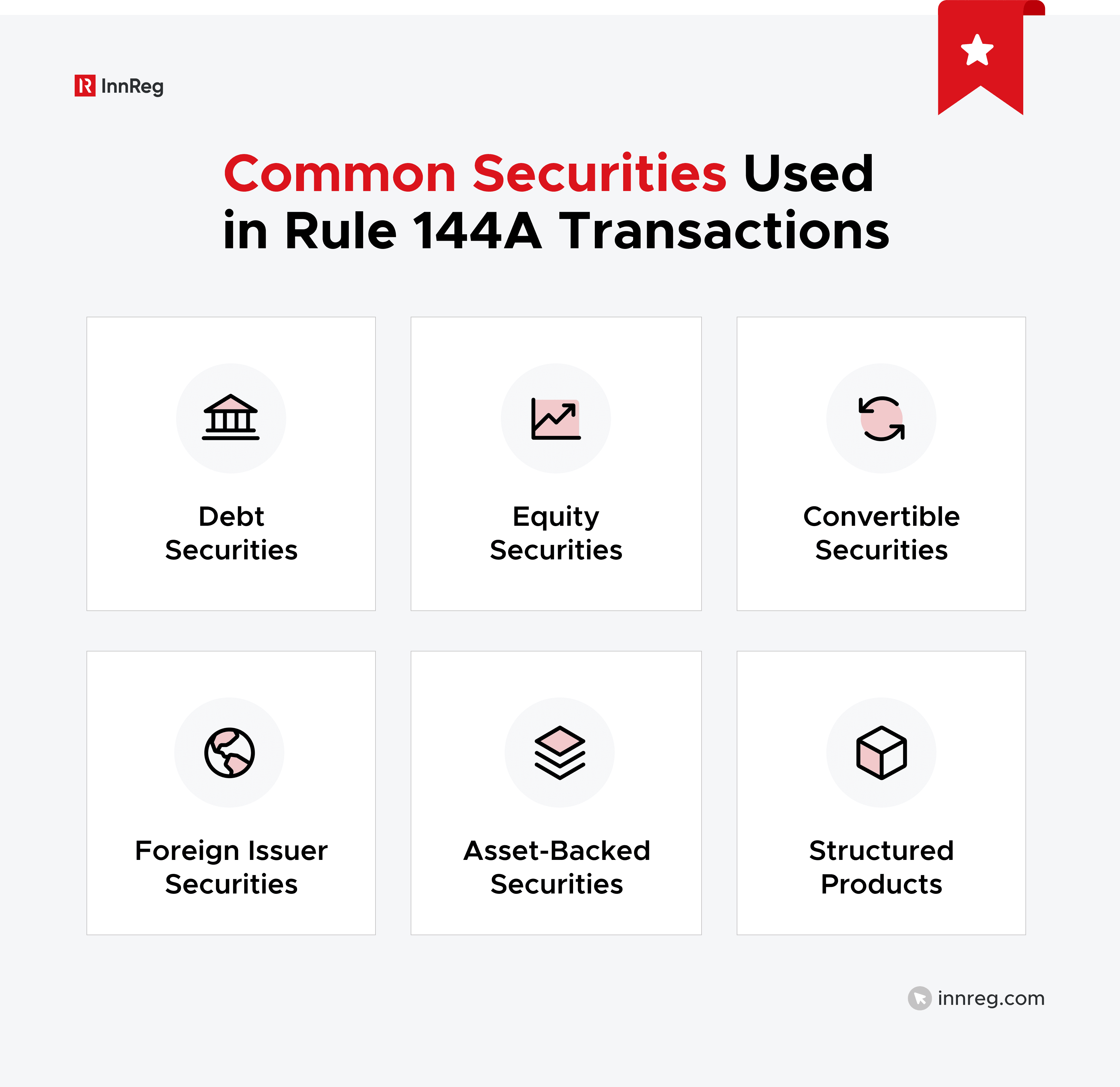
Rule 144A can be used with a wide range of securities, which is one reason it has become such an important part of the institutional market.
Not all securities are treated the same, however. The sections below look at some of the most common types of securities that appear in Rule 144A transactions, along with a few important limitations to keep in mind.
1. Debt Securities
When companies need to raise capital, they may issue bonds or other debt instruments through a private offering. Rule 144A provides a way to reach qualified institutional buyers without going through the registration process required for a public offering.
Because of these advantages, the rule is widely used by both US and foreign issuers. It plays an important role in the corporate bond market and is often used in large financing transactions.
2. Equity Securities
While debt offerings account for a large share of Rule 144A activity, equity transactions also make use of the rule, particularly when companies and investors are looking for alternatives to the public markets.
These transactions are often associated with privately held shares, pre-IPO investments, and other securities that aren't freely traded on public markets. Rule 144A can provide a pathway for eligible institutional investors to buy and sell these securities within a defined market.
3. Convertible Securities
Convertible securities start out as one type of investment but can later be converted into another, most commonly shares of stock. Because they combine features of both debt and equity, convertible securities can appeal to issuers and investors looking for additional flexibility.
Rule 144A is frequently used in institutional offerings involving convertible notes and similar instruments. This allows companies to access institutional capital while offering investors a security that may provide different opportunities over time.
4. Foreign Issuer Securities
Rule 144A is widely used by companies based outside the United States.
For many foreign issuers, the rule provides a way to access US institutional investors without completing a traditional public offering in the US. This makes the US capital markets more accessible while still allowing transactions to take place within the Rule 144A framework.
As a result, Rule 144A has become a common feature of cross-border securities offerings. Many international companies use it as part of their broader capital-raising strategy when seeking investment from US institutions.
5. Asset-Backed and Structured Products
Asset-backed and structured products typically draw their value from pools of financial assets, such as loans, receivables, or other income-producing holdings. Rather than relying on the performance of a single company, their value is often linked to the underlying assets that support them.
Because these transactions are frequently sold to institutional investors, Rule 144A has become a common framework for bringing many asset-backed and structured products to market.
6. Securities That Don’t Qualify
While Rule 144A covers a broad range of securities, it doesn't apply to every investment. Securities that are already listed and actively traded on a national securities exchange generally fall outside its scope, as the framework was designed for private market transactions.
Eligibility also depends on the specific characteristics of the security and how the transaction is structured. As a result, not every privately issued security qualifies. Firms typically assess each offering on a case-by-case basis before relying on the exemption.
SEC Rule 144A vs. Rule 144: Key Differences
Despite their similar names, Rule 144 and Rule 144A serve different purposes. Both deal with securities transactions involving restricted securities, but they apply in different situations and are designed for different types of investors.
Here's a quick comparison:
Rule 144A | Rule 144 |
|---|---|
Primarily applies to private resales of certain securities | Primarily provides a pathway for public resale of restricted or controlled securities |
Transactions are generally limited to Qualified Institutional Buyers (QIBs) | Securities may eventually be sold into the public market if applicable conditions are met |
Commonly used in institutional capital markets | Often used by company insiders, affiliates, and holders of restricted securities |
Focuses on transactions between eligible institutional participants | Focuses on meeting holding periods and other resale requirements |
Not intended for retail investor participation | Can ultimately result in securities becoming available to public investors |
Whether a security qualifies depends on both the security itself and the structure of the transaction. That's why firms typically review each transaction carefully before relying on Rule 144A.

SEC Rule 144A vs. Regulation D
SEC Rule 144A and Regulation D are two of the most commonly used frameworks in securities offerings. Because they often appear in the same discussions, they're sometimes confused with one another. However, they serve different purposes.
How the Two Exemptions Differ
Regulation D focuses on how unregistered securities are offered and sold, while Rule 144A governs how certain privately placed securities can be resold after they're issued. Here's a simple comparison:
SEC Rule 144A | Regulation D |
|---|---|
Primarily focuses on the resale of certain securities | Primarily focuses on the initial sale of securities |
Commonly used in institutional transactions | Commonly used by companies raising capital |
Generally limited to Qualified Institutional Buyers (QIBs) | Often used with accredited investors and other eligible purchasers |
Typically applies after securities have already been issued | Typically applies when securities are first offered |
Supports a market for eligible resales | Provides a framework for private capital raising |
Private Placements vs. Institutional Resales
A private placement and an institutional resale may involve the same securities, but they're not the same transaction.
A private placement is where securities are sold directly by the issuer to investors. This is typically the stage where a company raises capital.
An institutional resale happens later, when those securities are sold from one investor to another. Rather than raising new capital for the issuer, the transaction allows ownership of the securities to change hands.
This distinction helps explain why Regulation D and Rule 144A are often discussed together. One is commonly associated with the initial sale of securities, while the other is commonly associated with certain resales that occur afterward.
When Companies Use Regulation D Instead of Rule 144A
Companies often turn to Regulation D when they're looking to raise capital directly from investors.
For example, a startup seeking funding, a private fund raising capital, or a growing company looking to expand may use Regulation D to sell securities without going through the public offering process. In these situations, the focus is on raising capital, not creating a market for future resales.
Rule 144A typically enters the picture later and in different circumstances. That's why companies evaluating fundraising options often look to Regulation D first, while Rule 144A is more commonly associated with transactions involving institutional investors and secondary market activity.
SEC Rule 144A vs. Regulation S
SEC Rule 144A and Regulation S are frequently used in international securities offerings. In fact, many transactions rely on both frameworks as part of the same overall deal structure.
While Rule 144A focuses on certain transactions involving US institutional investors, Regulation S is designed for securities offerings that take place outside the United States.
The sections below explain how the two frameworks differ and why they're often used together.
Domestic vs. Offshore Transactions
One of the biggest differences between Rule 144A and Regulation S is the market they're designed to serve.
Rule 144A | Regulation S |
|---|---|
Generally used for transactions involving eligible US institutional investors | Generally used for offerings made outside the United States |
Focuses on the US institutional market | Focuses on offshore markets |
Commonly used when issuers want access to US institutional capital | Commonly used when issuers are targeting non-US investors |
Subject to Rule 144A requirements, including QIB eligibility | Subject to Regulation S requirements for offshore transactions |
Therefore, Rule 144A is associated with the US institutional market, while Regulation S is designed for securities offerings that take place outside the United States.
How Rule 144A and Regulation S Work Together
Rule 144A and Regulation S are often part of the same transaction in many international offerings.
A company may offer securities to eligible institutional investors in the US under Rule 144A while simultaneously offering securities to investors outside the US under Regulation S. This approach allows issuers to reach a broader group of investors without conducting a traditional public offering.
For companies seeking capital from both the US and international markets, using the two frameworks together can be an effective way to expand their investor base.
See also:
Information and Disclosure Requirements Under SEC Rule 144A
Access to reliable information is an important part of any securities transaction, and Rule 144A deals are no different.
Investors need enough detail to evaluate an opportunity and understand the risks involved. While disclosure requirements can vary based on the issuer and the transaction, firms should keep in mind several key principles.
Rule 144A(d)(4) Information Requirements
Not every company that relies on Rule 144A is required to file regular reports with the SEC.
To address that, Rule 144A includes information requirements for certain non-reporting issuers. If requested by a prospective buyer, the issuer must make specific information available so the investor can better understand the company and the securities being offered.
The required information generally includes:
Basic details about the issuer
Its business
Its financial condition
The goal is to give investors access to enough information to evaluate the opportunity, even when the company isn't subject to the same reporting requirements as a public company.
Disclosure Expectations for Non-Reporting Issuers
When a company doesn't file regular reports with the SEC, investors often look for additional information before committing capital.
That doesn't necessarily mean public-company-style reporting. However, institutional investors typically expect a clear picture of the company's business, financial condition, management team, and potential risks.
The level of disclosure can vary from one transaction to another, but transparency is often a key consideration. Investors generally want enough information to understand what they're investing in and how the company operates before making a decision.
Due Diligence Expectations From Institutional Investors
Institutional investors typically don't make investment decisions based on marketing materials alone. Before participating in a Rule 144A transaction, they often conduct their own review of the issuer and the offering.
That review may include examining financial information, evaluating business operations, understanding the management team, and assessing potential risks. The goal is to develop an independent view of the investment rather than relying solely on information provided during the offering process.
The depth of due diligence often depends on the transaction itself. Larger or more complex offerings may receive greater scrutiny, particularly when investors are evaluating companies with limited public information available.
Common Disclosure Risks
Even when companies provide information to investors, disclosure issues can still create challenges.
Some of the most common disclosure risks include:
Incomplete information that leaves investors without a clear understanding of the business or offering.
Outdated disclosures that no longer reflect the company's current operations, financial condition, or risks.
Inconsistent information across offering materials, presentations, financial documents, or investor communications.
Overly optimistic statements that aren't supported by the underlying facts.
Failure to disclose material risks that could influence an investor's decision.
Limited documentation supporting key claims or representations made during the offering process.
Strong disclosure practices help investors make informed decisions and can reduce the likelihood of misunderstandings later in the transaction process.

Need help with broker-dealer compliance?
Fill out the form below and our experts will get back to you.
Advantages of SEC Rule 144A
Rule 144A has remained widely used for decades because it offers several advantages for issuers and institutional investors.
Some of the key benefits include:
Access to institutional capital: Companies can reach large institutional investors that actively participate in the securities markets.
An alternative to a public offering: Rule 144A provides another path for companies that may not be ready to pursue a traditional public offering.
Greater flexibility for investors: Eligible investors have a framework for buying and selling certain securities after they have been issued.
Broader fundraising opportunities for foreign issuers: Companies based outside the United States can use Rule 144A to connect with US institutional investors.
Support for a wide range of transaction types: The rule is used across debt offerings, equity transactions, convertible securities, asset-backed products, and other institutional financing structures.
A well-established market framework: Because Rule 144A has been used for many years, many market participants are familiar with how these transactions are typically structured and executed.
While Rule 144A offers important advantages, firms should also consider the compliance obligations and transaction-specific risks that come with relying on the Rule.
Risks and Compliance Challenges Under SEC Rule 144A
While Rule 144A can offer important benefits, it also comes with compliance responsibilities and transaction-specific risks.
Some of the most common challenges include:
Investor eligibility issues: Transactions are generally limited to Qualified Institutional Buyers. Failing to confirm eligibility can create regulatory concerns.
Disclosure shortcomings: Incomplete, inaccurate, or inconsistent information can raise concerns during investor due diligence and increase transaction risk.
Transaction structuring complexities: Some offerings involve multiple regulatory frameworks, which can make planning and execution more challenging.
Transfer restriction concerns: Firms need appropriate controls to help prevent securities from being transferred in ways that fall outside the Rule 144A framework.
Documentation and recordkeeping gaps: Poor documentation can make it difficult to demonstrate compliance if questions arise later.
Evolving business models and products: Innovative financial products may raise regulatory questions that aren't always straightforward, particularly in rapidly changing sectors such as fintech.
Because every transaction is different, firms often benefit from evaluating potential compliance risks early in the process rather than addressing issues after a transaction is underway.

SEC Rule 144A Compliance Considerations for Broker-Dealers and Fintech Firms
For broker-dealers and fintech companies, Rule 144A is about more than understanding the rule itself. It's also about having the right processes in place to support compliant transactions.
Key areas to consider include:
Investor eligibility reviews: Firms should have a process for confirming that investors meet the applicable requirements before participating in Rule 144A transactions.
Disclosure controls: Offering materials, investor communications, and supporting documents should be reviewed for accuracy and consistency.
Recordkeeping practices: Maintaining clear records can help demonstrate how key decisions were made and how compliance requirements were addressed.
Transaction monitoring: Firms should understand how securities are being offered, transferred, and managed throughout the transaction lifecycle.
Cross-functional coordination: Legal, compliance, operations, and business teams often need to work together to address regulatory considerations effectively.
Product and business model reviews: For fintech firms, new products and innovative structures may require additional analysis before they are brought to market.
A practical compliance framework can help firms identify potential issues early and support more effective decision-making throughout the transaction process.
SEC Rule 144A for Foreign Issuers
For foreign issuers, Rule 144A can make it easier to connect with large US investors without going through the process of becoming a public company in the United States. That's one reason it has become a popular option for international companies.
In many cases, Rule 144A is used as part of a broader fundraising strategy that includes investors in different countries. This gives foreign issuers another way to reach potential investors while working within established securities regulations.
SEC Rule 144A and the Modern Private Capital Market
Private capital markets have grown significantly over the past few decades, and Rule 144A has grown alongside them.
Today, companies have more options for raising capital. Many choose to remain private for longer periods, while institutional investors continue looking for opportunities beyond the public markets.
Rule 144A has helped support this evolution by providing a framework for certain institutional securities transactions.
SEC Rule 144A Compliance Checklist
Every Rule 144A transaction is different, but there are a few core areas that firms typically review before moving forward. The checklist below highlights some of the most important considerations.
See also:
1. Pre-Transaction Legal Review
Before moving forward with a Rule 144A transaction, firms typically review the proposed structure to confirm that the rule is being used appropriately.
This review often includes:
Evaluating the transaction structure to determine whether Rule 144A is the right framework.
Identifying any additional regulatory requirements that may apply alongside Rule 144A.
Reviewing offering materials and supporting documents for consistency and accuracy.
Assessing potential legal and compliance risks before the transaction moves forward.
Addressing legal and regulatory questions early can help reduce delays and make the transaction process more efficient.

2. QIB Verification Procedures
Before participating in a Rule 144A transaction, firms typically confirm that investors meet the applicable QIB requirements.
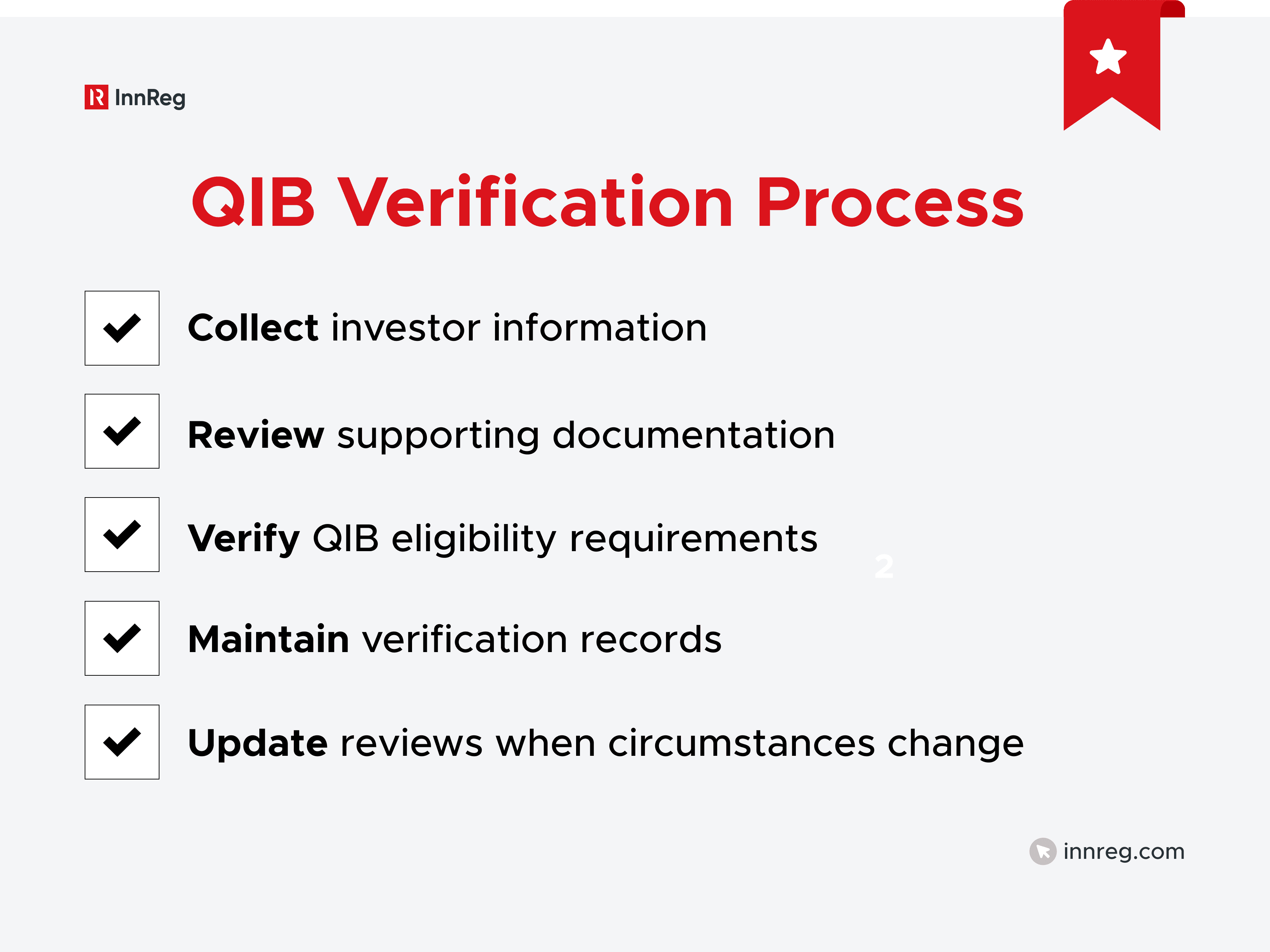
Common verification steps include:
Collecting information about the investor to support eligibility reviews.
Reviewing documentation and certifications provided by investors.
Maintaining records of the verification process for compliance and audit purposes.
Updating reviews when circumstances change or when additional verification is needed.
Having a clear verification process can help firms demonstrate that reasonable steps were taken to confirm investor eligibility.
3. Disclosure and Due Diligence Preparation
Investors will often want a clear understanding of the issuer, the securities being offered, and any material risks associated with the transaction.
Preparation may include:
Gathering key business and financial information that investors may request during the review process.
Reviewing offering materials for accuracy and consistency before they are shared with potential investors.
Identifying material risks and important disclosures that should be communicated clearly.
Organizing supporting documentation that may be needed during investor due diligence.
Good preparation can help facilitate investor reviews and reduce the likelihood of questions or concerns arising later in the transaction process.
4. Transfer Restriction Controls
Rule 144A transactions are subject to specific transfer limitations, so firms typically have procedures in place to help manage how securities are bought and sold.
Common controls may include:
Clearly documenting transfer restrictions in offering materials and transaction documents.
Reviewing proposed transfers before they are completed.
Maintaining records of transfers and related approvals.
Providing guidance to relevant teams and market participants on applicable transfer requirements.
Strong transfer controls can help reduce the risk of securities transfers that fall outside the transaction’s intended framework.
5. Post-Transaction Compliance Monitoring
Compliance responsibilities don't necessarily end once a transaction is completed.
After a Rule 144A transaction, firms may continue monitoring certain activities and maintaining records related to the offering.
Common post-transaction activities include:
Maintaining transaction records and supporting documentation.
Monitoring transfers and other transaction-related activity when appropriate.
Reviewing compliance procedures periodically to confirm they remain effective.
Addressing regulatory inquiries, audits, or examinations if they arise.
Updating internal policies and processes based on lessons learned from previous transactions.
Ongoing monitoring can help firms identify issues early and maintain a well-documented compliance process over time.
—
SEC Rule 144A is a key part of today's securities markets, giving companies access to private capital while creating opportunities for qualified institutional investors to buy and sell certain securities.
Its impact extends beyond a single type of transaction. Whether it's used for bond offerings, foreign issuer deals, or other private market activities, Rule 144A helps support liquidity and capital formation across a wide range of transactions.
Frequently Asked Questions(FAQs) About SEC Rule 144A
Is SEC Rule 144A an Exemption From SEC Registration?
Not exactly. Rule 144A is primarily a safe harbor for certain resales of securities. It doesn't serve as the exemption used for the original issuance of the securities.
Can Retail Investors Buy Rule 144A Securities?
Generally, no. Rule 144A transactions are typically limited to Qualified Institutional Buyers (QIBs), which are large institutional investors that meet specific SEC requirements.
Are Rule 144A Securities Publicly Traded?
No. Rule 144A securities aren't publicly traded in the same way as securities listed on a national securities exchange. They're generally bought and sold to eligible institutional investors outside of public markets.
Can Rule 144A Securities Later Become Registered Securities?
Yes. In some cases, securities originally sold in Rule 144A transactions may later be registered with the SEC and become publicly tradable.
Why Do Foreign Issuers Use Rule 144A?
Many foreign issuers use Rule 144A to access US institutional investors without pursuing a traditional US public offering. This gives them another way to raise capital from the US market.


Tarik is a Principal Compliance Consultant at InnReg with over 5 years of experience advising fintech clients across broker-dealer, RIA, and money transmitter verticals. He holds FINRA Series 3, 7, 24, 57, 63, 79, and 99 licenses, with expertise in regulatory strategy, supervisory systems, and compliance roadmap implementation.
How Can InnReg Help?
InnReg is a global regulatory compliance and operations consulting team serving financial services companies since 2013.
We are especially effective at launching and scaling fintechs with innovative compliance strategies and delivering cost-effective managed services, assisted by proprietary regtech solutions.
If you need help with broker-dealer compliance, reach out to our regulatory experts today:
Related Articles




Featured LinkedIn Posts