SEC Rule Violations: Common Compliance Risks to Mitigate
Key Takeaways
Common SEC violations stem from gaps between written policies and daily operations.
These issues may arise when a firm’s policies, disclosures, controls, and day-to-day practices aren’t aligned.
Fintech firms are innovating quickly, but compliance expectations aren’t slowing down.
As platforms combine brokerage services, digital assets, automated advice, and embedded finance, the rules they need to follow become more complex. What looks like a simple product launch or partnership can trigger multiple SEC requirements behind the scenes.
This guide reviews common SEC rule violations and compliance risk areas, how potential deficiencies may be identified, and factors that may contribute to escalation. It also discusses compliance considerations for fintech firms and practical steps firms can take to strengthen their controls.
At InnReg, we support fintech companies, broker-dealers, and RIAs in assessing and addressing SEC compliance risks. Our team supports firms with registration, compliance program development, supervisory frameworks, and ongoing compliance operations.


What Counts as an SEC Rule Violation
An SEC rule violation may occur when a person or firm fails to comply with an applicable federal securities law, SEC rule, or regulatory requirement. That includes:
Requirements under the Investment Advisers Act
Requirements under the Securities Exchange Act
Rules governing disclosures, supervision, custody, and recordkeeping
Potential compliance issues may be identified during SEC examinations and may, depending on the circumstances, be referred for additional review or investigation.
Stage | What Happens | What It Means for Your Firm |
|---|---|---|
Identification During Examinations | The Division of Examinations reviews filings, marketing materials, trade data, emails, and internal policies. Examiners compare disclosures and written policies against actual operations. | Regulators assess whether your disclosures, policies, and daily practices align. |
Documentation of Findings | Staff document observations in internal workpapers. SEC staff may issue a deficiency letter describing observed deficiencies, weaknesses, or other compliance concerns. | A deficiency letter communicates staff observations and generally gives the firm an opportunity to respond and describe any corrective action. |
Examination vs. Enforcement | Examinations are supervisory and focused on compliance assessment. Enforcement investigations are formal, may involve subpoenas, and are handled by the Division of Enforcement. | Serious findings or unresolved issues may trigger a formal enforcement investigation. |
Escalation to Formal Charges | Factors such as material misstatements, investor harm, unresolved concerns, or an inadequate response to identified deficiencies may contribute to an enforcement referral. | Enforcement proceedings may result in settlements, penalties, or litigation. |
Most issues come down to a simple gap. Your policies say one thing, but your operations show another. That gap might involve incomplete books and records, inaccurate Form ADV disclosures, unsupported marketing claims, or weak supervisory review.
Common SEC Rule Violations and Compliance Risk Areas in 2026
Several recurring SEC compliance risks often come from basic compliance responsibilities. The rules themselves haven’t changed much, but many firms struggle to apply them consistently in their day-to-day operations.
Below are common risk areas, why they happen, and how firms can mitigate the risk.
1. Books and Records Violations Under The Advisers Act and Exchange Act
Applicable SEC rules require firms to create, maintain, and preserve specified books and records for prescribed periods. Missing, incomplete, or inconsistent documentation may raise questions about whether relevant controls operated as intended.
Electronic communications remain an important recordkeeping consideration. Business discussions increasingly take place through text messages, collaboration platforms, and personal devices that may fall outside formal archiving systems.
When required business communications occur through unapproved channels and aren’t preserved, the firm may face books-and-records and supervisory concerns.
2. Investment Adviser Marketing Rule Violations Under Rule 206(4)-1
SEC Rule 206(4)-1, also known as the SEC Marketing Rule, establishes requirements applicable to investment adviser advertisements for:
Performance
Advertising
Testimonials
Endorsements
General promotional content
When firms overstate results or leave out required context, it may result in Marketing Rule concerns.
Performance claims are a common area of scrutiny. Hypothetical performance is subject to specific conditions under the Marketing Rule, including policies and procedures reasonably designed to address its relevance to the advertisement’s intended audience. Firms should also review whether assumptions, limitations, risks, and other required information are presented appropriately.
Learn more about the SEC Marketing Rule →
3. Custody Rule Violations Under Rule 206(4)-2
SEC Rule 206(4)-2 applies to SEC-registered investment advisers that have custody of client funds or securities. Failure to satisfy applicable custody requirements may result in examination findings or enforcement risk.
A threshold issue is determining whether the adviser is deemed to have custody under the rule. Depending on the facts, fee-deduction authority, possession of client funds or securities, or certain forms of account access may result in an adviser being deemed to have custody.
Typical findings include:
Failure to obtain a required surprise examination, where applicable
Insufficient review of custodial arrangements or account statements
Incomplete disclosures about custody arrangements
Insufficient analysis or disclosure of digital asset custody arrangements
Firms offering hybrid or novel products should evaluate custody considerations during product design. Stock plus crypto structures, tokenized assets, and multi-layer platforms raise questions about who actually holds client assets and how protections apply.

4. Regulation Best Interest and Care Obligation Failures
Regulation Best Interest requires broker-dealers to act in a retail customer’s best interest when making a recommendation, without placing their own interests ahead of the customer’s interests.
Firms should be able to demonstrate how their recommendation processes address relevant customer information, costs, alternatives, risks, and conflicts. Many issues come down to a lack of analysis. If costs, alternatives, or conflicts aren’t addressed in writing, regulators may conclude someone didn’t meet the care obligation.
For firms relying on digital tools or scalable models, consistency is the real test. Without clear records and documented oversight behind the recommendation logic, those gaps may be identified during exams.
Learn more about Regulation Best Interest (Reg BI) →
5. Conflicts of Interest and Disclosure Violations
Having a conflict isn’t prohibited, but a firm may need to disclose, mitigate, or eliminate the conflict depending on the applicable legal standard and circumstances.
As revenue models evolve, new conflicts often emerge. Affiliate relationships, referral arrangements, incentive compensation, and proprietary products all require careful disclosure. Disclosures that don’t clearly explain how fees are calculated, or expenses are shared, may raise concerns with the SEC.
For scaling firms, conflict management can’t be static. As products and partnerships change, firms should reassess whether their disclosures and controls continue to address relevant conflicts.
See also:
6. Cybersecurity, Regulation S-P, and Information Security Risks
The SEC expects firms to protect client information and maintain protections that match their actual systems. When written policies don’t reflect how data is really stored, accessed, and monitored, that disconnect raises concerns.
Potential weaknesses may include limited testing, incomplete access reviews, insufficient incident-response planning, or inadequate vendor oversight. For example, a firm may have a cybersecurity policy but limited evidence of testing, access reviews, or vendor oversight.
Insufficient documentation may make it difficult to demonstrate how the firm’s information-security controls are designed and implemented.

Need help with broker-dealer compliance?
Fill out the form below and our experts will get back to you.
7. Form ADV and Regulatory Filing Misstatements
Documents like Form ADV are public-facing and relied upon by both regulators and clients. Inaccurate or outdated filings may raise concerns about whether the firm’s disclosures adequately reflect its current business.
Issues often arise from growth. New services are added. Fee structures change. Affiliates are formed. If filings aren’t updated promptly, the firm’s disclosures no longer reflect reality. Inconsistencies between Form ADV, client documents, marketing materials, and actual practices may be identified during an examination.
8. Failure to Supervise Under the Exchange Act
Firms are expected to maintain supervisory systems that are reasonably designed to detect and prevent misconduct. When potential misconduct or control failures are identified, SEC staff may review how supervisory responsibilities were assigned and carried out.
The focus is often on evidence. If someone didn’t document reviews or red flags weren’t escalated, it may raise questions about whether the supervisory system was reasonably designed and implemented.
Common issues include:
No documented review of high-risk transactions or communications
Insufficient supervisory capacity or unclear allocation of responsibilities
Inconsistent escalation of compliance concerns
Procedures that don’t match actual business workflows
Firms should reassess supervisory responsibilities, review frequency, and available resources as their activities and personnel change.
Learn more about written supervisory procedures for broker-dealers →

SEC Examination and Enforcement Areas Relevant in 2026
The SEC’s 2026 examination priorities highlight several key areas for investment advisers, broker-dealers, and other registered firms. These include compliance programs, Regulation Best Interest, cybersecurity, Regulation S-P, third-party oversight, and new financial technologies.
Recent SEC enforcement actions and risk alerts also provide useful guidance on the compliance issues discussed below.
Recent Off-Channel Communications and Recordkeeping Actions
Firms subject to SEC recordkeeping requirements generally must preserve business communications that constitute required records, including covered communications sent through unapproved devices or platforms. If employees discuss firm business over text or messaging apps, those records should be preserved.
Many enforcement actions focus on documentation gaps. When firms can’t produce complete communication records, regulators often treat that as a books and records failure.
Private Fund Fees, Expenses, Disclosures, and Conflicts
The SEC is paying close attention to how advisers disclose compensation and allocate costs across funds. When disclosures are thin on detail, regulators tend to keep pulling the thread.
Potential concerns may involve unclear disclosures, inconsistent expense allocations, undisclosed conflicts, or practices that differ from governing documents. If investors can't easily follow how fees are calculated or how expenses are being shared, the SEC is likely to treat the disclosure as inadequate.
Digital Asset Classification, Registration, and Custody Considerations
The SEC continues to examine how firms structure trading platforms, custody arrangements, and disclosures when crypto products are involved. Depending on the facts, the legal status of the assets, and the activities performed, federal securities laws and registration requirements may apply.
Many issues come down to classification and control. Firms may believe that a token or platform falls outside securities laws, while the SEC may see it differently. A model involving brokerage, exchange, advisory, or custody functions may raise registration, disclosure, and supervisory questions.
For firms building stock-and-crypto hybrids or tokenized-asset platforms, compliance analysis has to move alongside product design. When regulatory analysis and control development don’t keep pace with product design, the risk of compliance gaps may increase.
See also:
Artificial Intelligence and Algorithmic Advice Oversight
SEC examination staff may review how automated recommendations and AI-related tools are represented, monitored, tested, and supervised. Firms using technology to generate recommendations or support regulated functions should clearly define and document relevant oversight responsibilities.
Many issues center on documentation. Firms may promote AI-driven strategies but lack clear records showing how models were built, validated, or updated. If you can’t explain how the algorithm works and how it’s monitored, regulators may question your supervisory framework.
For firms built around technology, compliance has to keep pace with product and engineering teams. Model development that outpaces documentation, testing, and oversight may create examination and compliance risks.

Individual Liability and Senior Management Accountability
SEC investigations and enforcement actions may examine the conduct of executives, supervisors, and compliance personnel, particularly where individuals made or approved statements, disregarded identified concerns, or failed to carry out assigned responsibilities.
Whether an individual may be liable depends on the facts and the applicable legal standard.
Common areas of focus include:
Failure to address known compliance weaknesses
Signing inaccurate regulatory filings
Limited oversight of high-risk business areas
Weak remediation after prior exam findings
For senior leaders, compliance involvement has to be active and documented. Senior leaders should have clearly defined responsibilities and maintain appropriate records of material oversight, escalation, and remediation decisions.
Explore the SEC’s 2026 exam priorities and what they mean for fintech firms →
Why Fintech Firms May Face Distinct SEC Compliance Risks
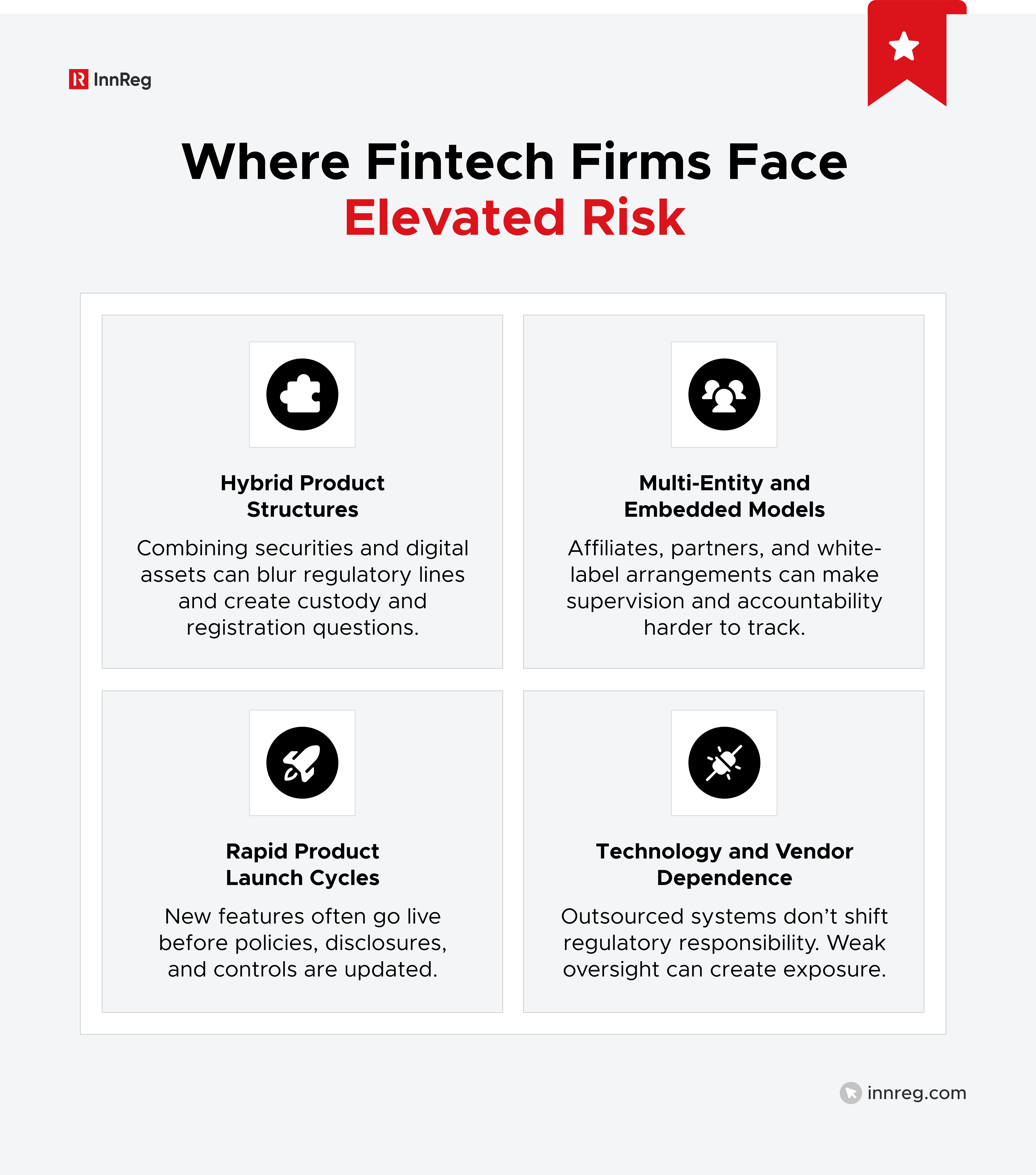
Many fintech platforms combine brokerage services, advisory services, digital assets, and other regulated functions into a single ecosystem. When responsibilities, registrations, and supervision lines aren’t clearly mapped, structural risk increases.
Hybrid Securities and Digital Asset Structures
When firms combine traditional securities with digital assets, the regulatory analysis becomes more complex. What looks like a single product to users may actually involve several regulated activities behind the scenes.
Classification is often the first hurdle. A tokenized instrument or stock plus crypto bundle may trigger securities laws, custody rules, or broker-dealer obligations. If the structure is not evaluated against applicable regulatory requirements, compliance gaps may arise.
For fintech firms building these models, product design and regulatory analysis should move together. When product development moves faster than regulatory analysis and control implementation, the risk of examination findings may increase.
Embedded Finance and Multi-Entity Models
When services are delivered through partners, APIs, or white-label arrangements, regulatory responsibility doesn’t always rest with one party. That makes oversight harder to track.
Many fintech firms operate across multiple affiliates. One entity may hold registrations, another may manage technology, and another may handle customer interactions. If roles and supervision lines aren’t clearly defined, accountability can become unclear.
Common risk areas include:
Confusion over which entity is responsible for compliance
Inconsistent disclosures across affiliated companies
Limited oversight of partners
Gaps in supervision when functions are outsourced
Rapid Growth Without Compliance Infrastructure
Rapid growth can expose compliance gaps. If compliance staffing and controls don’t grow alongside the business, pressure builds.
Informal or highly manual processes may become less effective as transaction volume, personnel, products, or legal entities increase. Informal approvals and manual tracking can create gaps. When supervision and documentation don’t keep pace with operational changes, the risk of errors and control gaps may increase.
Common risk areas include:
Outdated policies that don’t reflect current operations
Too few compliance personnel for the size of the firm
Limited training for new hires
No structured compliance testing
Growth doesn’t itself create a violation, but firms should reassess compliance resources and controls as their operations expand.
Third-Party Vendors and Technology Dependence
Fintech firms rely on vendors for many critical functions. Trading systems, onboarding tools, cloud providers, and data services often support core operations. Even so, the regulatory responsibility remains with the firm.
If a vendor mishandles data or fails to meet regulatory standards, regulators may hold the firm accountable. That’s why oversight can’t stop at contract signing.
Practical Steps for Managing SEC Compliance Risk
SEC findings may arise when a firm’s policies, disclosures, controls, and actual practices aren’t aligned. Documenting how controls are implemented, reviewed, and tested can help the firm demonstrate the operation of its compliance program during an examination.
Below are practical steps firms can take to strengthen their compliance framework and support sustainable growth.
1. Align Regulatory Requirements With Operational Controls
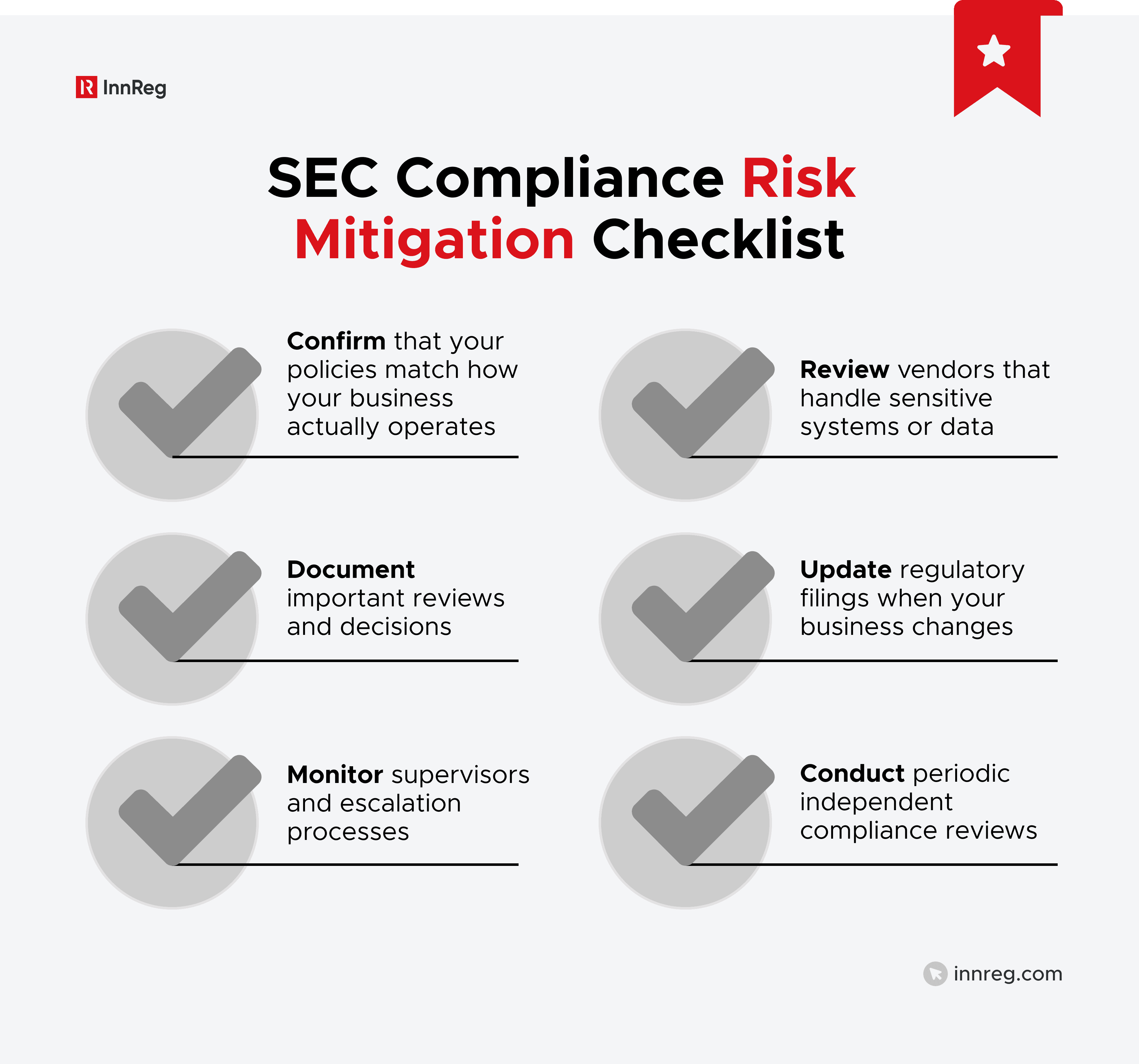
Start by mapping your regulatory obligations to actual business processes. For each material regulatory obligation, firms should identify the relevant workflow, responsible personnel, and related controls.
This exercise often reveals disconnects. A policy may reference a review that no one performs. A disclosure may describe a process that no longer exists. Written policies alone may not demonstrate compliance if they don’t reflect actual operations.
Regulatory mapping can help firms identify responsibilities, control gaps, and disclosure updates earlier in the decision-making process.
2. Strengthen Supervisory Systems and Testing
Supervisory procedures should be implemented consistently and supported by appropriate records. When reviews happen informally or aren’t documented, it becomes difficult to show regulators that oversight is working.
Clear structure makes a difference. Supervisors should know:
What they’re reviewing
How often they’re reviewing it
What happens when issues are identified
If exceptions aren’t tracked and addressed, patterns can develop without anyone noticing.
Structured supervisory reviews can provide clearer evidence of how issues are identified, escalated, and addressed.
3. Improve Documentation and Evidence Trails
Documentation provides evidence that required reviews, approvals, and escalations occurred. Missing or incomplete records may make it difficult for a firm to demonstrate how its policies and controls operated in practice.
Many firms rely on informal discussions or scattered notes. That approach creates gaps. If there’s no clear evidence trail, regulators may treat that as a control failure.
Clear documentation doesn’t have to be complicated. It just has to be consistent and easy to retrieve when questions arise.
4. Enhance Vendor Oversight and Due Diligence
Vendor oversight should be ongoing, not a one-time checklist. Before onboarding a provider, firms should understand:
What the vendor does
How it handles data
Whether it supports regulatory requirements
After onboarding, monitoring shouldn’t stop.
Compliance concerns may arise when firms rely on vendor controls without conducting appropriate due diligence or ongoing monitoring. Firms should maintain records of vendor due diligence, risk assessments, monitoring, and any identified remediation.
5. Conduct Periodic Independent Reviews
Periodic independent reviews may provide an additional assessment of the firm’s policies, controls, and documentation. They also test whether your compliance framework works as intended.
Independent reviews don’t need to be disruptive. When done thoughtfully, they provide clarity and help firms strengthen their compliance posture before questions arise from regulators.
Common Misconceptions About SEC Rule Violations
In the sections below, we’ll address a few frequent misconceptions that often surface during exams and explain why they can lead to problems if left unchallenged.
Disclosure Alone Solves Conflicts
Many firms believe that disclosing a conflict is enough. While disclosure is important, it’s only part of the obligation. Depending on the applicable standard and circumstances, firms may also need to mitigate or eliminate certain conflicts through controls, supervision, or changes to the arrangement.
Vague or overly broad disclosure may be viewed as insufficient. If clients can’t clearly understand the nature of the conflict and how it affects them, regulators may view the disclosure as ineffective.
Common misconceptions include:
Believing that adding language to Form ADV resolves the issue
Assuming clients read and fully understand dense disclosures
Treating all conflicts the same, regardless of severity
Failing to revisit disclosures as compensation models change
Disclosure is a starting point. Ongoing oversight and thoughtful control design are what demonstrate that conflicts are being handled responsibly.
Smaller Firms Aren’t Enforcement Targets
Some firms assume that enforcement actions focus only on large institutions. That belief can create a false sense of security. The SEC regularly brings cases against smaller and mid-sized firms when it identifies non-compliance.
Firm size doesn’t eliminate examination or enforcement risk. If your activities raise investor protection concerns, firm size won’t prevent scrutiny. In some cases, limited infrastructure at smaller firms can increase regulatory attention. Size doesn’t determine risk. Business model, supervisory controls, and documentation do.
Outsourcing Transfers Regulatory Responsibility
Outsourcing a function doesn’t necessarily transfer the firm’s underlying regulatory obligations. Even if a vendor handles key functions, the registered firm remains accountable.
Regulators expect oversight, not delegation. If a vendor fails to meet regulatory standards, SEC staff may review the firm’s due diligence, supervision, and monitoring of the service provider. A contract alone may not demonstrate adequate oversight.
Written Policies Equal Effective Compliance
Some firms assume that having detailed written policies means they’re compliant. Documentation matters, but regulators look beyond what’s written. They focus on how those policies function in daily operations.
If procedures aren’t implemented, tested, or updated, SEC staff may question whether the compliance program is reasonably designed and effective. Policies have to reflect real workflows.
Written policies are the foundation. Effective compliance comes from consistent execution and documented oversight.
—
SEC rule violations and examination deficiencies may arise from inaccurate disclosures, inadequate controls, incomplete records, insufficient supervision, or differences between written policies and actual practices. As fintech platforms grow and introduce new products, maintaining alignment between innovation, supervision, and documentation becomes increasingly important.
Regular reviews of controls, disclosures, supervisory processes, and documentation can help firms identify and address compliance gaps. Integrating compliance considerations into daily operations and material business changes can also provide clearer evidence of how the firm’s regulatory obligations are being managed.


Kushal Abeywickrama is the Chief Operating Officer at InnReg with over 10 years of experience in broker-dealer compliance, supervision, and regulatory operations across FINRA-regulated firms. He holds Series 7, 24, 4, 63, and 57 FINRA licenses and has previously held roles at HSBC and BlackSwan Technologies.
How Can InnReg Help?
InnReg is a global regulatory compliance and operations consulting team serving financial services companies since 2013.
We are especially effective at launching and scaling fintechs with innovative compliance strategies and delivering cost-effective managed services, assisted by proprietary regtech solutions.
If you need help with broker-dealer compliance, reach out to our regulatory experts today:
Related Articles



Featured LinkedIn Posts