What Does an AML Compliance Officer Do?
Key Takeaways
An AMLCO runs the day-to-day AML program across onboarding, monitoring, SARs, and governance
Financial institutions must designate an AMLCO under AML program rules
Core AML compliance officer responsibilities: build controls, oversee CDD, investigate alerts, and manage SAR decisions
Bank partners, digital onboarding, crypto, and rapid releases change AML risk
The AML compliance officer is the person responsible for running a company’s anti-money laundering (AML) program on a day-to-day basis. In regulated financial services, this is a defined role with clear expectations, even if the exact responsibilities differ across firms.
In practice, the job goes well beyond compliance documentation. It includes managing customer due diligence, overseeing transaction monitoring, making decisions around suspicious activity reporting, and keeping the program updated with changes in the business.
This article explains what the AML compliance officer role looks like in real terms. It breaks down the regulatory foundation, day-to-day responsibilities, and how the role operates inside modern fintech companies.
At InnReg, we help fintech companies build and manage AML compliance programs, including outsourced AML compliance officer support. From program design to day-to-day operations, our team works with you as your compliance function.


What Is an AML Compliance Officer?
An anti-money laundering (AML) compliance officer (often referred to as an AMLCO) is the individual designated to oversee a company’s anti-money laundering program and act as the central point of responsibility for how it operates. In US financial services, this role is typically required under AML program rules, which mandate that firms assign someone to coordinate and monitor day-to-day compliance.
The AMLCO is accountable for how the program functions in practice, including whether controls are implemented, whether risks are identified, and whether reporting obligations are met. The role often carries direct visibility with senior management and, in many cases, with regulators during exams or inquiries.
The expectation behind the role is broadly the same, but how it plays out depends on the type of firm. A broker-dealer, a money transmitter, and a fintech platform will all assign an AML compliance officer, though the day-to-day responsibilities are shaped by their specific regulatory frameworks and risk profiles.
Why Financial Institutions Need an AML Compliance Officer
Financial institutions are required to maintain AML programs, but those programs need clear ownership. The AML compliance officer serves as the central point of responsibility for how AML controls operate across the business.
Without that role, key functions like onboarding, monitoring, and reporting can become disconnected. The AML compliance officer brings structure and coordination to these activities.
Role of AML Programs in Financial Services
AML programs are a core part of how financial institutions manage financial crime risk. They are designed to detect, investigate, and report suspicious activity, while also establishing controls around who the firm does business with.
Regulators expect these programs to be risk-based and tailored to the firm’s products, customers, and geographic exposure.

These elements are not standalone. They function as an integrated framework that depends on coordination across systems and teams. This is where the AML compliance officer plays a key role, translating regulatory expectations into processes that actually work in day-to-day operations.
Learn more about AML compliance →
The AML Compliance Officer as the Coordinator of the Program
An AML program involves multiple systems, teams, and workflows. It touches onboarding, transaction monitoring, investigations, and reporting. The AML compliance officer acts as the central coordinator across all of these moving parts.
In practice, this means connecting functions that often sit in different parts of the organization.
This often means working across product and engineering teams that design onboarding flows, operations teams handling alerts and escalations, and legal or compliance teams interpreting regulatory requirements.
Without coordination, these functions can easily move in different directions. The AMLCO brings them together into a consistent approach that reflects the firm’s risk profile and regulatory expectations.
This coordination role becomes more complex in fintech environments. New products, integrations, and partners introduce additional dependencies. The AML compliance officer needs to translate those changes into updated controls, workflows, and documentation that can be maintained over time.
Internal Governance and Reporting Responsibilities
The AML compliance officer is not only responsible for day-to-day operations, but also for how AML risks are communicated within the organization. This includes reporting to senior management and, in many cases, providing visibility to the board or equivalent oversight body.
Regular reporting typically covers:
Key risk indicators and emerging trends
Suspicious activity reporting volumes and patterns
Backlogs, system issues, or control gaps
Updates on regulatory developments or exam findings
This is not just a formality. Clear internal reporting is how firms demonstrate that AML risks are understood and actively managed, rather than treated as a checkbox exercise.
The AML compliance officer also plays a role in escalation. When issues arise, whether it is a control failure, a spike in alerts, or a regulatory concern, they are responsible for bringing that information to the right level of management and helping define next steps.
Regulatory Requirements for an AML Compliance Officer
The AML compliance officer role is driven by regulation. US financial institutions are required to maintain AML programs that include a designated individual responsible for overseeing them, primarily under the Bank Secrecy Act (BSA).
Regulators do not define a single job description, but they do set clear expectations around accountability. The AMLCO is expected to understand the firm’s risks, oversee how controls operate, and serve as a point of contact during exams.
Requirements vary by institution type and regulator, but the core principle is consistent. A broker-dealer, bank, or money transmitter must assign responsibility to someone who oversees how the AML program functions in practice.
Bank Secrecy Act (BSA) Program Requirements
The obligation to appoint an AMLCO stems from the broader requirement to maintain an AML program under the Bank Secrecy Act. Under the BSA, financial institutions must establish a program capable of identifying and reporting suspicious activity.
This program is commonly described through five core components, often referred to as the “five pillars”:
Internal Controls | Independent Testing | Ongoing Training | AMLCO | Customer Due Diligence (CDD) |
|---|---|---|---|---|
Policies, procedures, and systems designed to detect and manage money laundering risks across the business. | Periodic reviews of the AML program, conducted by internal audit or external parties, to assess whether controls are functioning as expected. | Regular AML training for employees to keep them informed of regulatory requirements, red flags, and their responsibilities. | Appointment of an individual responsible for overseeing the AML program and coordinating its day-to-day operation. | Risk-based procedures to identify and verify customers, collect beneficial ownership information for legal entity customers, understand the purpose of each relationship, and keep customer risk profiles current. |
The designation of an AML compliance officer is not optional. It is one of the foundational elements of the AML framework, and regulators expect that individual to have sufficient authority and access to information to carry out the role.
In practice, this means the AML compliance officer must be positioned to understand how controls operate across the business and to escalate issues when needed. The role is tied directly to how regulators assess whether an AML program is functioning as intended.
Sector-Specific Rules
AML requirements apply across financial services, but the details vary by sector. Each type of institution operates under its own set of rules, regulators, and risk expectations, which directly shape how the AML compliance officer performs the role.
Broker-Dealers
Under the BSA, broker-dealers must maintain AML programs, with the SEC and FINRA providing additional oversight. The AML compliance officer oversees a framework consistent with FINRA Rule 3310, which includes customer identification, transaction monitoring, and suspicious activity reporting.
On a day-to-day level, this often involves reviewing trading activity, analyzing account behavior, and interacting with FINRA during examinations. Some firms, especially those in early stages or growing quickly, decide to outsource this responsibility.
InnReg supports fintechs by acting as an outsourced AMLCO, supporting broker-dealers with both program oversight and day-to-day execution. Contact us to learn more →
Money Transmitters and MSBs
Money services businesses, including money transmitters, are regulated primarily by FinCEN. Their AML programs are shaped by risks related to payments, remittances, and cross-border activity, which often involve high transaction volumes and fast processing times.
In this environment, the AML compliance officer typically oversees transaction monitoring, sanctions screening, and reporting obligations such as SARs and CTRs.
Where internal teams are limited, some MSBs bring in external support, with firms like InnReg stepping in to manage the program and its day-to-day operation.

Mutual Funds and Futures Intermediaries
Mutual funds and futures firms fall within the scope of the BSA and are overseen by the SEC and CFTC. Their AML compliance officers generally concentrate on investor onboarding, reviewing fund flows, and spotting unusual transaction behavior.
The activity may be less transaction-heavy than in broker-dealers, but risk still exists through investor actions and the way funds are set up.
Banks and Credit Unions
Banks and credit unions operate within well-developed AML frameworks under the supervision of federal banking regulators. In this setting, the AML compliance officer oversees a program that covers all products, services, and customer segments.
This often includes managing large-scale monitoring systems, handling high volumes of alerts, and maintaining ongoing communication with regulators during examinations.
Key US Regulators Involved in AML Oversight
AML requirements in the US are enforced through a multi-regulator framework. Different agencies oversee different types of institutions, and the AML compliance officer is expected to understand how these authorities apply to their business. There is no single regulator for AML. Oversight depends on the firm’s structure and activities.
In practice, this means firms may interact with more than one regulator, especially in fintech models that combine multiple services or partnerships. The AML compliance officer often serves as the primary point of contact during exams, inquiries, and information requests.
Regulator | Role in AML supervision |
|---|---|
FinCEN | AML rulemaking and BSA administration |
SEC | Oversight of broker-dealers, funds, and advisors |
FINRA | AML program supervision for broker-dealers |
Banking regulators (OCC, FDIC, Federal Reserve) | Bank AML supervision |
IRS | Delegated BSA examiner for MSBs |
NFA | AML examinations for futures intermediaries |
Understanding how these regulators interact is important in practice. For example, a broker-dealer may follow FinCEN rules, but will typically be examined by FINRA. The AML compliance officer is responsible for navigating these layers and aligning the program accordingly.
See also:
Core Responsibilities of an AML Compliance Officer
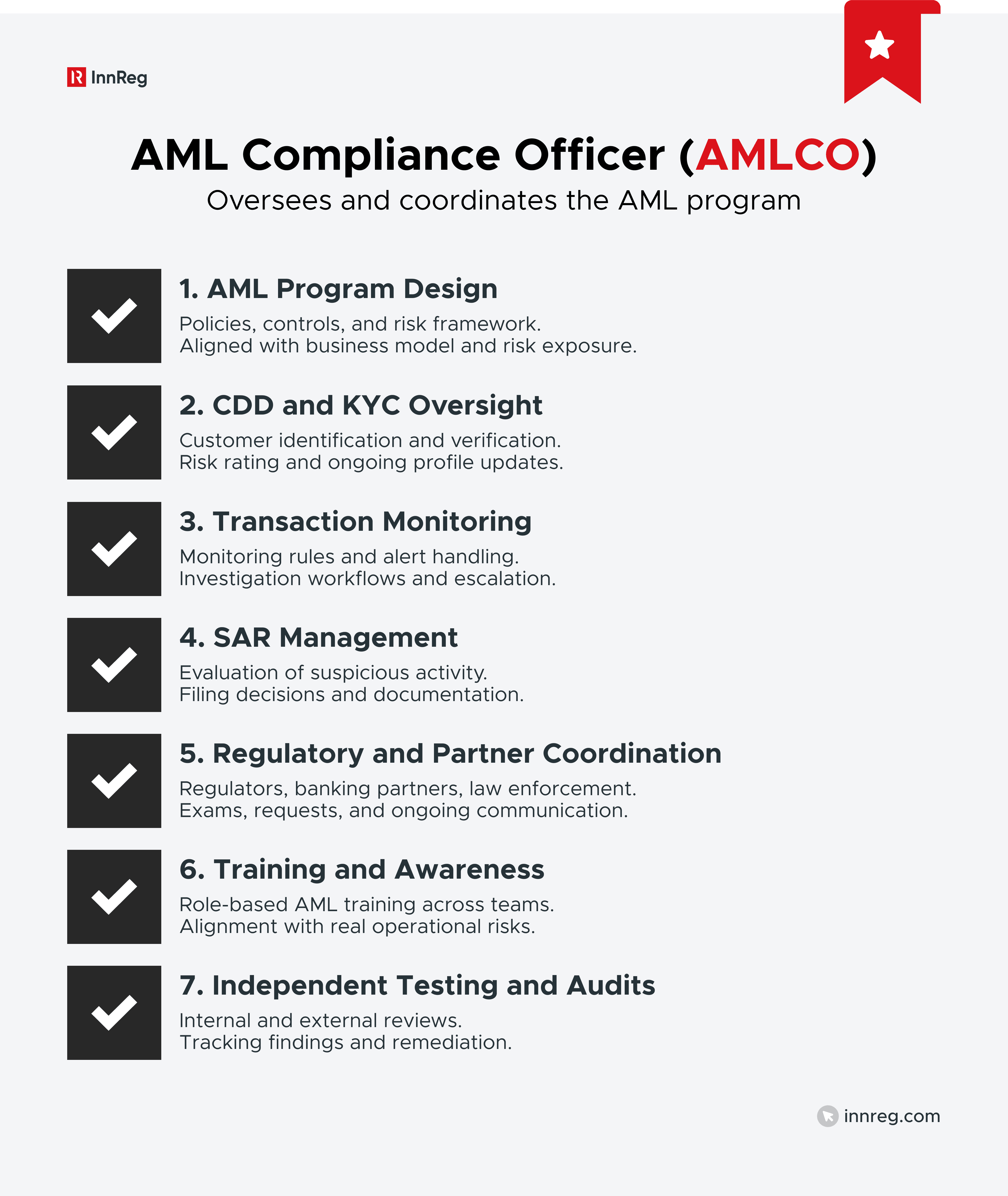
The AML compliance officer is responsible for how the AML program operates on a day-to-day basis. This goes beyond maintaining documentation. The role involves overseeing controls, making judgment calls on risk, and coordinating how different parts of the program function together.

Need help with money transmitter compliance?
Fill out the form below and our experts will get back to you.
1. Designing and Maintaining the AML Compliance Program
One of the primary responsibilities of an AML compliance officer is building and maintaining the firm’s AML framework. This includes developing policies, procedures, and controls that reflect how the business actually operates, not just what regulations require on paper.
The program typically starts with a risk assessment. This defines the firm’s exposure based on its products, customers, and geographies. From there, the AML compliance officer translates that risk into written policies and procedures, control design across onboarding and monitoring, and escalation and reporting workflows.
The program is not static. It needs to be updated as the business evolves, whether that means launching new products, entering new markets, or integrating with third-party providers.
Learn about our KYC and AML compliance consulting services →
2. Overseeing Customer Due Diligence (CDD) and KYC
Customer due diligence is a core part of any AML program. The AML compliance officer is responsible for how customers are identified, verified, and risk-rated at onboarding and over time. This includes defining what information is collected and how it is validated.
In practice, this means setting the standards for:
Customer identification and verification (CIP)
Beneficial ownership collection
Risk-based customer classification
CDD extends beyond the initial onboarding process. The AML compliance officer is responsible for how customer risk ratings are reviewed and adjusted over time, particularly when there are changes in activity or new data comes in.
In fintech environments, this usually involves working closely with product and engineering. Decisions around onboarding design, identity tools, and user experience directly shape how CDD works in practice.
Learn more about Customer Due Diligence (CDD) and KYC compliance →

3. Monitoring Transactions and Investigating Alerts
Transaction monitoring is one of the most operationally intensive parts of an AML program. The AML compliance officer is responsible for how monitoring systems are configured, how alerts are reviewed, and how potential issues are escalated.
This starts with setting monitoring rules and thresholds based on the firm’s risk profile. If thresholds are too low, teams get overwhelmed with false positives. If they are too high, relevant activity may be missed. The AML compliance officer is responsible for balancing that tradeoff.
When alerts are generated, the next step is investigation. The AML compliance officer sets the approach for reviewing, documenting, and escalating those alerts when necessary.
Fintech models often require monitoring systems to be adjusted over time. New features or integrations can change how transactions behave, which means rules and thresholds need to be revisited with input from data and engineering teams.
4. Managing Suspicious Activity Reporting (SAR)
Suspicious activity reporting is one of the most critical responsibilities within an AML program. The AML compliance officer is responsible for how potential suspicious activity is evaluated and whether it meets the threshold for filing a SAR.
The process goes beyond filing reports. It involves setting internal thresholds for escalation, reviewing investigation findings, and clearly documenting why a decision was made. Since not every alert leads to a SAR, judgment is a key part of the role.
Timing and consistency also matter. SARs must be filed within specific regulatory timeframes, and the underlying analysis must be clearly documented, especially in the case of regulatory review. The AML compliance officer oversees how these timelines are tracked and how decisions are recorded.
In practice, this area often requires coordination across teams. Investigations, legal input, and compliance review all feed into the final decision. The AML compliance officer brings structure to that process and acts as the point of accountability.
5. Coordinating with Regulators and Law Enforcement
Interaction with regulators is a regular part of the AML compliance officer’s role. The AML compliance officer serves as the primary point of contact during exams, inquiries, and follow-up requests, representing how the firm’s AML program operates in practice.
This responsibility often extends beyond regulators. Banking partners and other third parties typically expect a designated AMLCO who can speak to the program in detail. Both regulators and partners expect this individual to have relevant experience and direct involvement in the AML program, not just a formal title.
This includes preparing for regulatory exams, responding to information requests, and explaining how controls are designed and implemented. Documentation plays a key role here, as regulators and partners will often focus on how decisions were made and how the program operates in practice. The AML compliance officer is expected to be actively involved in designing, implementing, and overseeing the AML program on a day-to-day basis.
The role may also involve responding to law enforcement requests, such as subpoenas or information sharing under Section 314(a). The AML compliance officer is responsible for coordinating these responses and handling them in line with regulatory requirements.
Fintech models often add complexity to this function. Working with different regulators, banking partners, and jurisdictions requires ongoing coordination, with the AML compliance officer managing how information flows between those groups.
6. Managing AML Training and Awareness
AML training is a required component of any AML program. The AML compliance officer is responsible for how training is structured, delivered, and updated across the organization. This includes defining who needs training, how often it is conducted, and what topics are covered.
Training is not limited to compliance teams. Different functions face different risks, so content often varies by role. For example:
Operations teams may focus on alert handling and escalation
Customer-facing teams may focus on red flags during onboarding
Product and engineering teams may need awareness of how system design impacts AML controls
The goal is to make AML responsibilities clear in day-to-day work, not just in theory. This requires training that reflects how the business actually operates, rather than generic regulatory summaries.
As the company evolves, training needs to be updated. New products, changing risk profiles, and regulatory developments all affect what employees need to understand and how they apply AML controls in practice.
See also:
7. Coordinating Independent Testing and Audits
Independent testing is a required part of an AML program and a key focus during regulatory exams. The AML compliance officer is responsible for coordinating how the program is reviewed, whether through internal audit or external parties.
This includes defining the scope of testing, providing access to documentation, and responding to findings. Reviews typically assess whether controls are operating as described and whether gaps exist in areas like monitoring, reporting, or recordkeeping.
Testing is not just a regulatory requirement. It is one of the main ways firms identify weaknesses in their AML program before regulators do. The AML compliance officer is responsible for tracking remediation efforts and making sure issues are addressed over time.
In practice, many firms use external specialists to perform independent testing, particularly when internal resources are limited or when additional expertise is needed. This is an area where firms like InnReg often support clients, helping conduct AML reviews and translate findings into practical updates to the program.
InnReg helps fintechs by providing independent testing and audit services →

How the AML Compliance Officer Fits Into the Organization
The AML compliance officer operates across multiple parts of the organization. The role requires both visibility with senior management and coordination with operational teams. How it is positioned internally affects how effectively the AML program functions.
Reporting Lines and Governance
The reporting structure of the AML compliance officer is a key part of how the role functions. The AML compliance officer typically reports to senior management and may also have direct or indirect access to the board or an oversight committee. This reflects the expectation that AML risk is monitored at a high level within the organization.
At the same time, governance is not just about reporting lines. The AML compliance officer needs enough authority and independence to escalate issues when they arise, even if those issues involve operational or business decisions.
In practice, this means the role must be positioned so it can both collaborate with teams and raise concerns when needed. The balance between integration and independence is what allows the AML compliance officer to operate effectively.
Collaboration With Other Teams
The AML compliance officer works closely with multiple teams across the organization. The role depends on coordination with legal, risk, operations, and product functions to translate AML requirements into day-to-day processes.
These teams approach AML from different angles. Legal looks at regulatory requirements, risk evaluates exposure, operations manages alerts and escalations, and product and engineering shape system design.
The AML compliance officer ties these efforts together into a coordinated approach.
Key collaboration points typically include:
Legal: Interpreting regulatory requirements and advising on how rules apply to the business model
Risk: Assessing exposure and helping define risk frameworks and thresholds
Fraud and financial crime teams: Sharing intelligence, aligning on alerts, and coordinating investigations
Product and engineering: Designing onboarding flows, integrating controls, and adapting systems as the product evolves
The AML compliance officer connects these functions into a consistent approach, aligning how controls are designed, implemented, and applied in practice.
AML Compliance Officer Responsibilities in Fintech Companies
The role of the AML compliance officer takes on additional complexity in fintech environments. Digital products, third-party integrations, and fast product cycles introduce risks that are not always present in traditional financial institutions.
Area | Key AML Considerations in Fintech |
|---|---|
Digital onboarding | Automated identity verification and onboarding logic must be reviewed beyond policy design |
Bank partnerships | Alignment with partner bank requirements and shared AML responsibilities |
Cross-border and crypto activity | Exposure to multiple jurisdictions, sanctions regimes, and non-standard transaction patterns |
Rapid product changes | Ongoing updates to controls as new features, flows, and integrations are introduced |
Digital Onboarding and Identity Verification Challenges
Fintech companies typically rely on automated onboarding flows. The AML compliance officer must evaluate how identity verification tools, data sources, and onboarding logic work in practice, not just at a policy level.
This includes reviewing false positives, edge cases, and how exceptions are handled. Gaps in onboarding logic can scale quickly if not addressed early.
Embedded Finance and Partner Bank Models
Many fintech companies operate through bank partnerships rather than holding licenses directly. In these setups, the AML compliance officer must align the fintech’s controls with the expectations of the partner bank, which often has its own requirements around oversight, reporting, and governance.
This creates a shared responsibility model. The bank may retain ultimate regulatory accountability, while the fintech handles large parts of the day-to-day operations. The AML compliance officer sits in the middle of this structure, translating expectations into workable processes.
As a result, coordination becomes a central part of the role. The AML compliance officer manages communication, aligns workflows, and helps resolve gaps between how the fintech operates and what the bank expects.
Read about examples of bank-fintech partnerships →
Cross-Border Payments and Crypto Rails
Cross-border activity and crypto integrations introduce additional layers of risk. The AML compliance officer needs to account for jurisdictional differences, sanctions exposure, and varying transaction patterns.
Standard monitoring rules may not apply cleanly in these cases, requiring adjustments to thresholds and scenarios.
Rapid Product Launches and Compliance Oversight
Fintech companies tend to release new features quickly. This creates a moving target for compliance, especially when products evolve faster than internal controls.
The AML compliance officer needs to be involved early in the product lifecycle, not after launch. This includes reviewing how new features affect onboarding, transaction monitoring, and reporting.
Even small product changes can shift risk. A new payment flow, user type, or integration can introduce activity patterns that existing controls do not capture.
Without early involvement, controls can fall behind. Over time, these gaps become more difficult to identify and address.
When Companies Outsource the AML Compliance Officer Function
Not every company builds an in-house AML function from the start. Many fintechs, especially in early or high-growth stages, appoint an outsourced AML compliance officer (AMLCO) to take on the role while the business is still evolving.
This is common when internal resources are limited or when the firm needs experienced oversight quickly. Rather than hiring a full-time senior compliance officer, companies work with external providers who can step into the role and manage the AML program on an ongoing basis.
Outsourcing can also provide access to broader expertise. An outsourced AML compliance officer is often supported by a team, rather than a single individual, which can be useful in areas like program design, regulatory interaction, and independent testing.
At the same time, the structure needs to be clearly defined. The AMLCO, whether internal or outsourced, remains responsible for how the program operates in practice. This includes involvement in day-to-day activities, communication with regulators and partners, and oversight of key controls.
In practice, many firms use a hybrid approach. Internal teams handle certain operational tasks, while the outsourced AML compliance officer provides oversight, structure, and regulatory interface. This model can work well for fintech companies that need flexibility as they scale.
For companies operating in more complex models, such as broker-dealers, money transmitters, or embedded finance platforms, firms like InnReg often act as the outsourced AMLCO. This includes taking ownership of the program, coordinating with regulators and partners, and adapting controls as the business evolves.
Contact us to learn how we can help you by providing outsourced AMLCO services →
—
The AML compliance officer is not just a regulatory requirement, but a central function that determines how effectively a firm manages financial crime risk in practice. From onboarding and monitoring to SAR decisions and regulatory interaction, the role connects multiple moving parts into a coherent program.
As financial services evolve, especially in fintech environments, the expectations placed on the AMLCO continue to expand. New products, faster release cycles, and complex partnerships require ongoing adjustments to controls and processes. In this context, the effectiveness of an AML program depends less on documentation and more on how well it operates day to day.
Whether built internally or supported through outsourcing, the AML compliance officer remains accountable for ensuring that the program reflects the firm’s real risk profile and keeps pace with how the business changes.

João is a Senior Compliance Consultant with over 6 years of experience in AML/CTF, KYC/EDD, and regulatory compliance across crypto, fintech, and traditional finance. He has held roles at KPMG, Kraken, Binance, and BNP Paribas, with expertise in transaction monitoring, SAR filing, high-risk client reviews, PEP/VASP due diligence, and frameworks including FATF, MiCA, and EU AML Directives. He is an active ACAMS member and holds the Chainalysis Reactor Certification (CRC).
How Can InnReg Help?
InnReg is a global regulatory compliance and operations consulting team serving financial services companies since 2013.
We are especially effective at launching and scaling fintechs with innovative compliance strategies and delivering cost-effective managed services, assisted by proprietary regtech solutions.
If you need help with money transmitter compliance, reach out to our regulatory experts today:
Related Articles



Featured LinkedIn Posts