What Does a Principal Financial Officer (PFO) Do?
Key Takeaways
A Principal Financial Officer is responsible for financial reporting, disclosures, and regulatory accountability.
The Principal Financial Officer is named in SEC filings, like 10-K/10-Q, with SOX certification responsibility.
The Principal Financial Officer is accountable for financial reporting and external disclosures, and in many firms, the CFO also serves as the PFO.
Core Principal Financial Officer responsibilities include reporting, controls, certifications, audits, and financial risk oversight.
A Principal Financial Officer (PFO) is a title that shows up frequently in regulatory filings, but it is often misunderstood in practice. Many fintechs see the term without fully understanding what responsibilities come with it or how it fits into their organization.
The role of PFO is tied to financial reporting, internal controls, and accountability to regulators like the Securities and Exchange Commission (SEC) and the Financial Industry Regulatory Authority (FINRA).
Depending on the firm, the Principal Financial Officer may overlap with roles such as Chief Financial Officer (CFO) or Financial and Operations Principal (FINOP), which can make responsibilities harder to distinguish.
This article explains what a PFO actually does, when the role becomes relevant, and how it fits into broker-dealers and fintech companies.
At InnReg, we help fintechs and broker-dealers structure financial reporting and compliance responsibilities. From initial setup to ongoing operations, our team supports firms as regulatory expectations increase.


What Is a Principal Financial Officer (PFO)?
A Principal Financial Officer (PFO) refers to the individual assigned responsibility for a company’s financial reporting and disclosures, particularly in regulatory filings. This title is most often seen in SEC filings, where firms must disclose who is responsible for the financial information they publish.
The role is less about title and more about responsibility. The principal financial officer is the person linked to the accuracy of financial statements, internal controls, and related certifications. This becomes visible in filings like annual and quarterly reports, where named individuals take responsibility for what is reported.
At a high level, a PFO is the executive or officer responsible for overseeing a firm’s financial reporting function. Their responsibilities include preparing financial statements, managing accounting processes, and supporting disclosures required under applicable regulations.
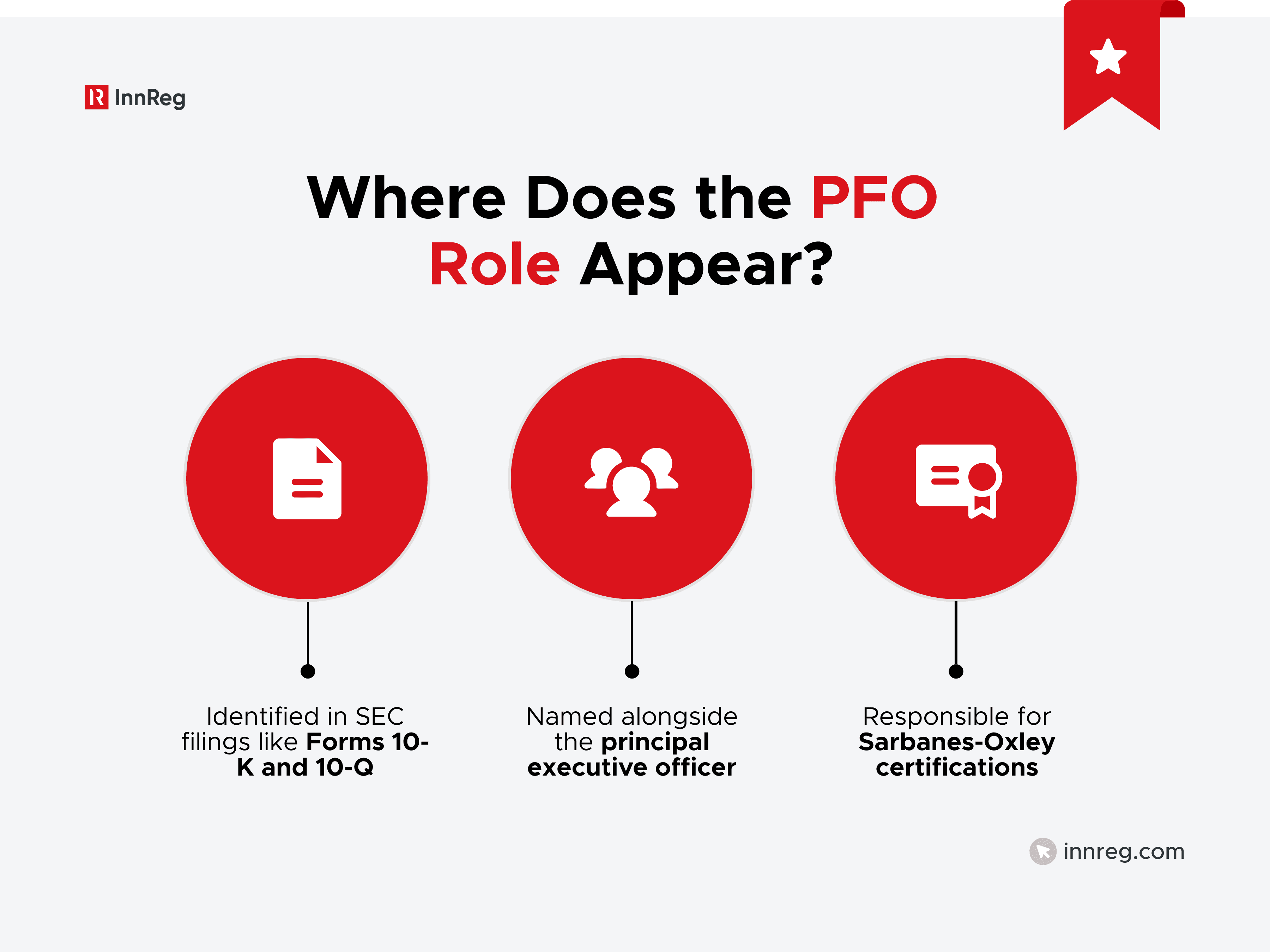
The principal financial officer designation is most visible in SEC filings. Public companies are required to identify their principal executive officer, and PFOin reports such as Forms 10-K and 10-Q. These individuals are also responsible for certifications required under the Sarbanes-Oxley Act.
For broker-dealers and fintechs preparing for public markets or operating under SEC oversight, this becomes relevant earlier than expected. The PFO is often the individual signing off on financial disclosures and certifications tied to regulatory filings, which carry both operational and legal implications.
FINRA-regulated firms may not always use the exact title in the same way, but the underlying responsibility remains. Financial accountability typically sits with roles such as the FINOP or senior finance leadership, depending on the structure of the firm.
How Does a PFO Differ From Other General Finance Leadership Titles?
What separates a principal financial officer from other finance roles is the link to formal filings. Positions like the CFO or the finance director describe how a company is structured internally. The PFO title, on the other hand, is associated with regulatory reporting and disclosures.
The same person can typically carry both titles. Even so, being identified as the principal financial officer means they are tied to the accuracy of reported financial information, especially in filings and audits.
When Is a Principal Financial Officer Required?
The requirement to designate a PFO depends on a firm’s regulatory status and reporting obligations. In most cases, the trigger is tied to reporting requirements, which is why many fintechs encounter it earlier than expected.
Public Companies and SEC Reporting Requirements
Public companies are required to identify their principal executive officer and principal financial officer in SEC filings such as Forms 10-K and 10-Q. These individuals are also responsible for certifications under the Sarbanes-Oxley Act.
From a regulatory standpoint, the principal financial officer is directly tied to financial disclosure accountability in public filings. This includes reviewing, certifying, and standing behind the accuracy of reported financial information.
For firms planning an IPO or entering public markets, this requirement becomes unavoidable. The role must be clearly defined, and responsibilities cannot be loosely assigned.
FINRA Requirements for Broker-Dealers
FINRA-regulated broker-dealers generally assign financial oversight responsibilities to roles such as the FINOP and other senior finance leaders. While some firms may designate a Principal Financial Officer, FINRA rules typically focus on specific supervisory and financial responsibility functions rather than requiring a PFO title.
For fintech broker-dealers, this usually becomes relevant as reporting obligations and regulatory scrutiny increase. As firms grow, expectations around ownership of financial reporting and related controls become more defined.
Situations Where Firms May Need to Designate a Principal Financial Officer
Even outside of fully public companies, there are situations where a principal financial officer designation becomes necessary. These are typically tied to formal reporting or investor expectations.
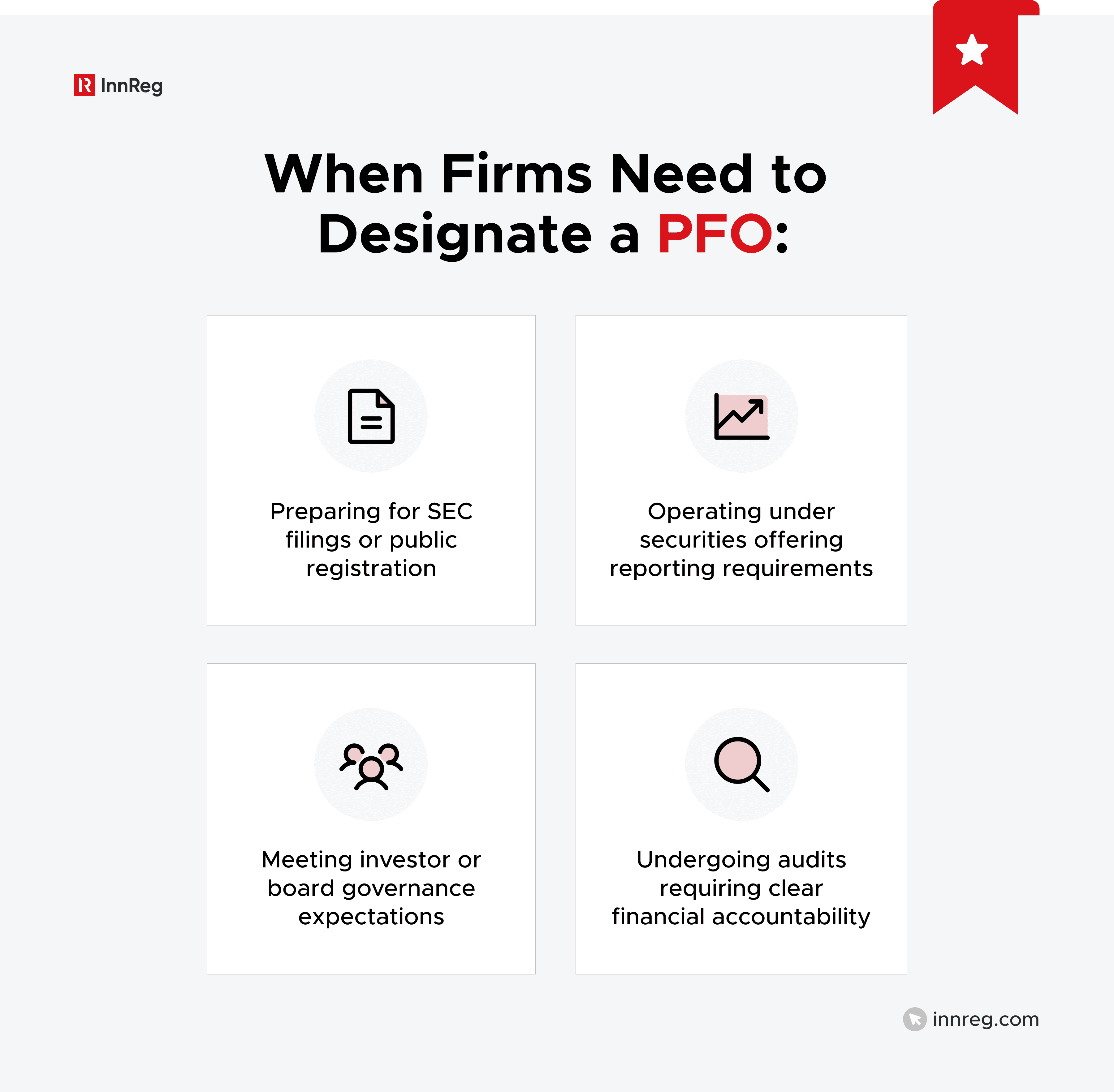
In these cases, the designation is less about title and more about assigning clear responsibility for financial reporting and controls.
Fintech Scenarios Where the Role Becomes Relevant
For fintech companies, the principal financial officer role often surfaces during periods of transition. Early-stage firms may not formally assign it, but that changes as complexity increases.
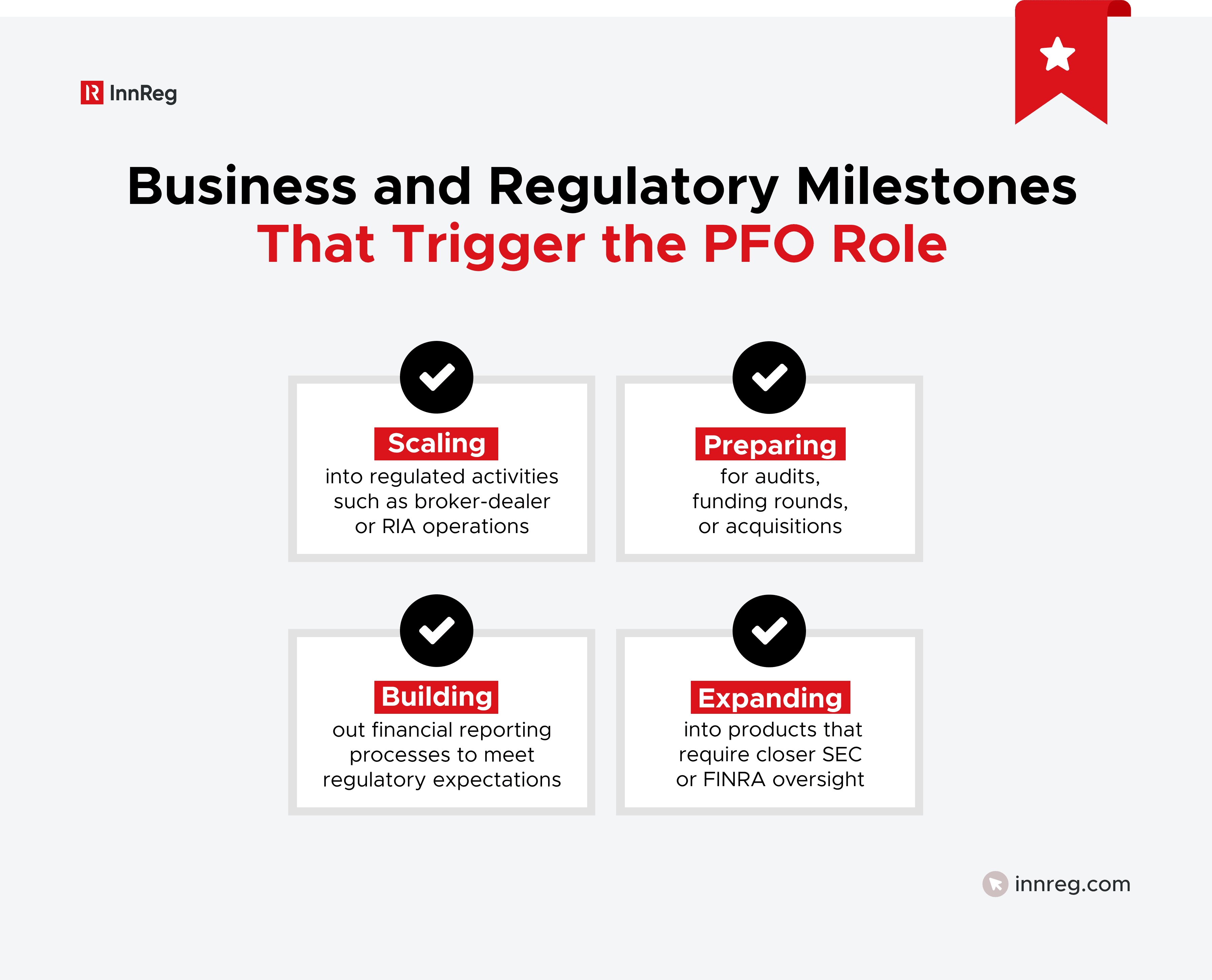
Many fintechs initially rely on informal structures, where finance, compliance, and operations overlap. Over time, that approach creates gaps. Assigning a PFO helps define ownership over financial reporting and reduces ambiguity during audits and regulatory reviews.
For broker-dealers, this often intersects with the FINOP role. While the titles differ, both functions are tied to financial responsibility. Firms that treat these roles as interchangeable without clear boundaries tend to run into issues during exams or filings.
Principal Financial Officer vs. CFO: What’s the Difference?
The difference between a principal financial officer and a CFO is a common source of confusion, especially in fintech and broker-dealer environments. In many firms, the same person holds both roles. Still, the CFO focuses on internal finance leadership, while the PFO is tied to external reporting and regulatory accountability.
Key Distinctions in Title vs. Function
A CFO is responsible for financial strategy, planning, budgeting, and overall financial management. This includes everything from capital allocation to forecasting and internal reporting.
The principal financial officer designation is narrower. It is used in filings to identify who is accountable for the accuracy of financial disclosures and reporting provided to regulators and the public.
This means a firm can have a CFO without formally designating a PFO, but once regulatory filings are involved, the PFO role must be clearly defined.
When the Same Person Holds Both Roles
In many fintechs and smaller broker-dealers, the CFO also acts as the principal financial officer. This is common and often practical, especially when the finance team is lean.
Even in these cases, the distinction still matters. When acting as PFO, the individual is taking on formal responsibility tied to filings and certifications, not just internal finance oversight.
This becomes particularly relevant during audits, SEC filings, or investor reporting, where accountability is explicitly assigned.
Regulatory vs. Operational Responsibilities
The difference between the roles becomes clearer when viewed through a regulatory lens. The CFO oversees the company's finance function, while the PFO designation identifies the executive responsible for financial reporting and disclosures. In many firms, the same person serves in both capacities
Below is a simple comparison:
Area | CFO | PFO |
|---|---|---|
Primary focus | Financial strategy and operations | Financial reporting and disclosures |
Scope | Internal management | External reporting and filings |
Regulatory role | Indirect | Direct accountability in filings |
Certifications | May be involved | Named in SEC certifications |
Typical context | Day-to-day finance leadership | SEC filings, audits, disclosures |
For broker-dealers, there is often an overlap between the PFO and FINOP roles. FINOPs manage net capital and FINRA reporting, while the PFO carries responsibility for broader financial disclosures.
If these roles are not clearly defined, firms may face scrutiny during audits, exams, or filings.
Principal Financial Officer vs. FINOP
The distinction between a principal financial officer and a FINOP can be unclear in broker-dealer environments because both roles involve financial oversight responsibilities.
A FINOP handles the broker-dealer side of financial operational compliance. That usually includes areas such as net capital requirements, reserve formula calculations, books and records obligations, and periodic filings required by FINRA and the SEC.
The PFO role is broader from a reporting perspective. Rather than focusing on operational calculations and compliance functions, the role is generally connected to oversight of financial reporting and disclosures.
In practice, smaller broker-dealers sometimes combine both functions under one person. Even so, the distinction still matters because the responsibilities attached to each role are different.
Area | FINOP | PFO |
|---|---|---|
Primary focus | Financial and operational compliance | Financial reporting and disclosures |
Regulatory framework | FINRA / SEC financial responsibility rules | SEC reporting and disclosure obligations |
Key responsibilities | Net capital, reserve formula, books, and records | Financial statements, disclosures, certifications |
Registration requirement | FINRA-registered role | Disclosure/accountability designation |
Typical environment | Broker-dealers | Public companies and regulated firms |
Core Responsibilities of a Principal Financial Officer
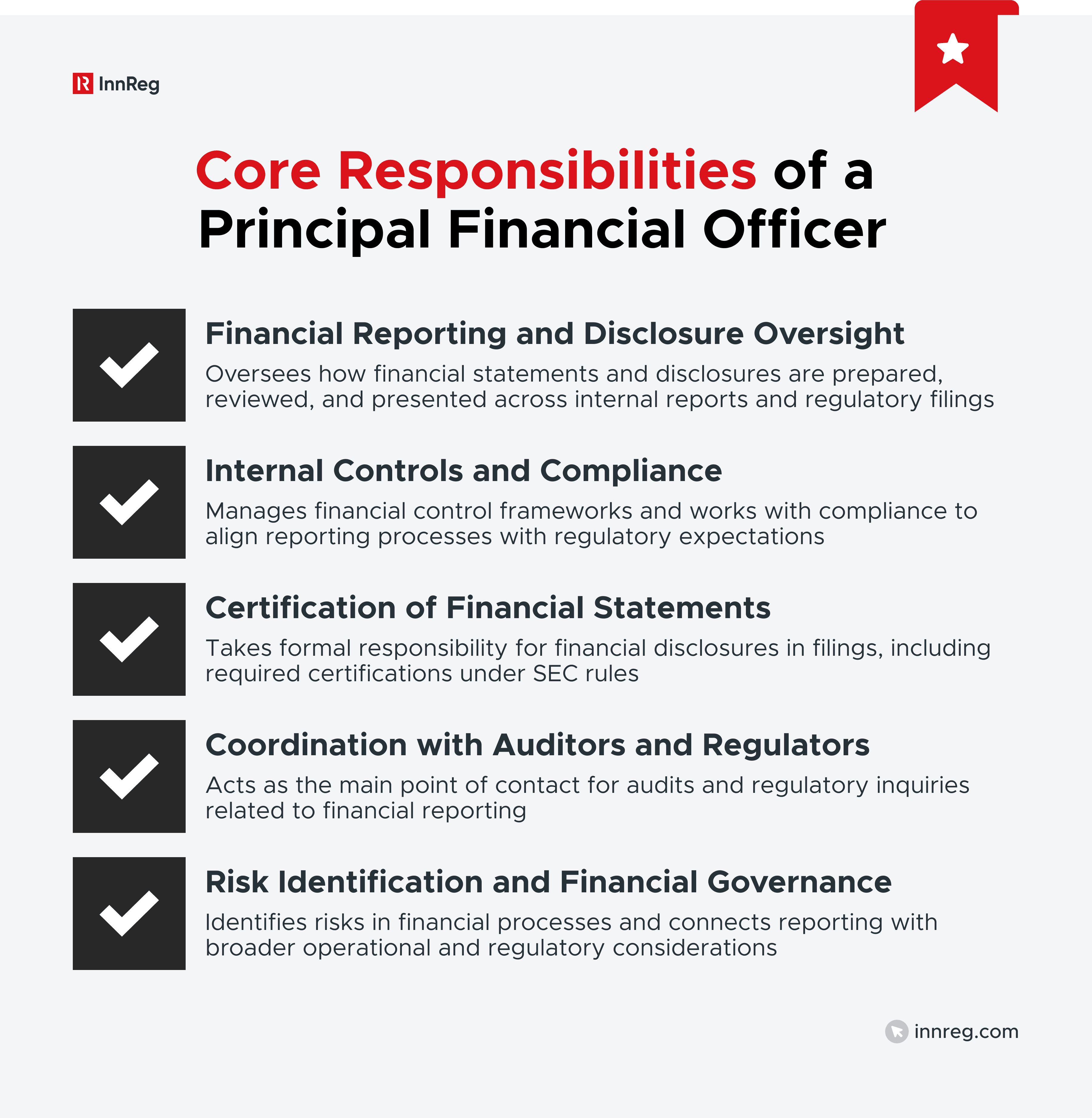
The principal financial officer sits at the center of financial reporting and regulatory accountability. The role goes beyond reviewing results and extends to oversight of financial processes, controls, and the flow of data across the organization, particularly in broker-dealers and other regulated firms.

Financial Reporting and Disclosure Oversight
A principal financial officer is responsible for overseeing how financial statements and disclosures are prepared and presented.
This includes both internal reports and external filings. The role typically involves reviewing financial statements, managing disclosure processes, and coordinating with accounting, compliance, and legal teams.
The focus is on the accuracy and consistency of reported financial information, especially in filings subject to regulatory scrutiny.
Internal Controls and Compliance
The PFO plays a central role in how financial controls are designed and maintained. This goes beyond traditional accounting controls and extends to how financial data is validated, approved, and documented across the organization.
In practice, the role involves overseeing control frameworks, working closely with compliance on regulatory expectations, and reviewing how financial reporting processes operate day-to-day.
For broker-dealers, this often connects directly to FINRA requirements around books and records. Weak or poorly defined controls tend to surface during audits or exams, which is why this area receives consistent attention.
See also:
Certification of Financial Statements
The principal financial officer is typically responsible for certifying financial statements in SEC-regulated environments, including under the Sarbanes-Oxley framework. This responsibility is tied directly to regulatory filings and disclosures.
These certifications connect accountability, not process. The PFO is expected to stand behind the accuracy of financial reporting, which requires visibility into both the numbers and how they are produced. Without that visibility, gaps tend to appear during filings or audits.

Need help with broker-dealer compliance?
Fill out the form below and our experts will get back to you.
Coordination with Auditors and Regulators
A principal financial officer typically leads coordination with auditors, handling everything from audit preparation to follow-up on findings. The role also involves working with regulators when questions arise around financial reporting.
This can include responding to inquiries, providing supporting documentation, and explaining how financial data is generated and reviewed.
Regulators tend to focus on ownership and clarity, which makes the PFO’s role in these interactions especially visible.
Risk Identification and Financial Governance
The principal financial officer is also responsible for identifying risks within financial reporting and control processes. These risks can stem from inconsistent data, weak controls, or dependencies between teams and systems.
This responsibility expands in fintech environments, where products and processes change quickly. The PFO is often the role that links financial reporting with operational and regulatory risk, particularly as new business lines are introduced.

Principal Financial Officer Responsibilities in SEC Filings
The role of a principal financial officer becomes most visible in SEC filings. This is where the designation is formally used and where responsibility is clearly assigned. For firms operating under SEC oversight, the PFO is the individual tied directly to the accuracy and completeness of financial disclosures.
Role in Forms 10-K, 10-Q, 8-K
In public companies and firms subject to SEC reporting, the principal financial officer is identified in filings such as Forms 10-K and 10-Q. These reports include detailed financial statements, disclosures, and supporting information about the company’s operations.
The PFO is typically involved in reviewing these filings before submission and coordinating the financial data that goes into them. This includes working with accounting, legal, and compliance teams to align disclosures with regulatory expectations.
Form 8-K filings can also involve the PFO, particularly when reporting material financial events. The role centers on oversight of financial content in filings that regulators, investors, and auditors review.
Certification Requirements Under SOX
Under the Sarbanes-Oxley Act, the principal financial officer is often required to certify the accuracy of financial statements and disclosures. These certifications are included in periodic filings and are tied to specific sections of the law.
This is a key point of accountability. The PFO is personally attesting to the accuracy and completeness of financial reporting, based on their knowledge of the firm’s processes and controls.
For this reason, the role requires more than a high-level review. The PFO needs visibility into how financial data is produced, validated, and approved across the organization.
Liability and Accountability Considerations
Being designated as a principal financial officer carries real accountability. While the role does not mean sole responsibility for all financial processes, it does mean being the named party in filings tied to financial disclosures.
Regulators focus on the clarity of responsibility. During reviews or enforcement actions, questions often come down to who signed off on the filings and what level of oversight they had.
Assigning the PFO title without aligning authority, access, and control over financial processes can create exposure, especially if issues arise in reporting. This is where firms tend to run into problems, particularly if responsibilities are shared informally without clear ownership.
For fintechs and broker-dealers, this is an area where structure matters. As reporting obligations increase, the expectation is that the PFO has a clear line of sight into financial data and the processes behind it, not just the final output.
See also:
How the Principal Financial Officer Fits Into a Fintech Company
The PFO role varies across fintech companies and tends to develop over time.
In early-stage fintechs, financial responsibilities are usually distributed across founders, finance leads, and sometimes external advisors. Reporting processes are often lightweight, and formal designation of a principal financial officer is not always prioritized.
As the company grows, that approach starts to break down. More stakeholders are involved. Reporting becomes more complex. Regulatory exposure increases. At this stage, the PFO role shifts from informal oversight to clearly defined ownership of financial reporting and controls.
Stage | Early-Stage Fintech | Growth-Stage |
|---|---|---|
Financial ownership | Shared across the team | Clearly assigned to PFO or equivalent |
Reporting processes | Informal, evolving | Structured and documented |
Regulatory exposure | Limited | Increasing SEC / FINRA oversight |
Audit readiness | Reactive | Proactive and ongoing |
Role clarity | Blurred responsibilities | Defined accountability |
Many fintechs move quickly on product and growth, while financial reporting structures lag behind. This creates gaps that are not always visible until external scrutiny increases.
Typical issues include unclear ownership of financial reporting, inconsistent documentation, and reliance on manual processes that do not scale. These gaps tend to surface during audits, investor diligence, or regulatory reviews when firms are expected to demonstrate how they produce and validate financial information.
Another common challenge is the overlap between roles. Finance, compliance, and operations may share responsibilities without clear boundaries. This can lead to confusion during filings or exams, especially when regulators ask who is accountable for specific disclosures.

Skills and Qualifications of an Effective Principal Financial Officer
The PFO role sits at the intersection of finance, compliance, and regulatory reporting.
As a result, an effective PFO combines multiple skills:
Technical accounting and reporting expertise: A PFO needs a strong grasp of financial reporting, including how statements are prepared, reviewed, and disclosed. This includes familiarity with GAAP, financial close processes, and the structure of regulatory filings. The expectation is not just accuracy, but a clear understanding of how financial data flows through the organization.
Regulatory and compliance awareness: The role requires working knowledge of SEC and FINRA expectations, especially in broker-dealer environments. This includes understanding reporting obligations, recordkeeping requirements, and how financial disclosures are evaluated during exams. A PFO should be able to connect financial reporting with regulatory requirements, not treat them as separate functions.
Communication with executives, boards, and regulators: A PFO regularly interacts with internal leadership and external stakeholders. This includes explaining financial results, supporting board discussions, and responding to regulatory or audit inquiries. Clear communication is critical, particularly when financial data needs to be translated into decisions or regulatory responses.
Principal Financial Officer in Fintech: Key Compliance Considerations
The principal financial officer role in fintech sits between financial reporting and compliance. As companies grow, the PFO links financial data to regulatory expectations, particularly in broker-dealers and firms operating under SEC and FINRA oversight.
Intersection with SEC, FINRA, and Other Frameworks
A principal financial officer must understand multiple regulatory frameworks, including SEC reporting and FINRA expectations. Financial reporting is not isolated. It is connected to disclosures, books and records, and supporting processes.
For broker-dealers, this often overlaps with net capital and reserve requirements. Regulators typically assess how these areas work together, which is where firms run into issues if responsibilities are not aligned.
Financial Controls in Tech-Driven Environments
Fintech companies rely heavily on technology to manage financial data. This creates efficiency, but it also introduces new risks. Financial data may flow across multiple systems, vendors, and internal tools.
For the PFO, this means understanding not just the outputs, but how data is generated and processed. Control gaps often appear at the system level, where data is transferred, transformed, or aggregated.
In broker-dealers, this becomes more sensitive due to regulatory expectations around accuracy and recordkeeping. Systems must support consistent reporting, and changes in product or infrastructure can affect how financial data is captured.
Documentation, Audit Trails, and Governance Expectations
Regulators expect firms to demonstrate how financial information is produced and validated. This goes beyond having policies in place. It requires documentation that reflects actual processes and decisions.
The PFO is typically involved in making sure that reporting workflows are documented, audit trails are maintained, and governance structures are clear. When documentation does not match how processes actually work, issues tend to surface during audits or regulatory reviews.
For fintechs, this can be a challenge. Rapid product changes, evolving systems, and cross-functional teams make it harder to maintain consistent documentation. As a result, governance needs to be actively managed, not treated as a one-time setup.
When to Appoint a Principal Financial Officer
Deciding when to formally designate a principal financial officer r is not always straightforward. Many fintechs delay the decision because they are already handling those responsibilities internally. Over time, that approach becomes harder to maintain.
Triggers: Fundraising, Audits, Scaling, Regulatory Exposure
Certain milestones tend to bring the PFO role into focus. Fundraising is one of them. Investors often expect clear ownership of financial reporting, especially as diligence becomes more detailed.
Audits create a similar pressure. Once external auditors are involved, firms are expected to show who is responsible for financial reporting and how controls are structured. Scaling also plays a role, as growing transaction volume and product complexity increase the need for structured reporting.
Regulatory exposure is another key trigger. Entering broker-dealer activities, expanding into new products, or operating under SEC oversight all require a more formal approach to financial accountability.
Risks of Delaying the Role
Putting off the formal designation of a principal financial officer can lead to gaps that are not obvious at first. Reporting may still run, but ownership over financial disclosures is often unclear, which becomes a problem when firms need to explain how information is prepared and reviewed.
Over time, issues like inconsistent processes, informal review practices, and limited documentation start to surface. These tend to come up during audits, investor diligence, or regulatory exams, where firms are expected to show clear structure and accountability.
Another common issue is role overlap. When finance, compliance, and operations are not clearly separated, it can lead to conflicting responses during filings or regulatory reviews.
Timing Guidance for Fintech Founders
For most fintechs, it makes sense to define the PFO role before it becomes mandatory. Waiting until a filing, audit, or regulatory review forces the decision often results in reactive adjustments.
A more practical approach is to assign responsibility as soon as the firm starts preparing for external reporting, regulated activities, or institutional funding. Clear ownership of financial reporting should be in place early, not after gaps are identified.
In broker-dealers, this timing often aligns with other regulatory roles such as the FINOP. Even if the title differs, the underlying expectation remains the same. Someone must be clearly responsible for financial reporting and disclosures, with visibility into both the data and the processes behind it.
—
The principal financial officer plays a central role in how financial reporting is managed and presented. While the title often appears in filings, its importance shows up in day-to-day operations, especially as firms scale and take on regulatory obligations.
In practice, the PFO is the point where financial data, controls, and compliance come together. Firms that define this role clearly tend to navigate audits and reporting requirements with fewer issues than those relying on informal structures.

Matthew Jenkins is a Senior Compliance Consultant at InnReg with extensive experience in compliance program design, regulatory risk, and fintech operations, having previously served as Chief Compliance Officer and Principal Financial Officer at SoFi and Deputy Chief Compliance Officer at Revolut. He specializes in broker-dealer compliance and cross-functional regulatory operations across FINRA-regulated environments.
How Can InnReg Help?
InnReg is a global regulatory compliance and operations consulting team serving financial services companies since 2013.
We are especially effective at launching and scaling fintechs with innovative compliance strategies and delivering cost-effective managed services, assisted by proprietary regtech solutions.
If you need help with broker-dealer compliance, reach out to our regulatory experts today:
Related Articles




Featured LinkedIn Posts