What Does a General Securities Representative Do?
Key Takeaways
General Securities Representatives handle broad securities sales and brokerage activities.
Series 7 registration enables trading across multiple investment product categories.
FINRA and SEC rules heavily govern customer communications and recommendations.
Fintech platforms increasingly require registered representatives for investing-related features.
Strong supervision and compliance controls are essential for broker-dealer operations.
A General Securities Representative is one of the most common registered roles in the securities industry. These professionals are involved in customer-facing brokerage activity, from discussing investment products to processing securities transactions through a FINRA-member firm.
As more fintech companies expand into investing and brokerage services, understanding the Series 7 role has become increasingly important.
This article explains what General Securities Representatives do, when registration may be required, and the key compliance responsibilities tied to the role.
At InnReg, we support firms hiring and supervising General Securities Representatives operating under the Series 7 license. Our team helps broker-dealers and fintech platforms address registration, supervision, recordkeeping, and customer communication requirements.


What Is a General Securities Representative?
A General Securities Representative is a registered professional who can sell and support a broad range of securities products through a broker-dealer. This role is most commonly tied to the Series 7 license, one of the primary FINRA registrations used across the securities industry.
Most of the time, these representatives are usually the main point of contact for customers. Depending on the firm, the role may also support retail investing, institutional services, or modern fintech products with embedded investing features.
Because this role sits so close to customer interactions, it also comes with significant regulatory responsibilities. FINRA and SEC rules shape how representatives communicate, handle transactions, maintain records, and operate within a firm’s supervisory structure.
What Can a General Securities Representative Do?
A General Securities Representative can participate in many of the activities involved in selling and supporting securities products through a broker-dealer.
Their responsibilities usually include:
Working with clients
Discussing investment products
Processing transactions
Supporting brokerage account activity
The role is common across traditional broker-dealers, wealth management firms, and fintech companies offering investment products.
Core Permitted Activities
The work of General Securities Representatives often centers around customer accounts, investment transactions, and discussions about securities products.
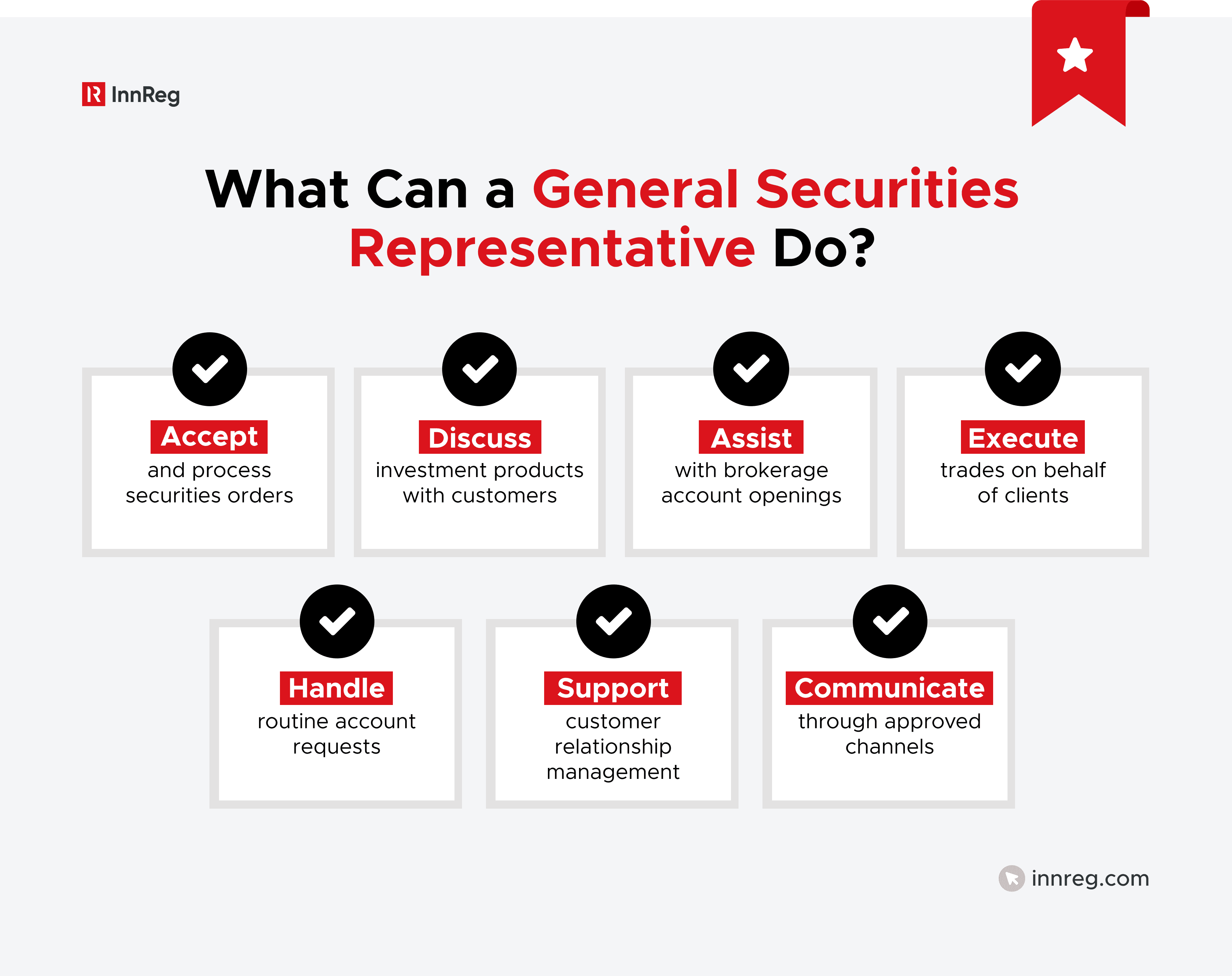
The day-to-day responsibilities can vary depending on the firm. Some representatives work in traditional brokerage environments, while others support digital investment platforms, mobile trading apps, or fintech products connected to banking and payments services.
Types of Securities They Can Sell
One of the main reasons firms use the Series 7 registration is that it covers a broad range of investment products. A General Securities Representative can typically work with stocks, bonds, mutual funds, ETFs, options, municipal securities, and certain private placements.
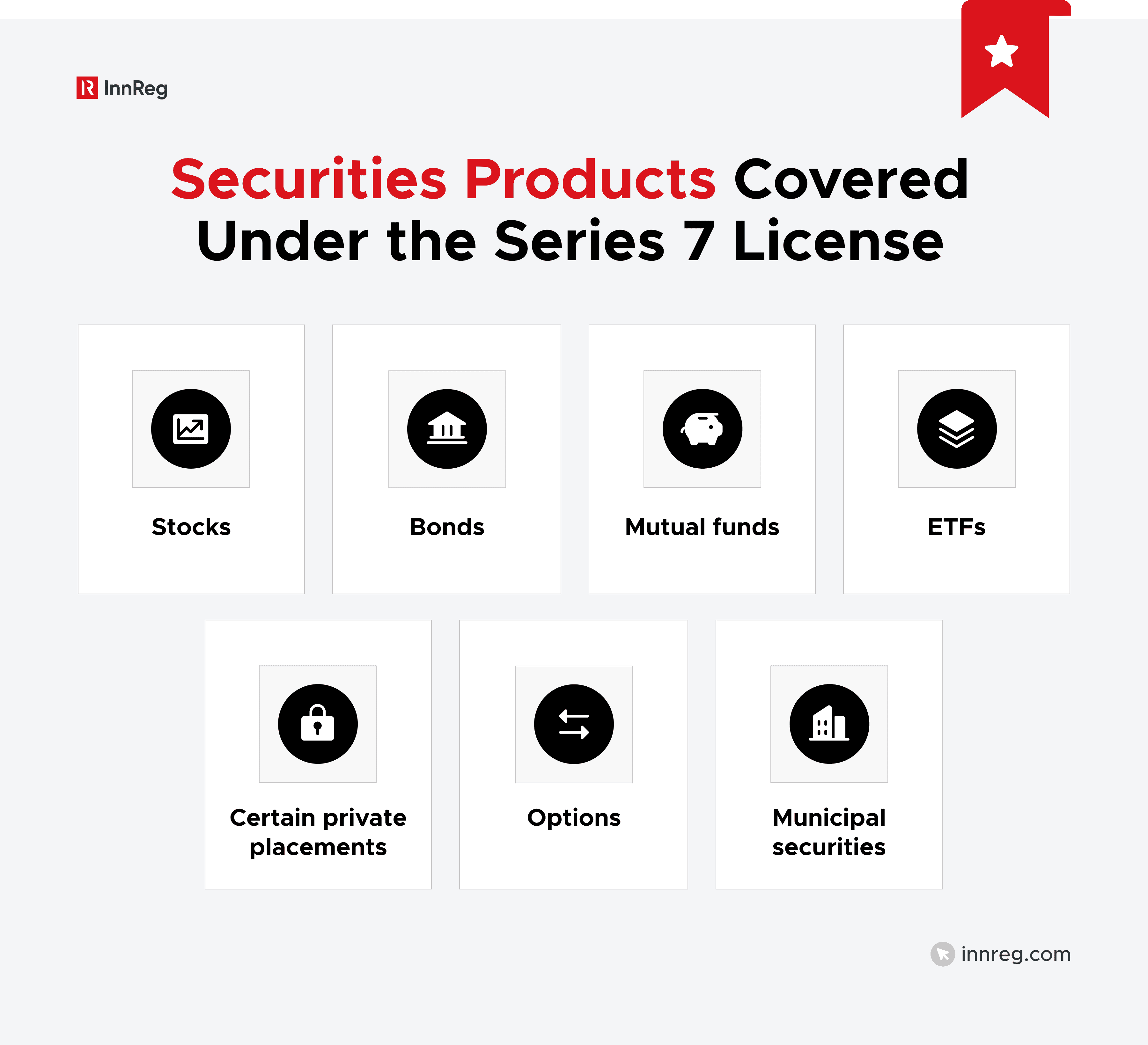
This flexibility allows representatives to work with different types of customers and investment products. A representative at a traditional broker-dealer may focus on retail investing, while another one at a fintech firm may support self-directed trading, app-based investing features, or hybrid financial products.
The broad scope of the Series 7 license also comes with additional compliance responsibilities. Certain products, including options and private offerings, may require enhanced supervision and additional internal review processes.
Client Interaction and Advisory Limitations
General Securities Representatives are allowed to communicate directly with customers about securities products and transactions. They may answer questions, discuss investment options, and make recommendations related to brokerage services offered through their firm.
That said, there are limits to what the registration allows. Holding a Series 7 license doesn't automatically make someone an investment advisor representative. Different rules may apply when a firm offers:
Ongoing investment advice
Discretionary portfolio management
Fee-based advisory services
This distinction is becoming more important as fintech companies expand beyond traditional brokerage models. Many platforms now combine investing tools with financial planning features, automated portfolios, or subscription-based services. Depending on how those services are structured, additional registrations or regulatory considerations may apply.

When Do You Need a General Securities Representative?
A company typically needs General Securities Representatives when employees are involved in selling securities or communicating with customers about investment transactions. This often applies to broker-dealers, investment platforms, and fintech firms offering securities-related products or services.
Activities that may trigger registration requirements include:
Recommending securities transactions
Discussing investment products with customers
Accepting securities orders
Receiving transaction-based compensation
Opening brokerage accounts
Marketing securities offerings
Many firms discover licensing obligations as their products become more sophisticated or customer-facing. A platform that starts as a payments or banking product may later add investing features, stock rewards, or digital asset functionality that changes its regulatory profile.
This is especially common in fintech. Companies building innovative financial products sometimes focus heavily on product design and user experience early on, then later realize certain customer interactions may fall within securities regulations.
What Licenses Are Required to Become a General Securities Representative?
To become a General Securities Representative, individuals must pass the required FINRA qualification exams and register through a FINRA-member broker-dealer. The primary registration tied to the role is the Series 7 license, which is commonly paired with the Securities Industry Essentials (SIE) exam.
See also:
Series 7 Exam
The Series 7 exam, formally known as the General Securities Representative Qualification Examination, is the primary licensing exam required for individuals who want to work as General Securities Representatives.
This exam is administered by FINRA and is designed for professionals involved in securities sales and customer-facing brokerage activities. It covers a wide range of topics, including:
Securities products
Account opening procedures
Customer communications
Trade execution
Regulatory obligations
Candidates are also tested on areas such as suitability, risk disclosures, and rules governing interactions with customers.
Because the Series 7 license permits broad securities activity, the exam is significantly more comprehensive than many other FINRA registrations.

Need help with broker-dealer compliance?
Fill out the form below and our experts will get back to you.
SIE Exam
Before taking the Series 7 exam, candidates must first pass the SIE exam.
The SIE is an introductory FINRA exam that covers basic concepts related to the securities industry, including investment products, market structure, regulatory agencies, and prohibited activities.
Unlike the Series 7, the SIE doesn't require sponsorship from a broker-dealer. Many candidates take it before joining a firm as a way to begin the licensing process early.
The SIE focuses on foundational industry knowledge, while the Series 7 is more closely tied to day-to-day representative activity and customer interactions. Passing both exams is typically required to become a fully registered General Securities Representative.
Learn more about the Securities Industry Essentials (SIE) exam →
Other Requirements
Passing the required exams is only one part of becoming a General Securities Representative. Candidates also go through background checks, fingerprinting, and registration filings through FINRA’s Central Registration Depository (CRD) system.
Firms are expected to review an applicant’s disciplinary history, disclosures, and employment record before moving forward with registration. Registered representatives are also subject to continuing education and ongoing compliance obligations after becoming licensed.
Registration is tied closely to supervision and oversight, not just testing. Broker-dealers are responsible for monitoring the activities of their registered representatives and maintaining internal procedures related to training, communications, and customer interactions.
Registration Process Through FINRA and CRD
Once a candidate passes the required exams, the registration process is completed through FINRA’s CRD system. Broker-dealers use this system to submit registration filings, manage disclosures, and maintain records related to registered personnel.
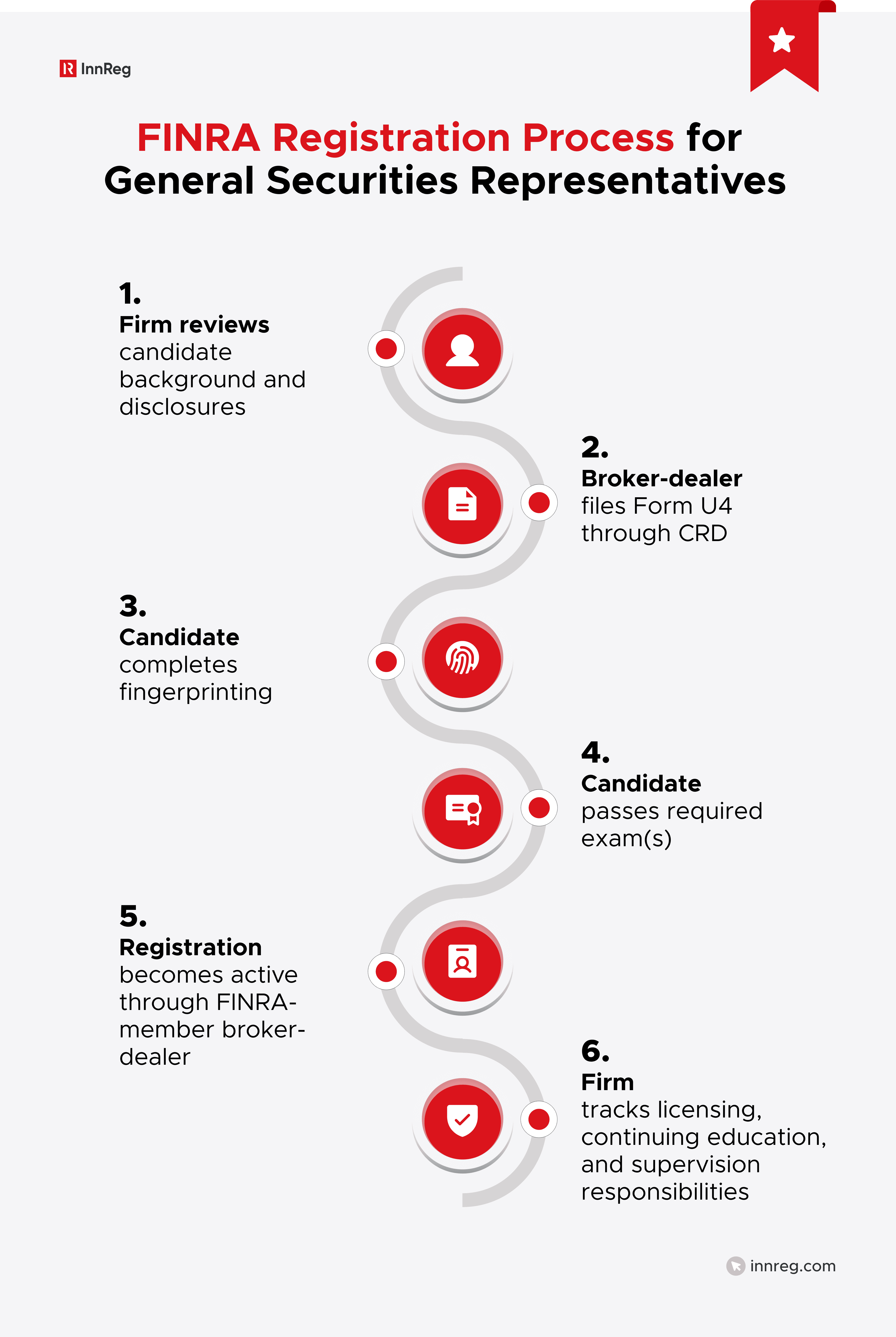
The registration process typically includes filing Form U4, completing fingerprinting requirements, and reviewing the candidate’s background and disclosures.
For firms, registration is closely tied to onboarding and compliance operations. This often includes tracking licensing status, continuing education requirements, disclosures, and supervisory responsibilities.
Learn more about FINRA’s Central Registration Depository (CRD) system →
Firm Sponsorship Requirements
To take the Series 7 exam and become fully registered, candidates must be sponsored by a FINRA-member broker-dealer. This means the firm takes responsibility for filing the registration paperwork and supervising the representative’s activities once registered.
Sponsorship is more than an administrative requirement. Broker-dealers are expected to supervise their registered representatives closely and maintain systems for monitoring securities activity, customer communications, and compliance obligations.

General Securities Representative vs. Other FINRA Licenses
FINRA offers many different registrations, and each license is tied to specific types of securities activity. Here are the key differences between these licenses.
Series 7 vs. Series 6
The Series 6 and Series 7 licenses are both used for customer-facing securities activity, but the Series 6 is very limited in the types of investment products and brokerage services.
The Series 6 license is used for representatives limited to selling products such as mutual funds and variable annuities. The Series 7 license covers a much broader range of securities products and brokerage activities.
License | Main Scope |
|---|---|
Series 6 | Mutual funds, variable annuities, and limited packaged products |
Series 7 | Stocks, bonds, ETFs, options, mutual funds, variable annuities, and broader brokerage activity |
The Series 7 license is generally preferred for firms offering full brokerage functionality or more sophisticated investment products. Many fintech companies choose this route because their platforms often expand over time into additional securities offerings, trading features, or hybrid financial products.
Series 7 vs. Series 79
The Series 7 and Series 79 licenses are designed for different types of securities activity. The Series 7 focuses on general brokerage and customer-facing investment activity, while the Series 79 is specifically tied to investment banking functions.
Representatives with a Series 79 registration typically work on mergers and acquisitions, capital raises, debt offerings, and restructuring transactions. The license is commonly used by investment banks and corporate finance groups involved in underwriting and advisory activity.
License | Primary Focus |
|---|---|
Series 7 | General securities sales and brokerage activity |
Series 79 | Investment banking and corporate finance transactions |
The Series 79 doesn’t provide the broad brokerage permissions that come with the Series 7 license. Representatives working with retail customers, brokerage accounts, or securities trading activity generally need the Series 7 registration instead.
This distinction can become important for fintech firms expanding into capital markets or fundraising services, where different registrations and supervisory structures may apply.
Representative vs. Principal (Series 24)
A General Securities Representative and a General Securities Principal serve different functions within a broker-dealer. The representative handles customer-facing securities activity, while the principal is responsible for supervision and oversight.
Representatives may work directly with clients, discuss investment products, and process securities transactions. Principals, on the other hand, are responsible for supervising those activities and overseeing the firm’s compliance and operational controls.
Registration | Primary Responsibility |
|---|---|
Series 7 Representative | Customer-facing securities activity |
Series 24 Principal | Supervision and compliance oversight |
Most broker-dealers are required to maintain properly registered principals to supervise their securities business. This includes oversight of registered representatives, advertising reviews, written supervisory procedures, and internal compliance controls.
See also:
Key Responsibilities of a General Securities Representative
General Securities Representatives handle a wide range of responsibilities tied to customer accounts, securities transactions, and brokerage operations. While the exact role varies by firm, common responsibilities often include:
Opening customer accounts: Representatives may help customers complete account applications, collect required information, and explain available account types and investment products.
Discussing securities products with clients: This can include answering customer questions, explaining product features, and discussing potential risks associated with investments.
Executing securities transactions: Representatives may process customer orders involving stocks, bonds, ETFs, mutual funds, options, and other securities products approved by the firm.
Maintaining customer records: Firms expect representatives to document customer information accurately and keep records updated as account activity changes over time.
Following supervisory and compliance procedures: Representatives are generally required to follow internal firm policies related to communications, disclosures, approvals, and escalation procedures.
Completing ongoing training and regulatory education: Registered representatives must stay current on regulatory obligations, firm policies, and continuing education requirements.
Communicating with customers through approved channels: Customer communications, including emails, messages, and marketing-related interactions, are often subject to review and supervision by the broker-dealer.
The role combines customer service, securities activity, and regulatory responsibilities. For fintech firms, these responsibilities may also extend into digital onboarding systems, app-based interactions, and technology-driven customer workflows.

Regulatory Framework Governing General Securities Representatives
General Securities Representatives operate within a regulatory framework shaped primarily by FINRA and the SEC. These rules cover how representatives interact with customers, communicate about investment products, handle securities transactions, and follow internal supervisory procedures.
FINRA Rules
FINRA rules govern many parts of a General Securities Representative’s day-to-day activities, including customer communications, supervision, recordkeeping, outside business activities, and securities recommendations.
Some of the most commonly relevant FINRA rules include:
FINRA Rule 3110 (Supervision): Requires broker-dealers to maintain supervisory systems and written supervisory procedures for overseeing registered representatives and securities activity.
FINRA Rule 2210 (Communications with the Public): Governs advertising, marketing materials, social media content, and customer communications related to securities products and services.
FINRA Rule 4511 (Books and Records): Covers recordkeeping obligations for broker-dealers and registered personnel.
FINRA Rule 3270 (Outside Business Activities): Requires representatives to disclose outside business activities to their firm.
FINRA Rule 3280 (Private Securities Transactions): Addresses situations where representatives participate in securities transactions outside the scope of their broker-dealer.
FINRA expects firms to supervise representatives actively and maintain policies tailored to their business activities. For fintech firms, this often includes additional focus on digital communications, app-based customer interactions, and technology-driven workflows.
SEC Oversight and Regulation Best Interest
In addition to FINRA rules, General Securities Representatives are also subject to SEC regulations that apply to broker-dealers and customer recommendations. One of the most important frameworks is Regulation Best Interest, commonly called Reg BI.
Reg BI requires broker-dealers and their representatives to act in the retail customer’s best interest when making securities recommendations. This includes:
Providing clear disclosures
Managing conflicts of interest
Considering whether a recommendation is appropriate for the customer’s financial situation and objectives
Reg BI has increased regulatory focus on how firms document recommendations, supervise representatives, and communicate with customers. This can affect everything from onboarding questionnaires and product disclosures to marketing materials and app design.
Learn more about Reg BI →
Broker-Dealer Supervisory Structure
Broker-dealers are required to maintain supervisory systems designed to oversee the activities of their registered representatives. This includes:
Monitoring customer interactions
Reviewing communications
Supervising securities transactions
Maintaining written supervisory procedures
Supervision is typically handled by registered principals and compliance personnel who review representative activity and escalate potential issues when needed. Firms are also expected to maintain processes for training, surveillance, recordkeeping, and internal approvals.
The supervisory structure should reflect the firm’s products, customer base, and operational model. A traditional retail broker-dealer may supervise activity differently from a fintech platform offering mobile investing tools, automated features, or digital onboarding workflows.
Common Compliance Risks and Challenges
General Securities Representatives operate in heavily regulated environments where customer interactions, communications, and trading activity are closely monitored. Some of the most common compliance risks include:
Unsuitable recommendations: Representatives may face issues if investment recommendations don’t align with a customer’s financial situation, investment objectives, or risk tolerance. Firms are expected to review how recommendations are made and documented.
Unauthorized trading: Problems can arise when trades are placed without proper customer approval or outside the scope of authorized activity. Weak account controls and poor documentation often increase this risk.
Misleading communications: Marketing materials, emails, social media posts, and customer discussions must comply with FINRA communication standards. Statements that are exaggerated, incomplete, or unclear can attract regulatory scrutiny.
Outside business activities: Representatives are generally required to disclose outside business involvement to their broker-dealer. This may include consulting work, side businesses, board positions, or other financial activities.
Private securities transactions: Selling securities outside the firm without proper approval can create significant compliance concerns. These activities are often referred to as “selling away” and are closely monitored by regulators.
Recordkeeping failures: Broker-dealers are expected to maintain records related to customer communications, transactions, approvals, and supervisory reviews. Missing or incomplete records can create examination and enforcement issues.
Many compliance problems develop from gaps in supervision, documentation, or internal processes rather than intentional misconduct. This is one reason firms often invest heavily in surveillance systems, training programs, and supervisory controls as their operations grow.

—
General Securities Representatives play a central role in broker-dealer operations, client communications, and securities transactions across the financial services industry.
As fintech firms continue expanding into investment and brokerage-related services, understanding how Series 7 registration, supervision, and FINRA requirements apply in practice becomes increasingly important.
Establishing strong compliance frameworks around registered representative activity can help firms support growth, reduce regulatory risk, and adapt more effectively as their business models evolve.

Tarik is a Principal Compliance Consultant at InnReg with over 5 years of experience advising fintech clients across broker-dealer, RIA, and money transmitter verticals. He holds FINRA Series 3, 7, 24, 57, 63, 79, and 99 licenses, with expertise in regulatory strategy, supervisory systems, and compliance roadmap implementation.
How Can InnReg Help?
InnReg is a global regulatory compliance and operations consulting team serving financial services companies since 2013.
We are especially effective at launching and scaling fintechs with innovative compliance strategies and delivering cost-effective managed services, assisted by proprietary regtech solutions.
If you need help with broker-dealer compliance, reach out to our regulatory experts today:
Related Articles



Featured LinkedIn Posts