What Does a General Securities Principal Do?
Key Takeaways
A general securities principal oversees core broker-dealer activities and supervision.
The role requires a Series 24 license and FINRA registration.
Supervision involves active day-to-day involvement, not just policies.
The role is broad but doesn’t cover specialized areas without additional licenses.
Growing firms need stronger, more structured supervision frameworks.
Many firms combine internal principals with external support to manage oversight.
A general securities principal plays a central role in how a broker-dealer operates. If you’re building or scaling a regulated firm, this is the person responsible for supervising key activities and making sure your business aligns with FINRA expectations.
It’s also a role that’s often misunderstood. Many teams know they need a Series 24, but aren’t always clear on what that responsibility looks like in practice or how involved the principal needs to be.
This guide breaks down what a general securities principal actually does, how the role fits into your firm, and what it means for your supervision and compliance structure.
At InnReg, we help broker-dealers structure and support the General Securities Principal role in practice. From Series 24 staffing and supervisory design to written supervisory procedures and ongoing oversight, our team works with you to build a supervision framework that reflects how your firm operates.


What Is a General Securities Principal?
A general securities principal is a licensed supervisor within a broker-dealer who is responsible for overseeing a broad range of the firm’s securities activities. To hold this role, the individual must pass the Series 7 and Series 24 exams and be registered with FINRA as a principal.
This role typically sits above registered representatives and works closely with compliance leadership. In many firms, the general securities principal is part of the supervisory framework that supports the Chief Compliance Officer (CCO), helping translate regulatory requirements into day-to-day oversight.
What Does a General Securities Principal Actually Do?
A general securities principal is responsible for supervising how the broker-dealer operates in real time, not just a review after the fact. The role connects policies, people, and day-to-day activity, making sure they align with regulatory expectations.
1. Supervising the Firm’s Activities
One of the main responsibilities is overseeing trading and sales activity. This includes:
Reviewing transactions
Monitoring for red flags
Stepping in when something doesn’t look right
The principal is also personally accountable for supervision under FINRA rules, which means they can’t delegate responsibility without proper oversight. Even if tasks are shared, the expectation is that supervision is active and documented.
2. Managing Compliance Programs and Written Supervisory Procedures (WSPs)
General securities principals are essential to building and maintaining the firm’s WSPs. These documents define how supervision works across the business.
This involves:
Updating procedures as the business evolves
Setting up internal controls
Defining escalation paths
A strong setup means the firm can respond consistently to issues and document how decisions are made, which matters during exams.
Learn more about Written Supervisory Procedures (WSPs) →
3. Approving Communications and Marketing Materials
FINRA Rule 2210 requires firms to review and approve certain communications before they are published. That responsibility often sits with a general securities principal.
This goes beyond static marketing materials. It includes:
Social media
App-based messaging
Influencer content
The principal needs to understand how the firm communicates with customers across channels, not just review isolated pieces.
4. Overseeing Customer Accounts and Transactions
Another key area is customer account oversight. This includes:
Approving new accounts
Reviewing activity
Monitoring for suitability concerns
The principal is also involved in how the firm applies Regulation Best Interest (Reg BI). That means looking at recommendations, disclosures, and how customer interests are considered. The goal is to identify issues early and address them before they become larger problems.
5. Supervising Personnel and Registrations
General securities principals supervise registered representatives and help manage licensing requirements across the firm.
This includes:
Reviewing Forms U4 and U5
Tracking registrations
Making sure supervision aligns with each person’s role
A clear structure helps the firm assign responsibility correctly and avoid gaps in oversight, especially as the team grows.
|
|
What Can a General Securities Principal Supervise?
A general securities principal can supervise most core broker-dealer activities, but the scope depends on the firm’s structure and the licenses held by other principals. The role is broad, though it doesn’t cover every specialized area.
Across most firms, this includes oversight of:
Securities sales to retail and institutional clients
Trading activity, including order handling and execution
Interactions between registered representatives and customers
This means the principal is involved in reviewing activity, approving certain actions, and monitoring how business is conducted across these areas.
At the same time, there are clear limits. A general securities principal can’t supervise activities that require separate principal licenses. These typically include:
Options supervision, requiring a Series 4
Municipal securities activities requiring a Series 53
Investment Banking activities requiring a Series 79
Certain research functions tied to analyst activity
For firms with more complex offerings, this often leads to a layered supervision model. You might have a general securities principal covering broad activity, while other principals handle specialized areas.
Key Responsibilities of a General Securities Principal
A broker-dealer can’t operate without proper principal supervision, and the general securities principal is a key part of that structure. FINRA expects firms to designate qualified principals based on the scope of their business.
Supervising the Firm’s Activities
A general securities principal oversees the firm’s core business lines, including trading, sales, and investment banking activity. This isn’t a passive role. It involves reviewing transactions, monitoring activity, and stepping in when something needs attention.
FINRA places clear expectations on supervision. The principal is accountable for how supervision is carried out, even if tasks are shared across the team.
That means staying involved, documenting decisions, and making sure issues are addressed in a timely and consistent way.

Managing Compliance Programs and WSPs
A general securities principal helps build and maintain the firm’s supervisory framework, starting with WSPs. These procedures define how the firm:
Monitors activity
Assigns responsibility
Handles issues when they arise
This isn’t a one-time task. As the business changes, the principal needs to update procedures, refine controls, and make sure the framework still reflects how the firm operates.
Approving Communications and Marketing Materials
A general securities principal is often responsible for reviewing and approving retail communications before they reach customers. This includes:
Marketing materials
Emails
Website content
Other forms of outreach covered under FINRA Rule 2210
The challenge is that communication today goes far beyond traditional formats. Firms use apps, social media, and sometimes third parties like influencers. The principal should understand how these channels work and how messages are delivered.
It’s not just about checking language. A general securities principal must confirm that communications are fair, balanced, and properly supported, especially when products or performance are being discussed.
See also:
Overseeing Customer Accounts and Transactions
A general securities principal reviews how customer accounts are opened, maintained, and monitored over time. This includes:
Approving new accounts
Checking for unusual activity
Making sure transactions align with the customer’s profile
This work ties closely to suitability and Regulation Best Interest. The principal needs to look at how recommendations are made and whether the right disclosures are in place.

Need help with broker-dealer compliance?
Fill out the form below and our experts will get back to you.
Supervising Personnel and Registrations
A general securities principal oversees registered representatives and how supervision is structured across the firm. This includes making sure each person is:
Properly licensed
Assigned the right responsibilities
Supervised at the right level
The role also involves reviewing and approving Forms U4 and U5, tracking registration status, and coordinating with compliance when changes happen.
When Does a Firm Need a General Securities Principal?
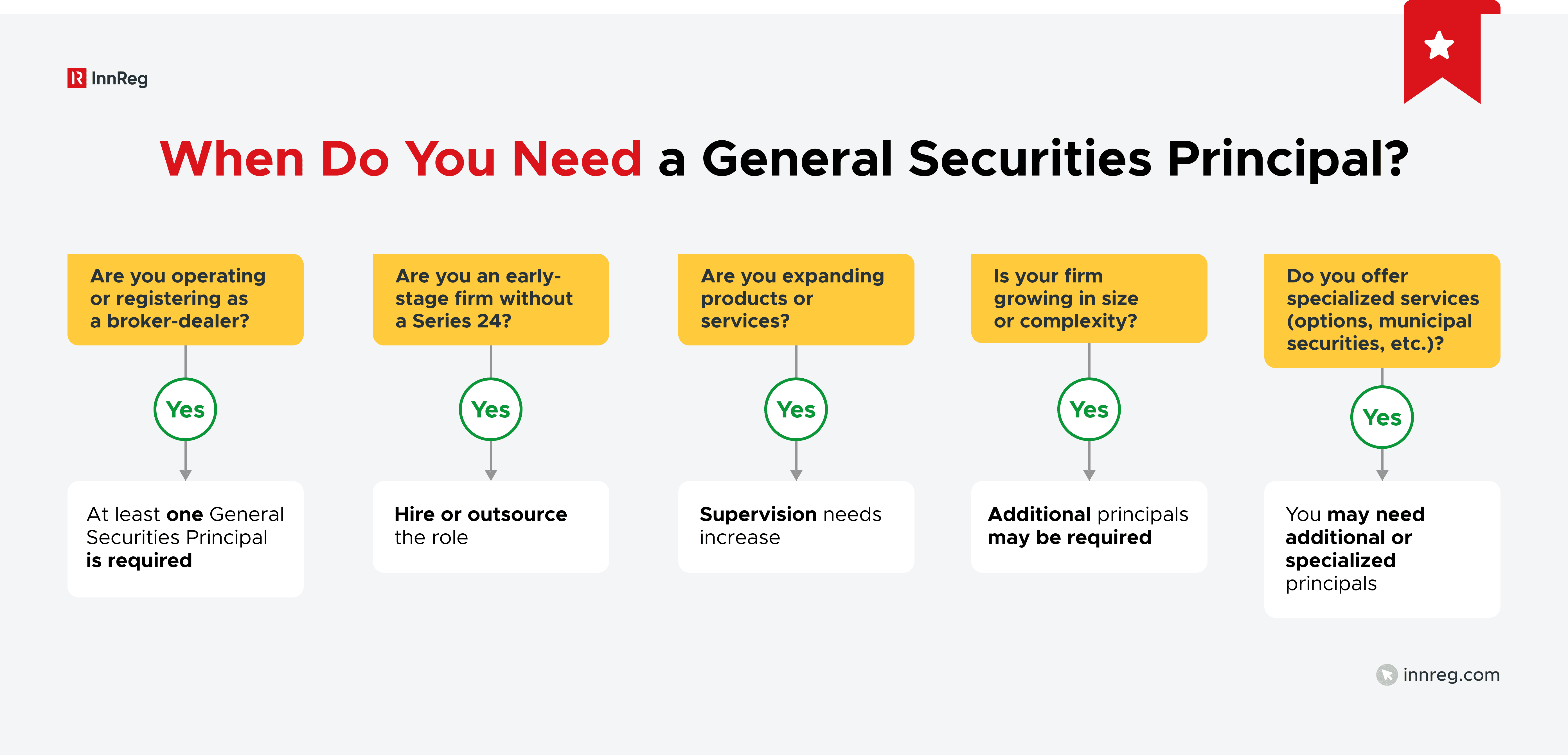
A broker-dealer needs a general securities principal to meet FINRA supervision requirements and operate compliantly. The exact setup depends on the firm’s size, structure, and the type of business it conducts.
Broker-Dealer Requirements
FINRA requires every broker-dealer to designate qualified principals to oversee its activities. In most cases, this includes at least one general securities principal.
The firm must assign supervisory responsibility to properly licensed individuals, and that structure needs to be clearly defined in its written supervisory procedures. Without this, the firm won’t meet baseline regulatory expectations.
Startup and Fintech Scenarios
For early-stage firms, this requirement often comes up during the registration process. Founders may not have a Series 24 internally, which means they need to obtain the license or bring in someone who does.
In fintech models, the timing and scope can vary. New products, digital platforms, or hybrid services can expand what needs to be supervised. This means firms need to think early about how supervision will work as the business evolves, not just at launch.
When Multiple Principals Are Required
As a firm grows, one principal is usually not enough. Different business lines, higher transaction volume, or added complexity can require additional supervisory coverage.
Multiple principals can manage different functions or business areas, particularly specialized services (options or municipal securities). Distributed principal responsibility can prevent potential gaps as the firm scales.

General Securities Principal vs. Other Principal Roles
While the supervisory responsibilities of a general securities principal cover a wide swath, it may not be the only principal role within a broker-dealer. Firms should have a solid grasp of the various activities and their relevant licenses, which determine how to correctly structure supervision.
Role | License | What They Supervise | When You Need Them |
|---|---|---|---|
General Securities Principal | Series 24 | Sales, trading, (broad supervision) | Always required for broker-dealers |
Registered Options Principal | Series 4 | Options trading and strategies | If offering options |
Investment Banking Principal | Series 79 | Investment banking, Underwriting, private placements | If doing investment banking activity |
Series 27 or Series 28 | Financial reporting, net capital | Always required |
General Securities Principal vs. Registered Options Principal
A Registered Options Principal (Series 4) is required to supervise options activities, which fall outside the scope of a general securities principal.
If a firm offers options trading, it must designate a Series 4 principal to oversee that activity. The general securities principal can still be involved in broader supervision, but options-specific review and approval must sit with the properly licensed principal.
General Securities Principal vs. Investment Banking Principal
The Series 79, or Investment Banking Principal, covers underwriting, private placements, and the advisory work that goes with capital markets deals. A general securities principal might have some line of sight into that activity, but firms tend to put an Investment Banking Principal in charge of supervising specific transactions. It keeps the right expertise paired with the more complicated, deal-heavy parts of the business.
General Securities Principal vs. FINOP
A Financial and Operations Principal (FINOP) supervises the firm’s operations and financial reporting and net capital requirements, which is a completely different function from business supervision.
The FINOP focuses on books and records, financial filings, and capital compliance. The general securities principal, on the other hand, focuses on supervising people and activities. Both roles are required, but they serve very different purposes within the firm.
See also:
Licensing Requirements: How to Become a General Securities Principal
Becoming a general securities principal requires passing the right exams and being registered through a broker-dealer. The process is structured, but manageable.
Series 24 Exam Overview
The Series 24 is the qualifying exam for becoming a general securities principal, and it’s built around real supervisory responsibilities inside a broker-dealer. It tests how you handle oversight, risk, and decision-making across the business.
The exam covers a wide range of topics, including:
Supervision of trading and sales
Communications review
Regulatory reporting
How to design and maintain supervisory systems
You’ll also see questions tied to FINRA rules like Rule 3110 and Rule 2210, along with scenarios that require judgment rather than memorization. A large portion of the exam focuses on how to apply rules in practice, especially when something goes wrong or needs escalation.
To obtain a General Securities Principal license, the Series 24 is required, and you typically need to hold the Series 7 first, since the general securities principal role builds on that foundation.
Check out our guide on FINRA Series 24 License →
Registration Requirements Under FINRA
Once you pass the Series 24, the next step is registration. You can’t register on your own. You need to be sponsored by a broker-dealer, which files your registration through FINRA.
That registration ties you directly into the firm's supervisory structure. It spells out what you're responsible for and where you fit in the organization. And it's not a box-checking exercise. Regulators pay close attention to how responsibilities get assigned and whether those assignments line up with how the firm actually operates.
Firms also have minimum principal requirements. Depending on the business model, they may need more than one principal to cover different areas.

Key Regulations That Shape the General Securities Principal Role
The general securities principal works within a regulatory framework set mainly by FINRA and the SEC. Those rules determine how supervision plays out, what has to be documented, and how firms answer for it. FINRA Rules You Need to Know
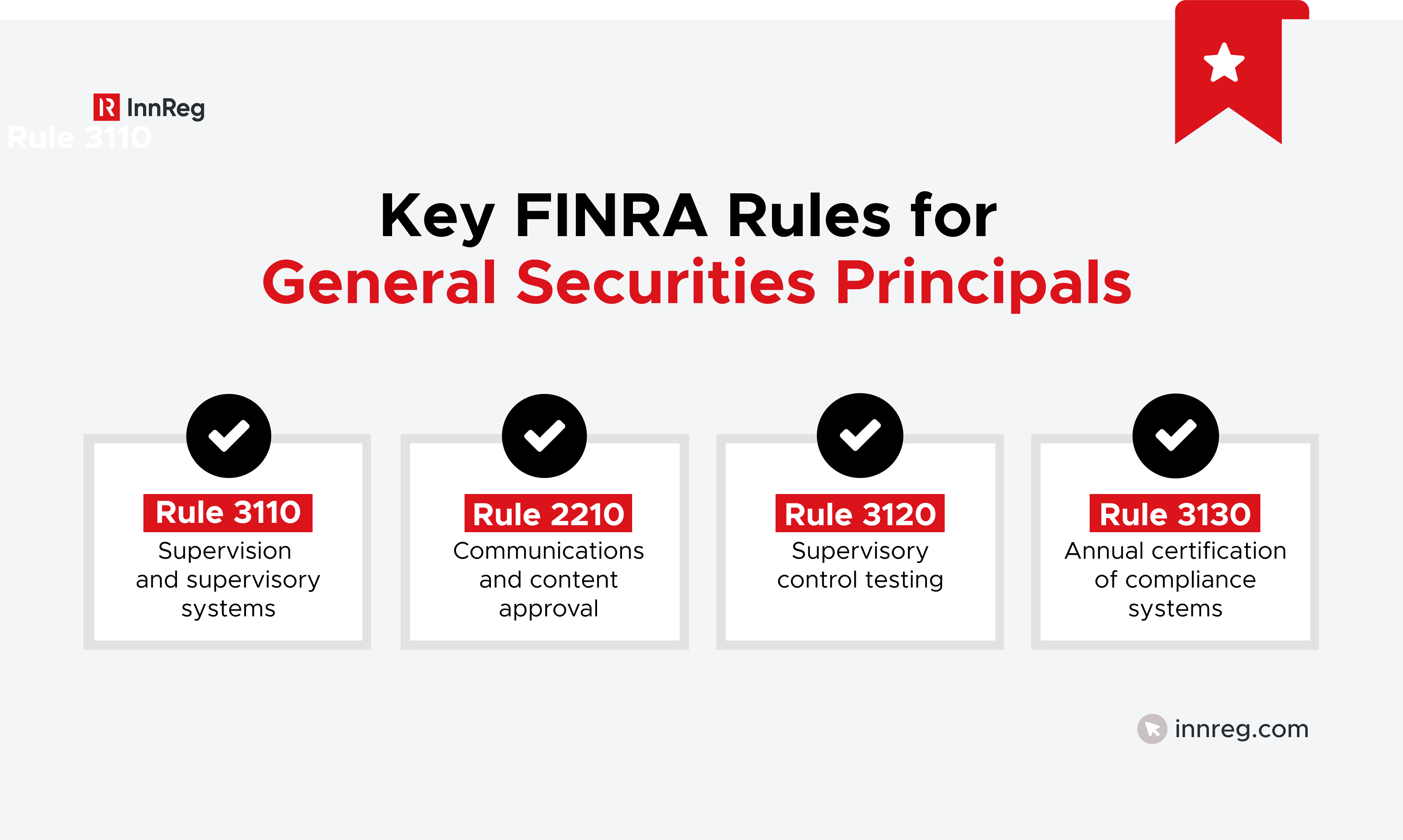
Several FINRA rules directly shape what a general securities principal is responsible for. These rules define how supervision should work and what regulators expect to see during exams.
1. FINRA Rule 3110 (Supervision)
Rule 3110 is the foundation of broker-dealer supervision. It requires firms to establish and maintain a supervisory system that covers all business activities and personnel.
This includes assigning clear responsibility, creating written supervisory procedures, and reviewing activity on an ongoing basis. For a general securities principal, this rule defines what supervision looks like day to day.
Learn more about FINRA Rule 3110 →
2. FINRA Rule 2210 (Communications)
Rule 2210 governs how firms communicate with the public. It sets standards for advertising, marketing materials, and other customer-facing content.
Under this rule, certain communications must be reviewed and approved before use. The general securities principal is often involved in that process, making sure the content is fair, balanced, and not misleading.
Learn more about FINRA Rule 2210 →
3. FINRA Rules 3120 and 3130 (Supervisory Controls and Certification)
These rules focus on testing and accountability. Rule 3120 requires firms to test their supervisory systems, while Rule 3130 requires senior management to certify that those systems are in place.
Together, they push firms to go beyond written procedures. The expectation is that supervision is actively tested, reviewed, and supported by leadership, not just documented.
Learn more about FINRA Rule 3130 →
4. SEC Oversight and Enforcement
FINRA isn’t the only regulator involved. The SEC also plays a major role, especially when it comes to enforcement and broader compliance expectations.
One of the biggest risks for a general securities principal is failure to supervise. If something goes wrong and supervision was weak or poorly documented, regulators will look closely at who was responsible. Accountability doesn’t stop at the firm level; it can extend to the individual principal.
The SEC pays just as much attention to books and records. Firms need clean, accurate documentation of what they did, the decisions they made, and the supervisory actions they took. That matters during an exam, but it matters even more if something escalates.

Common Compliance Challenges for General Securities Principals
Even with a strong setup, general securities principals deal with real operational challenges as firms grow and evolve. These issues often come from new technology, new products, and changing ways of interacting with customers.
Managing Digital Communications and Marketing
Digital communication moves fast, and that creates real pressure on supervision. Firms are using apps, social media, and sometimes influencers to reach customers.
A general securities principal needs to understand how these channels work and how messages are delivered, not just review static content. That includes tracking:
What’s posted
How it’s approved
How it’s archived
Recordkeeping is a big part of this. Regulators expect firms to retain communications across all channels. If content is scattered or not captured properly, it becomes a risk. Supervision only works if you can see and document what’s happening across platforms.
Crypto and Hybrid Product Oversight
New product models can blur the line between what is and isn’t a security. This is especially common in fintech, where firms combine brokerage services with crypto, payments, or other financial features.
A general securities principal needs to understand where the broker-dealer’s responsibilities start and stop, especially when multiple entities or affiliates are involved. This includes looking at:
How products are structured
How they’re marketed
Which activities fall under securities regulations
If roles and boundaries aren’t clearly defined, supervision can break down. Clarity around product structure and responsibility is key to avoiding gaps in oversight.
Supervisory Design in Fast-Growing Firms
Growth adds pressure to supervision. As teams expand and products evolve, the original setup often stops working the way it was intended.
A general securities principal needs to adapt supervisory structures as the firm scales, which includes:
Updating WSPs
Redefining responsibilities
Adding layers of oversight where needed.
What worked with a small team won’t hold up once activity increases.
Remote work adds another layer. Supervising distributed teams and conducting inspections across locations requires more structure and better tracking. Supervision has to keep pace with how the business operates, not lag behind it.
See also:
How Fintech Companies Typically Staff the General Securities Principal Role
There’s no single way to staff the general securities principal role, especially in fintech. The right approach depends on the firm’s stage, complexity, and internal expertise.
Internal Hire vs. Outsourced Model
Some firms choose to hire a full-time principal. This can work well if the business is stable and has enough scale to support a senior hire.
Others choose to outsource the principal role. This gives them access to experienced principals without committing to a full-time position. Both models can work, but the key is having someone actively involved in supervision, not just listed on paper.
Cost Considerations vs. Expertise
Hiring a senior principal can be expensive, and one person may not cover every area of the business.
With an outsourced model, firms can access multiple specialists for a similar or lower cost, depending on the setup. This can provide more coverage across supervision, compliance design, and regulatory interaction.
That said, cost shouldn’t be the only driver. The focus should be on whether the principal has the right experience for the firm’s specific model.
Common Structures in Early-Stage Firms
Early-stage firms often start lean. They may have one principal covering multiple areas, supported by external advisors or consultants.
As the business grows, the structure usually becomes more defined. Firms add additional principals, separate responsibilities, and build out a more formal supervision framework. The goal is to match the structure to the firm’s actual risk and activity level, not just meet minimum requirements.
—
A general securities principal is key to how a broker-dealer operates and manages supervision. The role requires more than oversight on paper. It involves staying close to day-to-day activity and making sure the right controls are in place.
As firms grow, especially in fintech, supervision becomes harder to manage without a clear structure. Having the right setup, with defined responsibilities and practical processes, makes it easier to handle that complexity and keep operations running as expected.
Frequently Asked Questions About General Securities Principals
What is the salary of a general securities principal?
As of 2026, the salary of a general securities principal varies depending on the firm, experience, and location, but a common benchmark is around $223,000 per year. However, compensation can be lower at smaller firms and higher for senior roles with broader supervisory responsibility.
Is the Series 24 a difficult exam?
Yes, most candidates consider it challenging. The exam covers a broad range of supervisory and regulatory topics, and it tests how you apply rules in real scenarios, not just memorization.
What is a principal in securities?
A principal is a licensed supervisor within a broker-dealer. They are responsible for overseeing business activities, registered representatives, and compliance with regulations. Their role is to manage and supervise, not just execute transactions.

Tarik is a Principal Compliance Consultant at InnReg with over 5 years of experience advising fintech clients across broker-dealer, RIA, and money transmitter verticals. He holds FINRA Series 3, 7, 24, 57, 63, 79, and 99 licenses, with expertise in regulatory strategy, supervisory systems, and compliance roadmap implementation.
How Can InnReg Help?
InnReg is a global regulatory compliance and operations consulting team serving financial services companies since 2013.
We are especially effective at launching and scaling fintechs with innovative compliance strategies and delivering cost-effective managed services, assisted by proprietary regtech solutions.
If you need help with broker-dealer compliance, reach out to our regulatory experts today:
Related Articles



Featured LinkedIn Posts