FINRA Electronic Communications: Key Requirements
Key Takeaways
FINRA electronic communication rules apply to emails, social media, messaging apps, and digital marketing.
Rule 2210 governs communication approvals, classifications, and content standards.
Rule 3110 requires supervision, monitoring, and documented communication reviews.
Certain communications require FINRA filing before or after public distribution.
Weak supervision and off-channel messaging frequently trigger FINRA enforcement actions.
FINRA electronic communications rules touch almost everything a regulated firm says online. A tweet from marketing, a WhatsApp message from a rep, or a product announcement sent by email can all create compliance obligations. For fintech firms using multiple communication channels, things can get messy quickly.
The problem is keeping supervision, approvals, recordkeeping, and employee activity aligned across fast-moving teams and modern technology platforms. FINRA expects firms to supervise communications based on how employees actually communicate, not just what’s written in policies.
This guide explains the key FINRA electronic communications requirements, including Rule 2210, Rule 3110, filing obligations, supervisory expectations, and common enforcement issues.
At InnReg, we help broker-dealers manage FINRA electronic communications compliance across email, social media, messaging apps, and digital marketing channels. Our team supports firms with Rule 2210 reviews, supervisory procedures, communication retention, and ongoing compliance oversight.


What Are FINRA Electronic Communications?
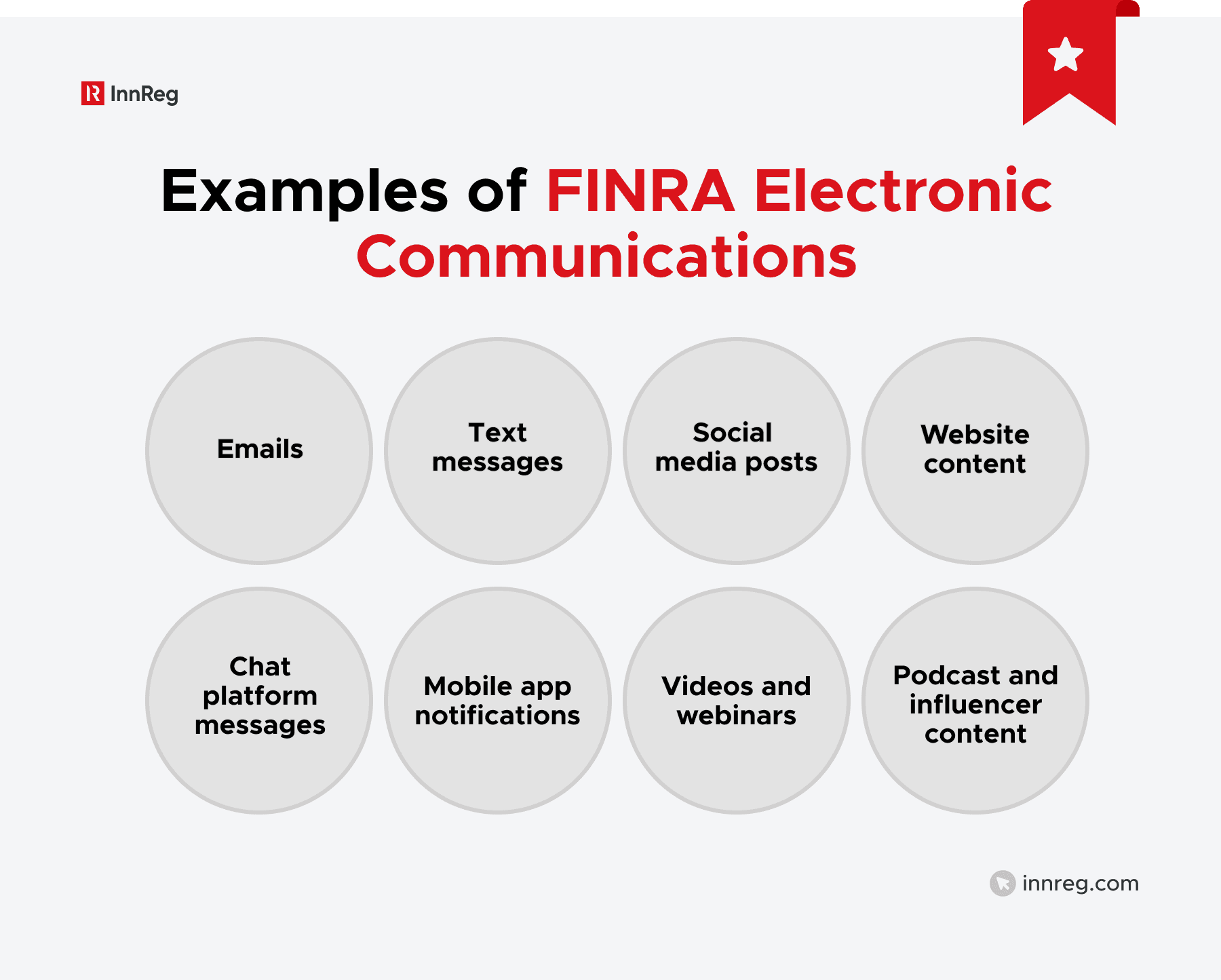
FINRA electronic communications include almost any digital message a broker-dealer sends or shares as part of its business activities. That includes emails, text messages, social media posts, website content, chat platform messages, mobile app notifications, videos, and even certain podcast or influencer content.
The rules don’t just apply to formal marketing campaigns. A casual LinkedIn post from a registered representative or a customer conversation through a messaging app may also fall within FINRA’s supervision and recordkeeping requirements. FINRA will likely expect a firm to supervise and retain any communication that relates to the firm’s business.
That’s where many firms run into problems. Teams often adopt new communication tools faster than compliance processes can keep up. A platform may start as an internal collaboration tool, then gradually become part of customer communications. If firms aren’t reviewing or properly archiving those messages, they can create regulatory exposure without realizing it.
FINRA Rules That Govern Electronic Communications
FINRA electronic communications rules primarily focus on two key areas: communications with the public and supervision. Here are the main FINRA rules firms need to understand, including how communications are classified, reviewed, approved, and monitored.
FINRA Rule 2210: Communications With the Public
FINRA Rule 2210 governs how broker-dealers communicate with customers and investors. The rule applies to many types of public-facing content, including emails, websites, social media posts, presentations, videos, and digital advertisements. The main goal is to prevent communications that are misleading, inaccurate, or missing important context.
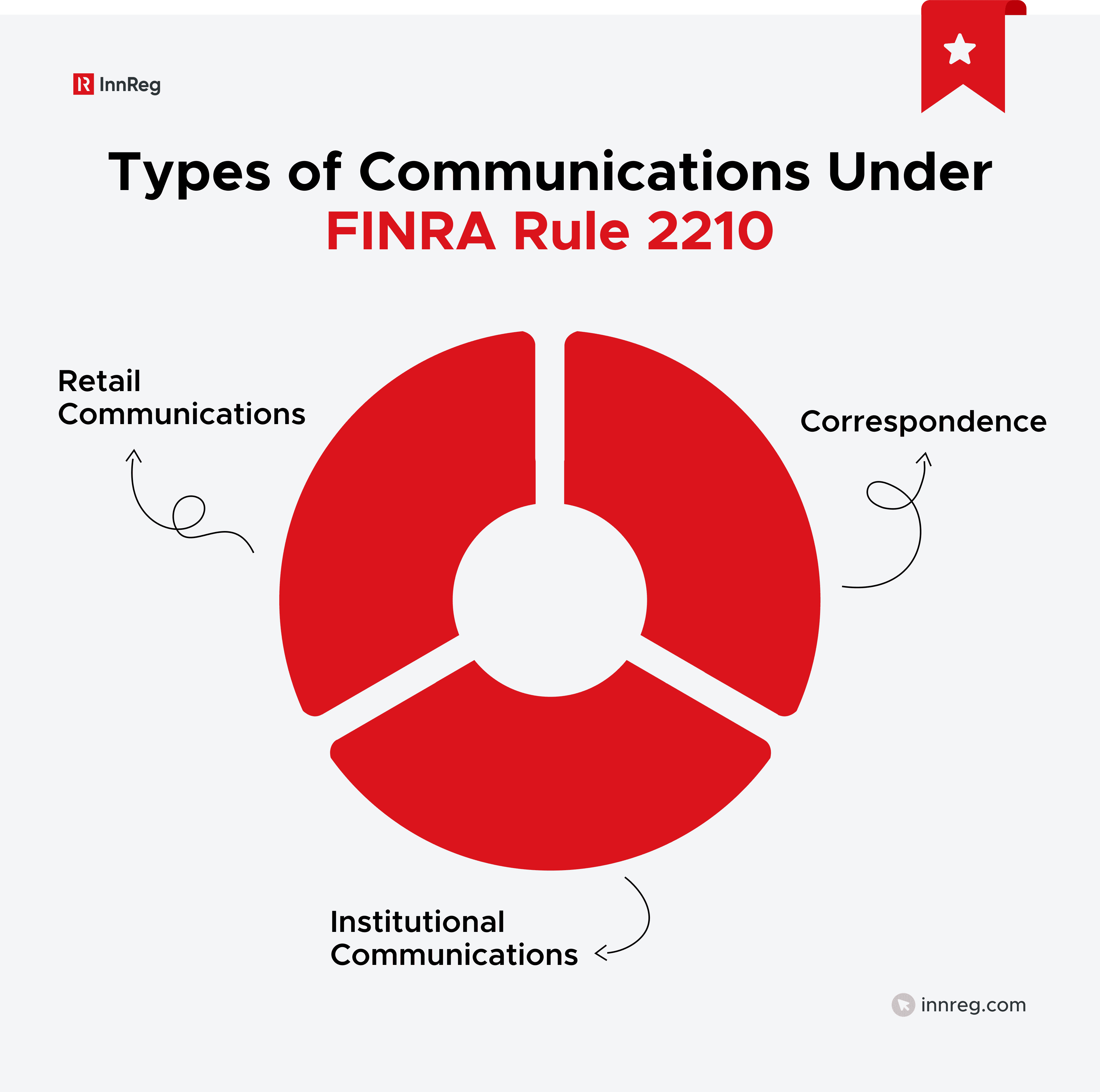
Rule 2210 also divides communications into different categories, each with its own review and supervision requirements. Those classifications affect whether a communication needs principal approval, filing with FINRA, or ongoing supervisory review.
Learn more about FINRA Rule 2210 →
1. Retail Communications
Retail communications are messages distributed or made available to more than 25 retail investors within any 30-day period. This category covers many common marketing materials, including websites, social media campaigns, sales emails, webinars, videos, and digital ads.
Retail communications usually carry the highest review and approval requirements under Rule 2210 because they’re broadly distributed to the public.
2. Correspondence
Correspondence refers to written or electronic messages distributed to 25 or fewer retail investors within a 30-calendar-day period. Common examples include one-to-one emails, direct messages, and smaller client communications.
While correspondence usually has fewer approval requirements than retail communications, firms still need supervisory processes to monitor and review these communications for compliance risks.
3. Institutional Communications
Institutional communications are messages distributed only to institutional investors, such as banks, insurance companies, registered investment companies, or other large financial organizations.
These communications generally have more flexibility under FINRA rules, but firms still need supervision and written policies governing how they’re reviewed and distributed. FINRA still expects institutional communications to be fair, balanced, and properly supervised.
4. Content Standards Under Rule 2210
Rule 2210 requires communications to be fair, balanced, and not misleading. Firms can’t make exaggerated claims, omit important risks, or present information in a way that could confuse investors. FINRA pays close attention to performance claims, promissory language, testimonials, and statements that lack proper context or disclosures.
Avoid promissory language with our Compliance Glossary for Fintech Marketing →
5. When Principal Approval Is Required
A registered principal must approve certain retail communications before they’re used or distributed. This often applies to:
Advertisements
Marketing campaigns
Websites
Social media promotions
Other public-facing content
The approval process helps firms review communications before they reach investors and identify potential compliance issues early.
6. When FINRA Filing May Be Required
Some communications must be filed with FINRA’s Advertising Regulation Department either before or after they’re first used. Filing requirements often depend on the firm’s business activities, products, or registration status. New member firms and firms marketing complex investment products typically face stricter filing obligations.
FINRA Rule 3110: Supervisory Review of Electronic Communications
FINRA Rule 3110 requires firms to supervise electronic communications and monitor how employees communicate for business purposes. The rule focuses on building review processes, documenting oversight activities, and identifying potential compliance risks across approved communication channels.
Learn more about FINRA Rule 3110 →
1. Review of Incoming and Outgoing Correspondence
FINRA expects firms to review both incoming and outgoing correspondence related to their business activities. The goal is to identify issues such as:
Misleading statements
Unauthorized communications
Customer complaints
Customer funds/securities
Signs of misconduct
Firms can use risk-based review methods, but they still need systems that reasonably monitor employee communications across approved channels.
2. Review of Internal Communications
FINRA may also expect firms to supervise certain internal communications, especially when they involve sales activity, product discussions, trading activity, or potential misconduct. Messages exchanged through chat platforms, collaboration tools, and internal messaging systems can all fall within a firm’s supervisory responsibilities.
Even when customers never see these communications, they can still create regulatory risk and become subject to review during examinations or investigations.
3. Role of Registered Principals
Depending on the communication type, principals may need to approve content before use, oversee review programs, investigate flagged issues, and document supervisory activity. FINRA expects firms to assign supervisory responsibilities clearly and maintain evidence of oversight.
4. Evidence of Supervisory Review
Firms need records showing that communications were reviewed and supervised. This may include approval logs, review notes, escalation records, timestamps, and documentation of follow-up actions. If a firm can’t demonstrate how reviews were performed, FINRA may view the supervisory process as ineffective, even if policies exist on paper.
FINRA Communication Classification Table
FINRA classifies communications into different categories based on who receives them and how broadly they’re distributed. These classifications affect approval, supervision, filing, and review requirements. The table below summarizes the main communication types firms commonly deal with.
Communication Type | Audience | Common Examples | Typical Review Requirements |
|---|---|---|---|
Retail Communications | More than 25 retail investors within 30 days | Social media campaigns, websites, webinars, advertisements, mass emails | Often requires principal approval before use and may require FINRA filing |
Correspondence | 25 or fewer retail investors within 30 days | One-to-one emails, direct messages, small group client communications | Subject to supervisory review and monitoring |
Institutional Communications | Institutional investors only | Market commentary, institutional sales materials, research-related communications | Supervision is required, but usually fewer approval obligations |

FINRA Electronic Communications Review Requirements
A firm’s review obligations usually depend on the communication type, the risks involved, and the channels employees use. Firms need supervisory processes that are documented, consistent, and capable of identifying potential compliance issues before they become larger problems.
Pre-Use Approval
Before certain communications can be published, they need to be reviewed and approved by a registered principal. This usually applies to public-facing content like advertisements, websites, marketing emails, presentations, and social media campaigns.
The reasoning is that FINRA wants firms to catch problems before investors see them. A misleading post, a missing disclosure, or an exaggerated product claim can create compliance issues. Pre-use approval helps firms review communications before they become regulatory problems.
Post-Use Review
Not every communication needs approval before it’s sent. Some communications can be reviewed after they’ve already been distributed, especially lower-risk correspondence and ongoing employee communications.
That doesn’t mean firms can ignore them. FINRA still expects firms to provide training and monitor these communications and identify potential issues like misleading statements, unauthorized promises, or unapproved business activity. Post-use review gives firms a way to supervise large volumes of communications without slowing down everyday operations.
Risk-Based Sampling
FINRA allows firms to use risk-based sampling when reviewing communications. Instead of reviewing every message manually, firms can focus more attention on higher-risk employees, communication channels, products, or activities.
For example, a firm reviews communications from sales teams more closely than routine operational messages. Communications involving retail investors, complex products, or performance discussions may also receive additional scrutiny. The idea is to focus supervisory resources where compliance risks are more likely to appear.
Lexicon and Exception Reviews
Many firms use lexicon reviews and exception reports to help monitor electronic communications. These systems flag certain words, phrases, or communication patterns that may indicate potential compliance issues.
For example, messages containing terms related to guarantees, insider information, customer complaints, or off-channel communications may be automatically flagged for review. These tools help firms identify higher-risk communications without manually reviewing every message.
Escalation and Follow-Up
When a communication raises a potential issue, firms need a clear process for escalation and follow-up. That may involve:
Compliance reviews
Supervisory discussions
Employee coaching
Additional investigation
Not every flagged message becomes a major problem, but firms are expected to respond when risks are identified. FINRA often looks at how firms handle issues after they’re detected, not just whether surveillance tools are in place.
FINRA Filing Requirements for Electronic Communications
Some electronic communications must be filed with FINRA before or after they’re first used. Filing obligations depend on factors like the firm’s registration status, the type of product being promoted, and the audience receiving the communication.
See also:
New Member Firm Filing Requirements
New FINRA member firms often face stricter filing requirements during their first year of membership. During this period, many retail communications must be filed with FINRA before they’re used with the public.
The goal is to give FINRA additional visibility into how new firms market their products and services. This requirement is critical for fintech firms launching new business models, products, or digital platforms that may involve more complex investor communications.

Need help with broker-dealer compliance?
Fill out the form below and our experts will get back to you.
Product-Specific Filing Requirements
Some products carry additional FINRA filing requirements because of their complexity or investor risk. This may include communications related to:
Options
Mutual funds
Variable products
Crypto-related offerings
These filings give FINRA a chance to review how products are being described to investors. FINRA often focuses on whether communications clearly explain risks, fees, limitations, and how the product actually works.
Communications That Are Excluded From Filing
Some communications are excluded from FINRA filing requirements, even though they still remain subject to internal supervision and recordkeeping rules. Common examples include correspondence, institutional communications, internal communications, and certain retail communications that don’t fall within specific filing categories.
For example, a one-to-one client email or a presentation shared only with institutional investors typically doesn’t need to be filed with FINRA. Firms also may not need to file communications restricted tos general market commentary that does not promote a specific product or service.

Common Filing Mistakes
Several filing issues appear repeatedly during FINRA examinations and enforcement actions. Many of them happen because firms move quickly and don’t have clear communication review processes in place.
Misclassifying communications: Firms sometimes treat marketing content as simple correspondence when FINRA would consider it retail communication. This commonly happens with social media posts, webinars, landing pages, and digital campaigns.
Missing filing deadlines: Some communications must be filed before use, while others must be filed within a specific timeframe after publication. Missing those deadlines can create regulatory issues even when the content itself is acceptable.
Updating content after approval: Marketing materials often change after compliance review. New performance figures, revised wording, updated graphics, or additional product claims may trigger another review or filing requirement.
Incomplete disclosures: Communications may discuss benefits or features without giving enough context about risks, fees, limitations, or product structure. FINRA frequently focuses on communications that appear balanced at first glance but omit important information.
Using unapproved communication channels: Employees sometimes promote products or communicate with investors through channels that aren’t covered by the firm’s supervisory process. This can create both filing and recordkeeping problems.
Poor coordination between teams: Filing issues often happens when marketing, product, legal, and compliance teams work separately without clear workflows. Fast-moving fintech environments can make this especially difficult when campaigns and product updates happen frequently.
What FINRA Examiners Look For
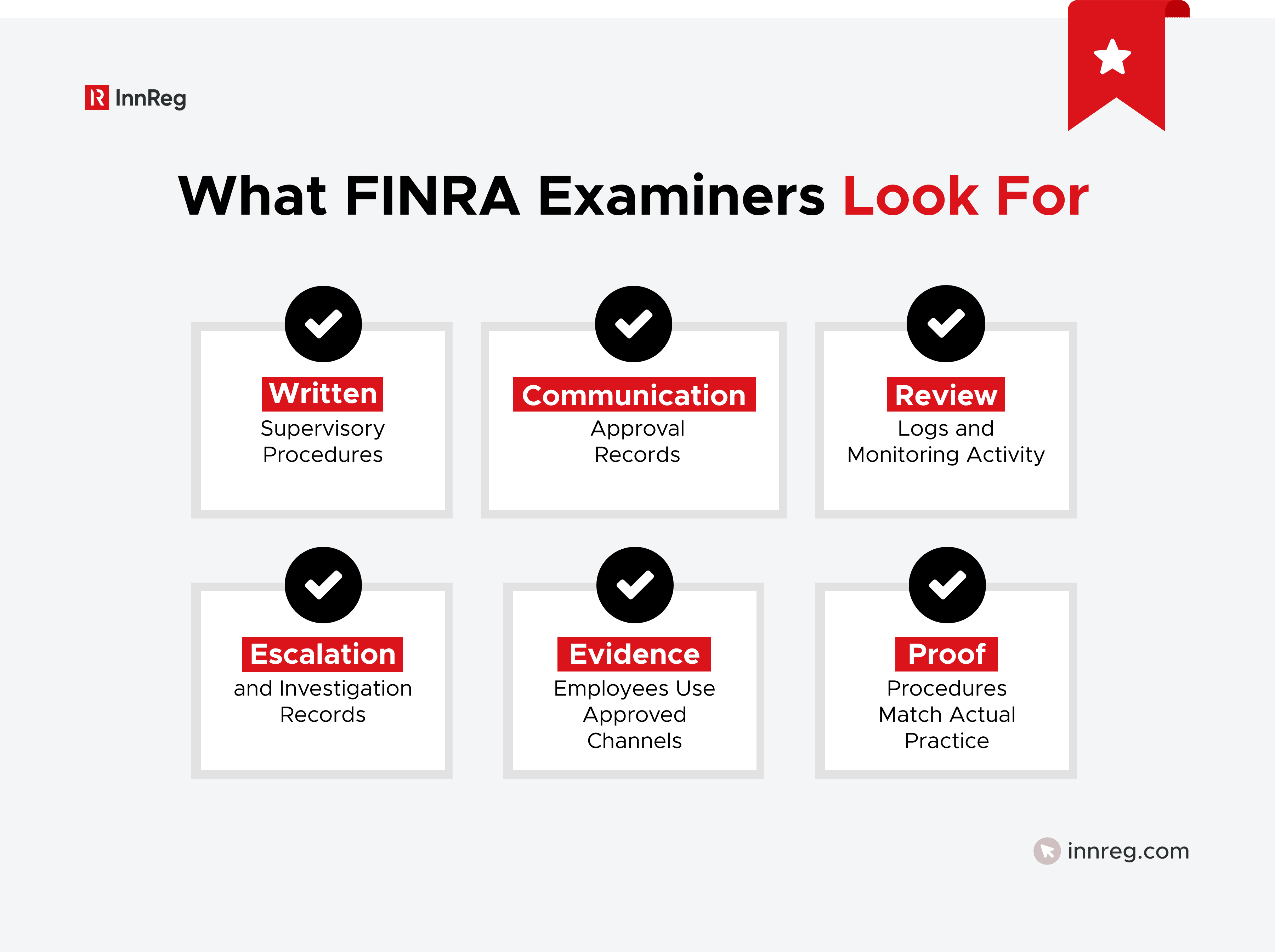
When FINRA reviews a firm’s electronic communications program, it usually focuses on whether the firm’s supervisory process works in day-to-day operations. Examiners often compare written policies against real communication activity, review records and approvals, and look for gaps between documented procedures and how employees communicate.
1. Written Supervisory Procedures
FINRA expects firms to maintain written supervisory procedures that explain how electronic communications are reviewed, approved, monitored, and retained. These procedures should clearly identify approved communication channels, supervisory responsibilities, escalation steps, and review processes.
Examiners often look closely at whether the procedures match what employees do day to day. A policy may look strong on paper, but problems can arise if employees communicate through platforms that aren’t covered or if reviews aren’t happening consistently.
FINRA generally expects supervisory procedures to reflect the firm’s real communication environment, not an idealized version of it.
Learn more about written supervisory procedures →
2. Approval Records
FINRA examiners often ask firms to produce records showing:
When communications were reviewed
Who approved them
What version was ultimately published
This helps demonstrate that supervisory reviews are executed and don’t solely exist as a policy requirement.
Approval records may include review logs, timestamps, archived drafts, comments, or workflow history from compliance systems.
3. Review Logs
Review logs help firms track how communications are monitored over time. These records may show:
Which communications were reviewed
When the review happened
Who performed it
Whether any issues were identified during the process
FINRA often looks at review logs to understand how active the supervisory program really is. Consistent review records can help demonstrate that communication monitoring is happening on an ongoing basis rather than only during examinations or audits.
4. Escalation Records
When communications raise potential concerns, firms are expected to document how those issues were handled. Escalation records may include internal reviews, supervisory discussions, investigation notes, employee follow-ups, or corrective actions.
These records help show that the firm responded appropriately once a risk was identified. FINRA often looks for evidence that issues weren’t simply flagged and ignored after detection.
5. Evidence That Procedures Match in Practice
FINRA doesn’t just review policies. Examiners also compare written procedures against what happens in reality. If a firm’s policies say only approved channels are used, but employees regularly communicate through personal devices or unmonitored apps, that gap can create serious compliance concerns.
This is a common challenge for fast-growing firms where communication habits evolve quickly across teams and platforms.
Recent FINRA Electronic Communications Enforcement Lessons
Recent FINRA enforcement actions show that electronic communications remain a major regulatory focus. Many cases involve misleading marketing statements, off-channel communications, weak supervision, social media activity, and failures to retain or monitor business communications across digital platforms.
Misleading Retail Communications
Many FINRA enforcement actions involving electronic communications focus on retail marketing that presents products or services in a misleading way. This doesn’t always involve intentional misconduct. Sometimes the issue is:
Overly aggressive marketing language
Incomplete disclosures
Simplified messaging that removes important context
Common examples include exaggerated performance claims, statements that downplay or exclude investment risks, unrealistic descriptions of potential returns, or marketing materials that make products sound safer or simpler than they actually are.
Social media content can also create issues because short-form posts often leave little room for balanced explanations or proper disclosures.
Influencer and Social Media Promotions
FINRA has increased its focus on influencer marketing and social media promotions, especially when firms use third parties to promote financial products or services online. A firm may still be responsible for communications created by influencers, affiliates, or paid promoters if the firm is involved in the content or benefits from the promotion.
This becomes risky when influencers make exaggerated claims, discuss investment returns without proper context, or promote products without clear disclosures. Short-form content on platforms like TikTok, Instagram, X, and YouTube, where engagement and speed are prioritized, can make balanced communication more difficult.
Firms also face challenges supervising content that moves quickly across multiple platforms. Posts may be edited, reshared, clipped into shorter videos, or republished by other accounts. FINRA expects firms to supervise social media promotions with the same level of attention applied to more traditional advertising channels.
Approved Channels With Failed Capture
Many policies limit employees to approved communication channels, but problems still arise when those channels aren’t properly captured or archived. Messages may disappear because of technical failures, incorrect settings, third-party platform limitations, or gaps in retention systems.
FINRA has brought enforcement actions against firms that allowed employees to communicate through approved apps without properly retaining the related records. This issue has become more common as firms adopt newer messaging platforms, collaboration tools, and mobile communication apps.
The challenge is often operational rather than intentional. Technology changes quickly, and communication tools may be added faster than compliance systems can adapt. FINRA expects firms to understand how their communication platforms work and whether records are being retained as required.
Weak Supervisory Procedures
Many electronic communications cases ultimately point to weak supervisory procedures. Firms may have written policies in place, but those policies often fail to reflect how employees really communicate or how the business operates day to day.
Common problems include:
Unclear approval processes
Inconsistent reviews
Outdated policies
Poor documentation
Limited oversight of newer communication channels
In some cases, employees use personal devices or messaging apps without supervisors fully understanding how those communications are being monitored.
This becomes especially challenging for fast-growing fintech firms where communication tools, marketing strategies, and operational workflows change quickly. FINRA generally expects supervisory procedures to evolve alongside the business instead of remaining static while communication practices shift over time.
Practical Checklist for FINRA Electronic Communications Compliance
Managing FINRA electronic communications compliance typically comes down to building repeatable processes that work in real operational environments. Firms need clear supervision, consistent review procedures, reliable recordkeeping, and communication controls that keep pace with how employees and customers actually interact.

1. Classify the Communication
Before reviewing a communication, firms first need to determine what type of communication it is under FINRA rules. A one-to-one client email, a social media advertisement, a webinar, and a presentation shared with institutional investors may all fall into different categories even if they discuss the same product or service.
That classification affects almost everything that follows. Different communication types can carry different approval requirements, supervisory expectations, filing obligations, and review standards. A communication that looks informal from a business perspective may still qualify as retail communication under FINRA rules if it’s distributed broadly enough.
2. Determine Approval Requirements
Once the communication is classified, firms need to determine whether principal approval is required before the content can be used. Some communications can be reviewed after distribution, while others must go through a formal approval process first.
This decision often depends on the audience, the type of content, and how broadly the communication will be distributed. Public-facing marketing materials usually receive more scrutiny than routine operational or one-to-one communications. The earlier firms identify approval requirements, the easier it becomes to avoid delays, missed reviews, or last-minute compliance problems.
3. Determine Filing Requirements
After identifying the approval requirements, firms also need to determine whether the communication must be filed with FINRA. Filing obligations can depend on the firm’s registration status, the type of product being promoted, and the audience receiving the communication.
This step is easy to overlook when marketing content moves quickly across websites, social media, email campaigns, and digital advertising channels. A communication that seems routine internally may still trigger filing requirements under FINRA rules.
4. Document the Review
Firms should maintain clear records showing how communications were reviewed and approved. This may include review notes, approval timestamps, escalations, revised drafts, and records of who participated in the review process.
Good documentation helps firms demonstrate that supervisory procedures are actually being followed. It also makes it easier to track decisions when communications are updated, republished, or questioned later during audits or examinations. If a review can’t be documented, regulators will likely question whether it happened at all.
5. Retain the Communication
FINRA and SEC rules require firms to retain business communications for specific periods of time. This includes emails, social media activity, text messages, marketing materials, internal communications, and other electronic records tied to the firm’s business activities.
Retention problems often happen when firms adopt new communication tools without fully understanding how records are stored or archived. Messages may disappear, fail to sync properly, or fall outside existing retention systems.
Firms need visibility into where business communications happen and whether those records can be retrieved later if regulators request them.
6. Test the Process
Communication supervision shouldn’t be treated as a set-it-and-forget-it process. Firms should periodically test whether reviews, approvals, retention systems, and escalation procedures are working the way they’re supposed to.
This may involve sampling communications, reviewing archived records, testing surveillance tools, or checking whether employees are following approved communication policies. Small operational gaps can become much larger compliance problems when they go unnoticed for long periods of time.
Testing also becomes important when firms introduce new products, adopt new technology platforms, or expand into additional communication channels. What worked six months ago may no longer reflect how the business operates today.
See also:
—
FINRA electronic communications rules apply to far more than traditional email marketing. Social media posts, messaging apps, websites, webinars, and internal collaboration tools can all create supervision, review, and recordkeeping obligations for regulated firms.
The biggest compliance challenges usually come from fast-moving communication environments where employees adopt new platforms faster than supervisory processes evolve. FINRA expects firms to supervise communications based on how business is actually conducted across modern channels.
Firms that manage this well, including firms working with InnReg, build practical review workflows, maintain strong recordkeeping controls, and regularly test whether their supervisory procedures match real-world operations.


Tarik is a Principal Compliance Consultant at InnReg with over 5 years of experience advising fintech clients across broker-dealer, RIA, and money transmitter verticals. He holds FINRA Series 3, 7, 24, 57, 63, 79, and 99 licenses, with expertise in regulatory strategy, supervisory systems, and compliance roadmap implementation.
How Can InnReg Help?
InnReg is a global regulatory compliance and operations consulting team serving financial services companies since 2013.
We are especially effective at launching and scaling fintechs with innovative compliance strategies and delivering cost-effective managed services, assisted by proprietary regtech solutions.
If you need help with broker-dealer compliance, reach out to our regulatory experts today:
Related Articles



Featured LinkedIn Posts