What Is an M&A Broker? A Full Guide
Key Takeaways
M&A brokers facilitate business sales, mergers, and acquisitions involving privately held companies.
Broker-dealer registration may be required for solicitation, negotiation, or transaction-based compensation.
The federal exemption allows certain M&A brokers to operate without broker-dealer registration.
The exemption applies to qualifying private-company control transactions, subject to specific conditions.
Exempt M&A brokers must monitor eligibility and comply with applicable state requirements.
Fintech M&A deals often require additional analysis due to securities and licensing considerations.
Mergers and acquisitions often move faster than the regulatory analysis behind them. Founders are focused on valuation and timing. Lawyers are structuring the deal. Compliance teams are trying to figure out who is involved and what licenses might be required. In the middle of all of this sits the M&A broker.
That role often raises questions. Is the broker simply making introductions, or are they actively involved in negotiating the deal? Does their role trigger securities law requirements, or can the transaction rely on an exemption?
In this guide, we’ll break down how M&A brokers fit into these deals and how the regulatory framework applies. We’ll also cover how M&A brokers participate in transactions, when securities laws come into play, and how the federal M&A broker exemption works in real-world scenarios.
At InnReg, we help financial services companies evaluate broker-dealer registration, licensing, and compliance obligations related to M&A transactions and ownership changes. Our team supports firms with regulatory strategy, compliance program development, and ongoing compliance management.


What Is an M&A Broker?
An M&A broker is an intermediary who connects buyers and sellers in merger and acquisition transactions. These transactions usually involve:
Privately held companies
Closely held ownership structures
Control-level interests rather than publicly traded shares
Unlike investment bankers focused on large public deals, M&A brokers often work with founder-led businesses, private equity sponsors, or strategic buyers, and their involvement can vary.
In some deals, they focus on sourcing opportunities and making introductions. In others, they stay involved as discussions progress and terms begin to take shape.
This is where securities laws start to matter. Even when a transaction feels like a business sale, it often involves ownership interests that qualify as securities. Once an M&A broker participates in that process, regulators look closely at:
What the broker is doing
How involved they are
How they are paid
Understanding that line is important. It helps determine whether a transaction requires broker registration or can rely on the federal M&A broker exemption. It also shapes how the deal should be structured from the start.
Exploring broker-dealer registration? Start with our broker-dealer registration guide and checklist →
What Does an M&A Broker Do?
M&A brokers can play several roles over the life of a transaction, and their level of involvement can vary widely from deal to deal. Some engagements are narrow and transactional, while others are more hands-on as discussions progress.
Here are the primary ways M&A brokers participate in transactions, along with the regulatory considerations tied to each.
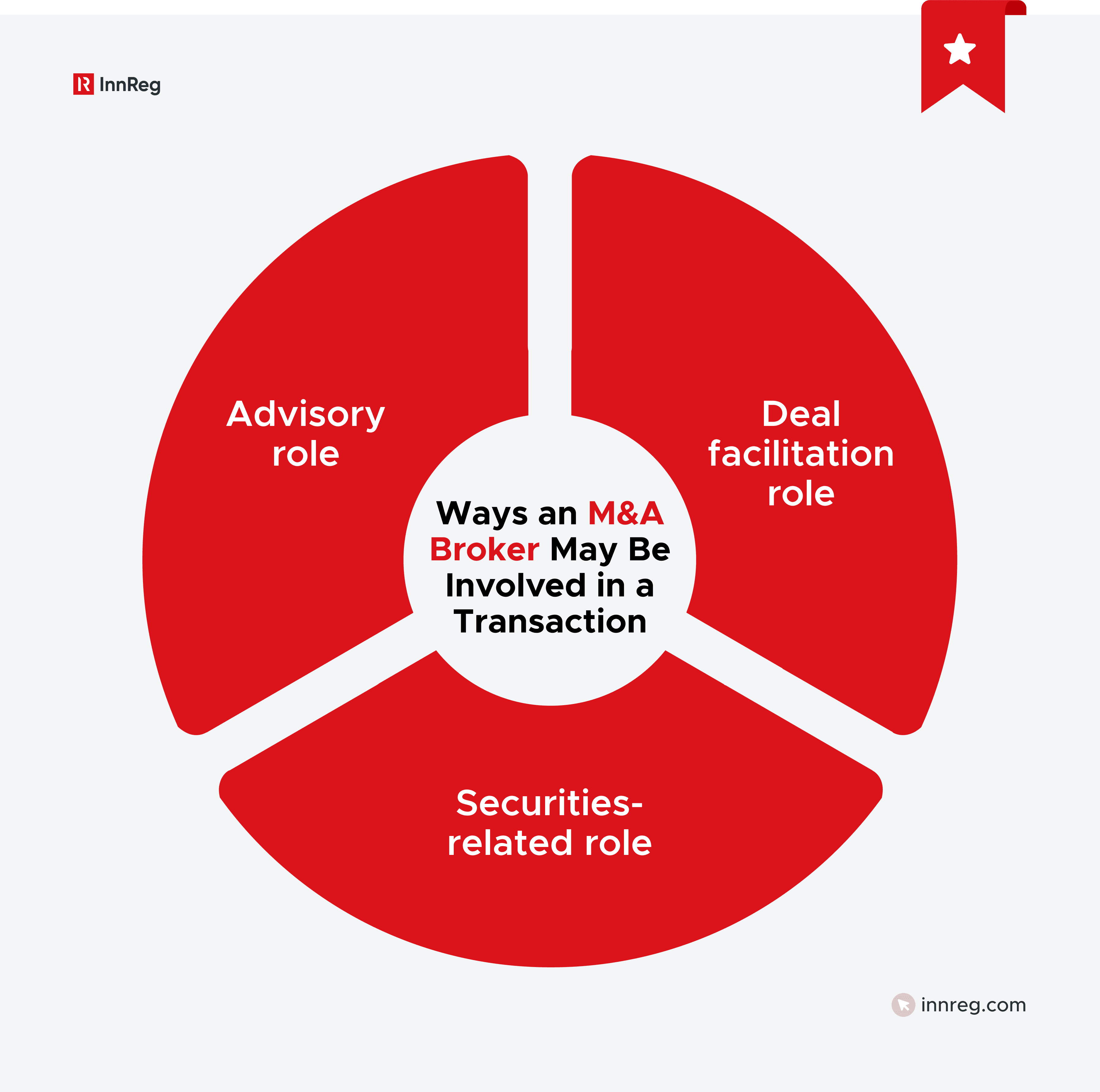
1. Advises on the Sale, Merger, or Acquisition of a Business
M&A brokers often get involved before a deal takes shape. At this stage, their role is usually advisory. They help business owners and buyers think through whether a sale, merger, or acquisition even makes sense.
That advice can include:
Discussing timing
Setting realistic expectations around value
Talking through how a business might be presented to potential counterparties
The focus is on the business and the transaction goals, not on trading securities or accessing public markets.
This type of involvement is generally lower risk from a regulatory standpoint. Problems tend to show up when advisory work starts to overlap with negotiating ownership interests or when compensation is tied directly to closing the deal.
2. Identifies Buyers or Sellers and Facilitates Transactions
In many deals, the M&A broker’s main value comes from making the right connections.
Instead of cold outreach or guesswork, brokers tap into their networks to introduce buyers and sellers who are already a strong fit. Those introductions often set the tone for the entire transaction and shape how discussions unfold from the start.
As discussions move forward, the brokers stay involved to keep conversations on track. They often:
Help coordinate meetings
Share high-level information between the parties
Serve as a consistent point of contact as terms begin to take shape
Regulators tend to look harder at this kind of activity. Lining up counterparties and shaping the discussions starts to resemble solicitation, particularly when the broker only gets paid if a deal goes through.
The broker’s level of involvement and fee structure often play a big role in how regulators view this activity.
3. Participates in Transactions Involving Securities
Some M&A transactions go beyond the sale of a business and involve ownership interests that are treated as securities. This can catch founders and deal teams off guard, especially when the transaction feels more like a private business sale than a securities offering.
When an M&A broker becomes involved at this stage, their role tends to draw closer regulatory attention. Activities like negotiating terms, discussing equity consideration, or shaping how ownership interests are transferred can all factor into how regulators view the broker’s involvement.
The key issue is how active the broker is in the securities side of the transaction. The more closely their work is tied to the transfer of ownership interests, the more likely securities laws come into play.
When Federal Broker-Dealer Registration Is Required
Not every M&A broker needs to be registered at the federal level, but certain activities can change that quickly. Registration often depends on how the broker is paid and how involved they are in the transaction. Here are the main areas regulators tend to focus on.
Transaction-Based Compensation
How an M&A broker gets paid is often one of the first things regulators look at. Compensation tied directly to whether a deal closes raises more questions than a flat or hourly fee.
Transaction-based compensation usually means the broker is paid a percentage of the deal value or receives a success fee at closing. From a regulatory standpoint, this can suggest the broker is doing more than providing general business advice. It may indicate active participation in the transaction itself.
Success fees on their own are not automatically a problem, but they do draw more regulatory attention. Once transaction-based compensation is combined with active negotiation or a hands-on role in getting deals done, it becomes much harder to argue that broker registration is not required.
For that reason, the compensation structure is typically discussed early, before engagement terms are finalized.
Effecting Transactions in Securities
Some M&A brokers limit their role to introductions and early coordination. Others stay closely involved as a deal moves toward closing. When ownership interests are part of the transaction, that level of involvement begins to matter more.
That’s when regulators focus on what the broker does during the deal. This can include:
Helping shape how ownership is transferred
Coordinating key steps at closing
Guiding the parties through the final exchange of interests
As brokers get closer to the moment a deal actually changes ownership, regulators tend to look more closely. At that point, the work may start to look less like general deal support and more like direct involvement in a securities transaction. That’s usually where broker registration questions begin to surface.

Solicitation, Negotiation, and Deal Participation
Another area regulators pay close attention to is how actively an M&A broker engages with buyers and sellers during the deal. This goes beyond making introductions and moves into shaping how the transaction comes together.
Solicitation: This often includes reaching out to potential buyers or investors and encouraging them to participate in a transaction.
Negotiation: This involves discussing deal terms, relaying offers, or helping the parties work through points of friction.
Deal participation: What may seem like trivial actions, from steering conversations to helping align expectations as terms evolve, will be considered by regulators.
Individually, these actions may seem routine. Taken together, they can signal a deeper level of involvement. When an M&A broker is actively soliciting interest, negotiating terms, and staying closely engaged throughout the deal, regulators may view that role as more than background support.
The Federal M&A Broker Exemption
Federal law includes a specific exemption designed for certain M&A broker activities. This exemption can allow brokers to participate in qualifying transactions without registering as broker-dealers, but it comes with defined limits.
Below, we outline how the exemption works, the conditions that apply, and where it doesn't extend.
See also:
Overview of the New Federal Exemption (Exchange Act § 15(b)(13))
The federal M&A broker exemption was created to bring more clarity to a space that had long relied on regulatory guidance and no-action letters. It formally recognizes that certain M&A broker activities, when limited in scope, don’t require full broker-dealer registration.
Under this exemption, an M&A broker can assist with qualifying transactions involving privately held companies without registering at the federal level. The focus is on deals where a buyer or group of buyers is acquiring control of a business, rather than purchasing passive investment interests.

Need help with broker-dealer compliance?
Fill out the form below and our experts will get back to you.
Conditions Required to Rely on the Exemption
The federal M&A broker exemption applies only if several specific conditions are met. These conditions are designed to keep the exemption focused on true business sales, not investment offerings.
Generally, the following requirements must be satisfied:
The transaction involves a privately held company, not a public issuer
The buyer, or group of buyers, is acquiring control of the business
The M&A broker doesn't have custody or control of funds or securities
The broker isn't involved in a public offering of securities
The broker doesn't represent both buyer and seller without proper disclosure and consent
Because the exemption is narrow, small changes in deal structure or broker involvement can affect whether it’s available. That’s why it’s important to review each transaction carefully before relying on it.
Transactions That Fall Outside the Exemption
The federal M&A broker exemption is helpful, but it has boundaries. Certain transactions and broker activities don’t qualify.
Examples include transactions where:
The company involved is publicly traded
Securities are offered to passive investors rather than buyers acquiring control
The broker has custody or control of funds or securities
The broker participates in a public offering of securities
The broker’s role resembles selling or distributing investment interests rather than facilitating a business sale
If a transaction falls into one of these buckets, the exemption is likely off the table. That’s why it helps to revisit eligibility as the deal structure develops.

M&A Broker vs. Traditional Broker-Dealer Roles
While M&A brokers and traditional broker-dealers both operate around transactions, their roles aren't the same. The differences matter because they affect licensing requirements, compliance obligations, and how deals are structured.
The table below highlights the key distinctions.
Aspect | M&A Broker | Traditional Broker-Dealer |
|---|---|---|
Typical transactions | Sales or acquisitions of privately held businesses | Purchases and sales of securities, including public offerings |
Type of buyer | Buyer acquiring control of a business | Investors, including passive investors |
Role in the deal | Facilitates introductions and supports deal discussions | Executes and effects securities transactions |
Compensation | Often success-based, subject to limits and exemptions | Transaction-based compensation is standard |
Registration | May rely on the federal M&A broker exemption if conditions are met | Federal registration generally required |
Regulatory focus | Nature of involvement and deal structure | Ongoing supervision, trading, and sales activity |
Custody of funds or securities | Not permitted under the exemption | May hold or handle client funds or securities |
Understanding these differences can help deal teams choose the right structure and avoid surprises later in the process. When an M&A broker’s role starts to look more like a traditional broker-dealer, registration questions tend to follow, which is why clarity around roles is so important early on.
What Compliance Obligations Apply to M&A Brokers?
Even when an M&A broker isn't required to register as a broker-dealer, compliance obligations still apply. The scope of those obligations depends on whether the broker is registered or relying on an exemption.
Here’s how compliance expectations differ in each case.

If You Are a Registered Broker-Dealer
When an M&A broker is registered as a broker-dealer, a full set of federal compliance obligations applies. These requirements touch how the firm is supervised, how compensation is structured, and how records and reports are maintained. Below are the key areas regulators expect registered firms to address.
Supervision and Written Supervisory Procedures
Registered broker-dealers are expected to maintain a supervisory structure that matches how the firm operates. For M&A brokers, that means supervision tailored to:
Deal activity
Compensation arrangements
How brokers interact with buyers and sellers
Written supervisory procedures play a central role here. They should clearly describe how M&A activity is reviewed, who is responsible for oversight, and how potential issues are escalated. Generic policies rarely hold up well if they don’t reflect how deals are sourced, negotiated, and closed.
Ongoing supervision matters just as much as written policies. Regulators look at whether firms are actively reviewing transactions, monitoring compensation, and documenting oversight as deals progress. For M&A brokers, supervision is less about volume and more about judgment calls made at key points in the transaction.
Learn more about building effective written supervisory procedures →
Compensation, Success Fees, and Conflicts
Compensation is a sensitive area for registered broker-dealers, especially in M&A transactions. Success fees and other transaction-based payments are common, but they need to be structured and disclosed carefully.
Conflicts can arise when compensation depends on a deal closing or when a broker’s incentives aren't fully aligned with the client’s interests. That might include:
Representing both sides of a transaction
Receiving different compensation depending on the outcome
These situations aren't automatically prohibited, but they do require clear disclosure and thoughtful oversight.
Registered firms are expected to identify these conflicts early and address them through policies, disclosures, and supervision. The focus is on transparency and documentation, so regulators can see how potential conflicts are managed throughout the life of a deal.
Recordkeeping and Regulatory Reporting
Registered broker-dealers are required to maintain detailed records of their activities, including M&A transactions. This includes:
Engagement agreements
Compensation arrangements
Documents related to how deals were structured and reviewed
These records aren't just for internal use. Regulators expect firms to produce them during examinations or in response to inquiries. Incomplete or inconsistent records can raise questions, even when the underlying transaction is otherwise compliant.
Ongoing regulatory reporting also plays a role. Depending on the firm’s activities, this can include filings related to financial condition, business changes, or supervisory issues. For M&A brokers, keeping records organized and current helps support both day-to-day oversight and regulatory exams.
Relying on the Exemption
Relying on the federal M&A broker exemption doesn't mean compliance obligations disappear. It shifts the focus. Brokers still need to monitor eligibility, maintain clear documentation, and account for state-level requirements.
Here’s what that looks like in practice.
Conditions to Monitor
When relying on the federal M&A broker exemption, eligibility isn't something you check once and forget. The conditions tied to the exemption need to be monitored throughout the life of the transaction.
Deal terms can change as negotiations progress. A buyer group may shift. Compensation structures may be revised. Any of these changes can affect whether the exemption still applies. That’s why it’s important to keep an eye on control, the type of ownership being transferred, and the broker’s level of involvement as the deal evolves.
Documentation Best Practices
Clear documentation is essential when applying the federal M&A broker exemption. If questions come up later, your records are often the first place regulators will look.
At a minimum, documentation should clearly describe:
The broker’s role
How compensation is structured
Why the transaction qualifies for the exemption
Engagement letters, deal summaries, and internal notes should all tell a consistent story.
Good documentation also helps as deals evolve. When terms change, updating records along the way makes it easier to show how exemption conditions were monitored throughout the transaction, not just at the start.
State Compliance Overlay
Even when a transaction aligns with the federal M&A broker exemption, state laws can still apply. Many states have their own broker or finder rules, and those requirements don’t always line up neatly with the federal framework.
Similar exemptions are recognized by some states. Others take a narrower view or impose separate registration or notice requirements. This can be especially relevant when parties are located in different states or when a broker is active across multiple jurisdictions.
Because of this, state-level analysis is often part of the compliance picture. Reviewing applicable state rules alongside the federal exemption helps avoid gaps that might not be obvious if you are only looking at the transaction from a federal perspective.
See also:
What Are the Most Common Compliance Challenges for M&A Brokers?
M&A brokers tend to face the same compliance issues again and again, especially as deals grow more complex or evolve over time. Below are some of the most common challenges, along with why they matter.
Misclassifying the Broker’s Role: Deals often start with a narrow scope and expand quickly. A broker who begins as a connector may become more involved as negotiations progress, which can change how their role is viewed under securities laws.
Transaction-Based Compensation Risks: Success fees are common in M&A transactions, but they can increase regulatory risk. When compensation is tied directly to closing, it can raise questions about whether the broker is participating in a securities transaction.
Drifting Outside the Exemption: Even when a deal initially qualifies for the federal M&A broker exemption, changes in structure, buyer composition, or broker involvement can push it outside the exemption without anyone noticing.
Insufficient Documentation: Weak or inconsistent documentation makes it harder to show how exemption conditions were met or how compliance decisions were made. This often becomes an issue during exams or follow-up inquiries.
Overlooking State-Level Requirements: Federal compliance is only part of the picture. State broker and finder rules can apply independently and are often missed, especially in multi-state transactions.
Conflicts of Interest: Representing both sides of a transaction or having incentives tied to deal outcomes can create conflicts that need to be disclosed and managed carefully.
Late Compliance Review: Compliance issues are often addressed after deal terms are already set. At that point, fixing structural issues can be difficult, costly, or disruptive to the transaction timeline.

Special Considerations for Fintech/Hybrid Models
M&A transactions involving fintechs often raise different questions than traditional business sales. New asset types, technology-driven models, and multi-jurisdiction operations can all affect how an M&A broker’s role is viewed from a regulatory standpoint. This is especially true when the deal doesn't fit neatly into existing categories.
1. Crypto, Tokenized Equity, and Hybrid Assets
M&A transactions involving crypto or tokenized assets often challenge traditional assumptions about what is being bought and sold. Even when a deal is framed as a business acquisition, the assets involved may still be treated as securities.
For M&A brokers, this creates added complexity. Tokens that convey any of the following can trigger a securities analysis, regardless of how they are labeled:
Ownership
Governance
Economic rights
That means the broker’s level of involvement and compensation structure matter just as much here as in more traditional equity deals.
Learn more about tokenized securities and what regulators expect from issuers and platforms →
2. Platform-Based Deal Facilitation Models
Some fintech businesses operate platforms that connect buyers and sellers for acquisitions or investment opportunities. When M&A brokers are involved in these models, the line between facilitating introductions and participating in transactions can become less clear.
Features like automated matching, standardized deal terms, or built-in workflows can raise questions about how active the platform really is. The more a platform shapes how deals are presented and executed, the more attention regulators tend to pay to the broker’s role.
For M&A brokers working with or through platforms, it’s important to understand how the technology fits into the transaction process. Small design or process choices can affect how the activity is viewed from a regulatory standpoint.
3. Cross-Border and Multi-Jurisdiction Transactions
When an M&A transaction crosses borders, regulatory complexity increases quickly. Different jurisdictions may have their own rules around broker activity, securities, and licensing, even when the deal structure looks similar.
An M&A broker may need to account for:
Where the buyers and sellers are located
Where the assets sit
Which laws apply to solicitation and deal activity
A transaction that is straightforward in one country can raise additional issues once another jurisdiction is involved.
Early coordination is especially important in cross-border deals. Addressing regulatory questions up front helps avoid delays or last-minute changes as the transaction moves toward closing.
—
M&A brokers can add real value to a transaction, but the regulatory line they operate on isn't always obvious. Small choices around compensation, deal involvement, or transaction structure can change how that role is viewed under securities laws.
For deal teams, the takeaway is simple. These questions are easier to address before a transaction gains momentum. Once terms are set and parties are aligned, adjusting structure or broker involvement becomes harder and more disruptive.
That’s especially true in fintech and hybrid transactions, where assets and platform-driven models tend to draw closer regulatory attention. Approaching M&A broker compliance with clarity and intention early on helps keep the focus where it belongs: on getting the deal done.
M&A Brokers FAQs
What Is the Difference Between a Business Broker and an M&A Broker?
Business brokers typically focus on smaller transactions, often involving local or owner-operated businesses. M&A brokers, on the other hand, usually work on larger, more complex deals and are more likely to be involved in transactions that raise securities law considerations. The distinction isn't always formal, but deal size, structure, and regulatory exposure tend to differ.
What Does M&A Stand For?
M&A stands for mergers and acquisitions. It refers to transactions where companies combine operations through a merger or where one company acquires another, either through an asset sale or the purchase of ownership interests.
How Much Does an M&A Broker Charge?
Fees vary based on the size and complexity of the transaction. Many M&A brokers charge success-based fees tied to the deal value, while others may use flat or hybrid fee structures. Compensation terms are important from a compliance perspective and are often reviewed closely when assessing registration or exemption requirements.


Tarik is a Principal Compliance Consultant at InnReg with over 5 years of experience advising fintech clients across broker-dealer, RIA, and money transmitter verticals. He holds FINRA Series 3, 7, 24, 57, 63, 79, and 99 licenses, with expertise in regulatory strategy, supervisory systems, and compliance roadmap implementation.
How Can InnReg Help?
InnReg is a global regulatory compliance and operations consulting team serving financial services companies since 2013.
We are especially effective at launching and scaling fintechs with innovative compliance strategies and delivering cost-effective managed services, assisted by proprietary regtech solutions.
If you need help with broker-dealer compliance, reach out to our regulatory experts today:
Related Articles




Featured LinkedIn Posts