What Is the Investment Adviser Public Disclosure (IAPD)?
The Investment Adviser Public Disclosure (IAPD) system is one of the first places regulators and investors refer to when they want to understand who an investment advisor is and how the firm operates.
This database also plays a key role in day-to-day operations. Firms rely on it to confirm registration details, maintain accurate public information, and track updates tied to Form ADV filings. Understanding what the IAPD encompasses is important for fast-moving fintechs that may risk making small errors or using outdated disclosures that can create unnecessary friction.
This article gives you a clear, practical look at how the IAPD works and why it matters. You’ll learn who appears in the database, what disclosures are included, how it connects to Form ADV, and how it differs from tools like FINRA BrokerCheck.
At InnReg, we help advisory firms manage Form ADV filings, maintain their IAPD profiles, and support ongoing compliance operations. Our team works with RIAs, ERAs, and fintech innovators navigating evolving registration and disclosure needs.


The Investment Adviser Public Disclosure (IAPD) Explained
The IAPD is a public database that provides a clear view of an investment advisor’s regulatory information.
It pulls together firm and individual data from Form ADV filings and presents it in a format that regulators, investors, and compliance teams can easily review. Think of it as the primary window into how an advisory firm is structured and how it operates.
At its core, the IAPD shows;
Who is registered
How they are registered
What disclosures apply to them
This includes firm details, ownership information, disciplinary history, compensation models, and the activities the firm is approved to conduct. For individuals, it covers background details, licenses, employment history, and any reportable events.
For fintech firms in particular, the IAPD is an important checkpoint at every stage of growth. Keeping the public profile accurate helps teams move quickly and stay aligned with regulatory expectations. This is also where a partner like InnReg can be helpful, especially when managing multiple filings across complex advisory structures.
Who Regulates the IAPD and Why It Matters
The IAPD exists because both the SEC and state securities regulators need a shared place to maintain advisor information. Together, they feed data into the system so anyone can see who oversees a firm and how that registration is structured. This combined approach gives users a clearer view of the regulatory landscape behind each advisory business.
Securities and Exchange Commission (SEC) vs. State Registration
Advisory firms fall into two main categories:
Those registered with the SEC
Those registered with state regulators
The IAPD helps make this distinction clear by showing exactly which authority oversees the firm and what that means for its filing obligations.
SEC registration generally applies to larger firms or those working with certain types of clients, while state registration covers smaller firms and local advisory businesses. The database displays this information upfront, along with details tied to each regulator’s requirements.
Growth in assets or changes in the business model often trigger a shift from state oversight to SEC registration. Understanding how the IAPD reflects these transitions helps firms prepare for the next stage without unnecessary delays.
Aspect | SEC Registration | State Registration |
|---|---|---|
Who it applies to | Larger firms or those meeting SEC eligibility thresholds | Smaller or local advisory firms below SEC thresholds |
Regulatory oversight is shown in IAPD | SEC is listed as the primary regulator | Specific state securities authority listed |
Common triggers | Growth in assets, specific client types, or multi-state operations | Firms starting out or operating primarily within one state |
What teams look for | Federal filing obligations and national disclosure requirements | State-specific rules, renewals, and reporting timelines |
Learn more about the differences between SEC and state registration for RIAs →
The Role of FINRA and the IARD System
The IAPD is powered by the Investment Adviser Registration Depository, or IARD. FINRA operates this system for the SEC and the states, which is why FINRA’s name shows up in advisor filing processes even though it doesn’t regulate RIAs.
Here’s how the pieces fit together:
FINRA runs the IARD platform, but the SEC and state regulators supply and review the data.
Firms submit Form ADV filings through IARD, including initial applications and ongoing amendments.
Information sent to IARD flows into the public IAPD database, where investors, regulators, and counterparties can review it.
Filing fees and renewals are handled inside IARD, keeping payments and submissions in one place.
Compliance teams track updates through IARD, since any change in ownership, business activities, conflicts, or disciplinary details appears later in the IAPD.
This structure makes IARD a critical part of the daily workflow for advisory firms, especially those in fintech that update filings more frequently as their business models evolve.
What Firms and Individuals Are Listed in the IAPD Database?
The IAPD includes more than just registered investment advisors. It brings together several categories of firms and individuals so users can get a complete view of the advisory landscape. This helps founders, lawyers, and compliance teams understand exactly who must appear in the system and why.
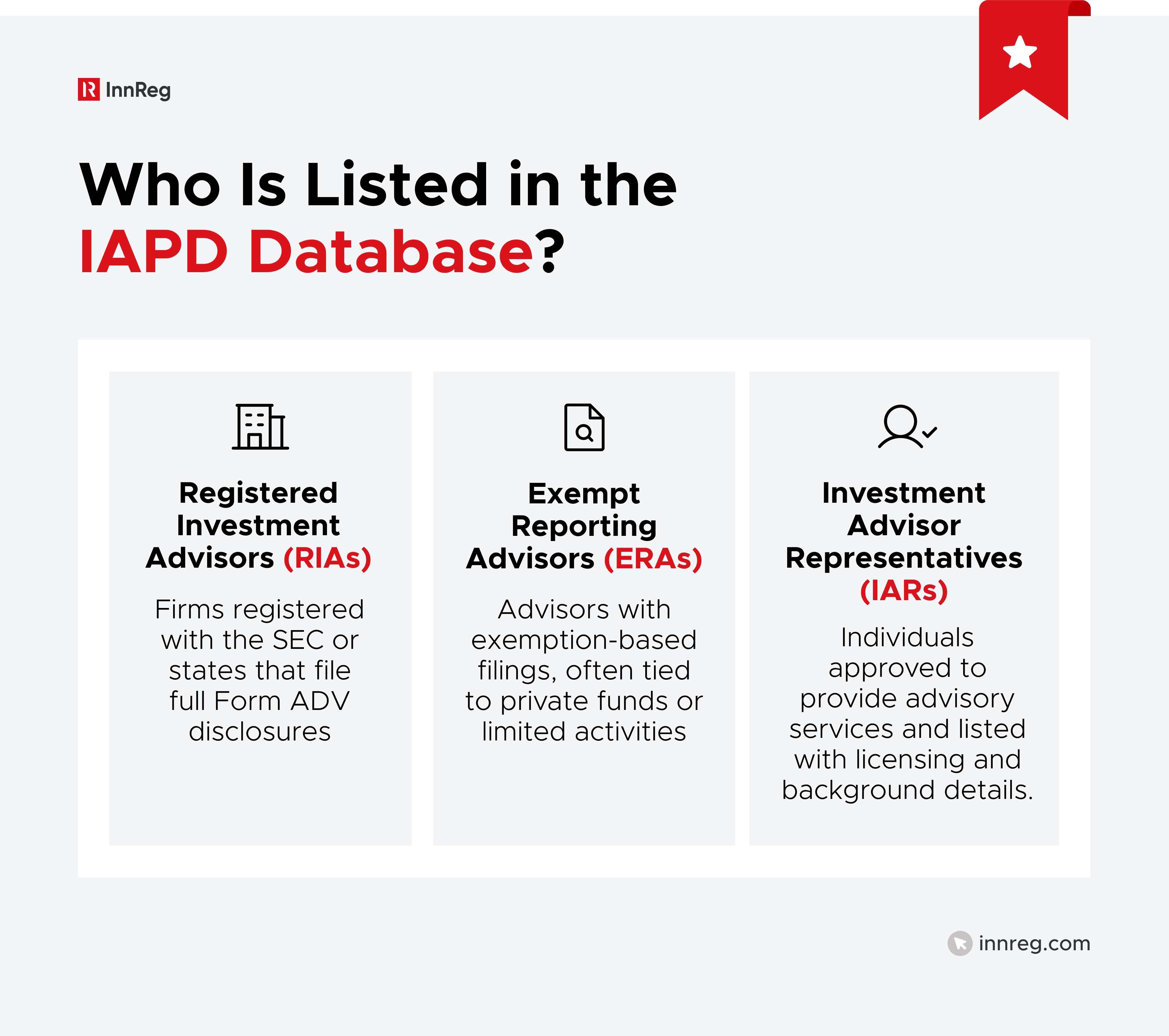
There are three main groups in the database: RIAs, Exempt Reporting Advisors (ERAs), and Investment Advisor Representatives (IARs).

Registered Investment Advisors
Registered Investment Advisors make up the core of the IAPD. These are firms that meet either state or SEC registration requirements and file Form ADV on an ongoing basis. Their profiles show how the firm is structured and what advisory activities it is approved to conduct.
A typical RIA listing includes ownership information, types of clients served, business lines, compensation methods, and any reportable disciplinary history. For fintech-focused RIAs, the profile often reflects more complex models, such as automated platforms, hybrid services, or digital asset activity.
You should also note that as these firms scale, their information changes quickly. Growth in assets, new product lines, or expanded geographic reach can all trigger updates to the IAPD.
Exempt Reporting Advisors
ERAs also appear in the IAPD even though they are not fully registered as RIAs.
These firms qualify for exemptions, often because they advise only private funds or meet specific criteria that place them under a lighter regulatory framework. Their filings are more limited, but the IAPD still shows key details about the firm and its exempt status.
An ERA profile typically includes ownership information, basic business descriptions, and any required disclosures tied to the exemption. While the filings are shorter than a full Form ADV, they still matter because investors and regulators use them to understand how the firm operates.
See also:
Investment Advisor Representatives (IARs)
The IAPD also lists individual Investment Advisor Representatives who work under registered firms.
These are the people who provide advice, interact with clients, or perform advisory functions that require registration. Their profiles help users see who is licensed, where they are approved to operate, and what background information applies to them.
An IAR listing usually includes employment history, exams passed, state registrations, and any reportable disciplinary events. This information gives clients and regulators a clear view of the individual’s qualifications and professional track record.

Need help with RIA compliance?
Fill out the form below and our experts will get back to you.
Key Disclosures You’ll Find on the IAPD Database
The IAPD brings together a wide range of disclosures that help users understand how an advisory firm operates. These details vary by firm type and registration, but most profiles follow a similar structure.
1. Firm Registration and Business Model
The IAPD shows how a firm is registered and gives a clear picture of the business it operates.
This section of the profile highlights the firm’s registration type and the advisory activities it’s approved to conduct. Users can also see whether the firm reports to the SEC or to state regulators.
You’ll find details about the services the firm provides, the types of clients it serves, and any additional business lines it reports. For fintech-focused firms, this may include automated platforms, digital asset activity, or technology-driven advisory models. These descriptions help regulators and investors understand how the firm fits within the broader advisory landscape.

2. Fees and Compensation Structures
The IAPD outlines how advisory firms earn revenue and what clients can expect from their fee models.
This section highlights the types of compensation the firm receives, such as asset-based fees, hourly charges, performance fees, or fixed rates. It also shows whether the firm or its advisors receive any additional compensation from third parties.
These disclosures help users understand potential incentives and how the firm structures its advisory relationships. For fintech firms, this can include subscription models, tiered pricing, or technology-assisted fee structures that differ from traditional advisory setups.
Because compensation models can evolve as products mature, firms often revisit this part of their Form ADV. Clear, updated disclosures help clients, regulators, and partners understand how the firm positions itself and how it balances the interests of the business with the needs of its advisory clients.
3. Disciplinary Events and Red Flags
The IAPD includes disclosures about disciplinary events for both firms and individuals. This section highlights any past or current issues that regulators or clients may want to review. It covers regulatory actions, criminal matters, civil proceedings, and other events that require reporting under Form ADV.
Not every entry is a major concern, but each one provides context about the firm’s history and how it handled the situation. Users can read summaries, see relevant dates, and understand whether the matter involved the firm, its owners, or its advisor representatives.
4. Affiliated Businesses and Conflicts of Interest
The IAPD also highlights relationships that may influence how a firm operates. This part of the profile shows affiliated businesses and potential conflicts of interest that arise from those connections. It helps users see whether the firm is tied to other financial entities, service providers, or owners with separate business activities.
These disclosures can include partnerships, related advisory services, insurance offerings, or other financial operations linked to the firm. For fintech companies, affiliations may also involve technology partners, digital asset platforms, or service providers that play a role in the product experience. Clear listings help users understand how the firm fits into a broader network.
5. Individual Advisor Background
The IAPD lists background information for each Investment Advisor Representative tied to a firm. This includes education, professional experience, exam history, and state registrations. Together, these details give users a simple way to evaluate the qualifications of the individuals who provide advisory services.
Profiles also show employment history, disclosures, and any licenses that the representative holds. For firms with growing advisory teams, especially those expanding into new states, this information helps clients and regulators understand where each representative is approved to operate.
Because advisor roles can change over time, this part of the IAPD may update frequently. New registrations, additional exams, or changes in employment flow into the system through Form U4 or related filings. Regular maintenance keeps the public information aligned with each advisor’s current responsibilities.
See also:
6. Form ADV Parts 1, 2, and 3 (Form CRS)
The IAPD pulls much of its information directly from Form ADV, which is the core filing for advisory firms. Each part of Form ADV provides a different type of disclosure, and together they create a complete picture of how the firm operates and communicates with clients.
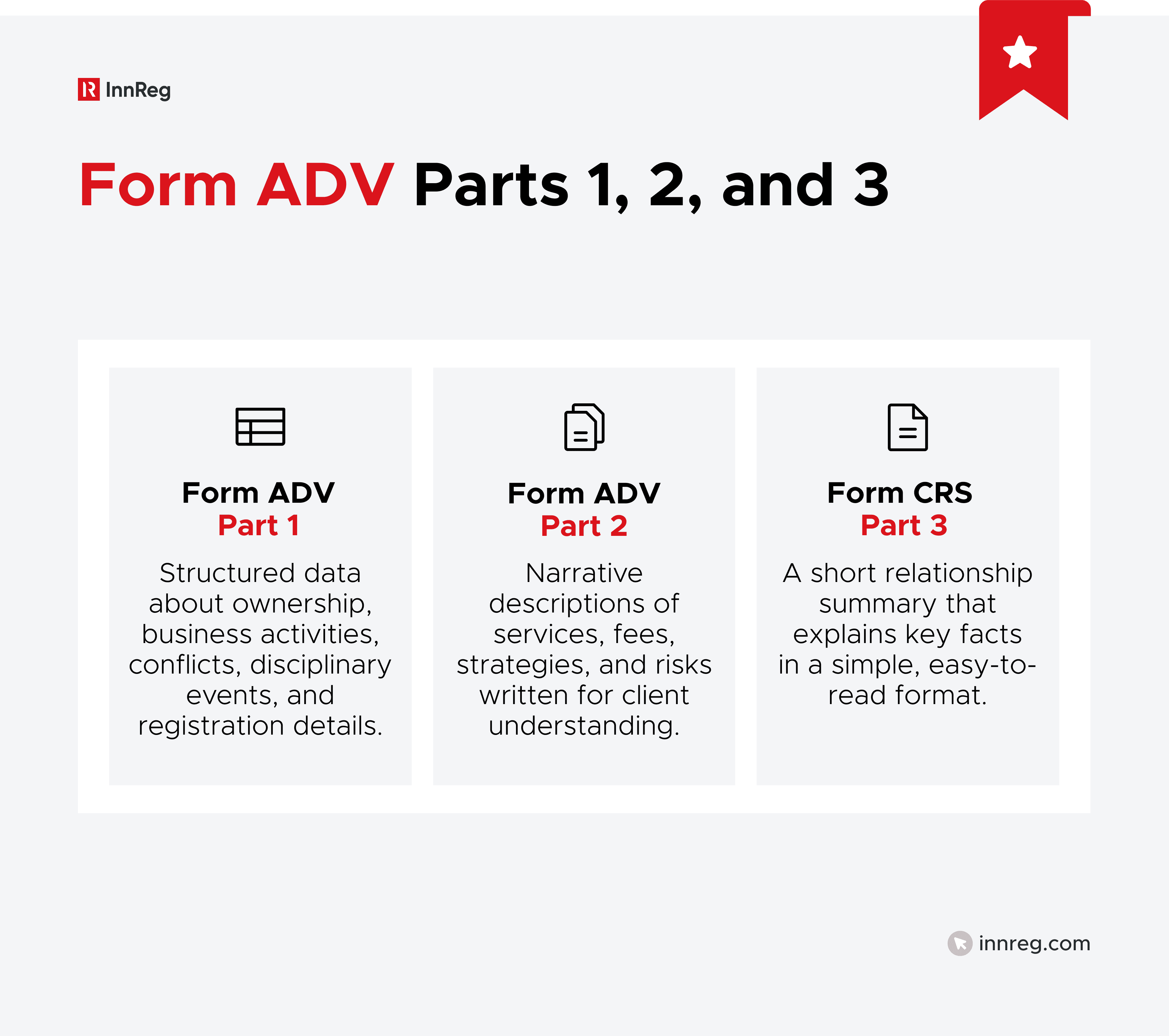
Form ADV Part 1 includes structured data about ownership, business activities, conflicts, disciplinary events, and registration details. This is the information that appears most visibly on the IAPD.
Form ADV Part 2 contains narrative descriptions of services, fees, investment strategies, and risks. It is designed to help clients understand how the firm works and what they should consider before engaging.
Form CRS (Part 3) is a concise relationship summary that explains key facts in a short, easy-to-read format.
For fintech advisory firms, these documents are essential to communicating how their technology-driven models function. Clear descriptions help regulators and investors understand how automated tools, digital assets, or platform features fit into the advisory relationship.
For a detailed breakdown of Form ADV requirements and how advisory firms use each section, visit our complete guide here: Form ADV Guide for Investment Advisors and Fintechs →

How to Search for Firms and Individuals in the IAPD System
The IAPD is designed to be simple to navigate once you know where to look. The search tool lets users find firms, exempt reporting advisors, and individual representatives with just a few pieces of information. You can search by name, CRD number, location, or even partial terms if you’re not sure of the exact spelling.
The search results show basic identifiers first, then link to full profiles with registration details, disclosures, and Form ADV documents. This setup lets users move quickly from a broad search to specific information without sifting through unnecessary data.
Here is a simple guide to help you move through the IAPD search tool with confidence:
Step 1: Go to the IAPD search page. You’ll see options to search for firms, individuals, or exempt reporting advisors.
Step 2: Enter a name or CRD number. Even a partial name will bring up results you can sort through.
Step 3: Review the search results. Each entry shows basic identifiers so you can confirm you have the right firm or individual.
Step 4: Open the profile. This is where you will find registration details, disclosures, and links to Form ADV filings.
Step 5: Download or view documents. Most firms provide Form ADV Parts 2 and 3 in formats you can read directly from the profile.
IAPD vs. BrokerCheck: What’s the Difference?
The IAPD and FINRA’s BrokerCheck are often mentioned together, but they serve different parts of the financial industry. The IAPD focuses on investment advisors, advisory firms, and exempt reporting advisors, while BrokerCheck focuses on broker-dealers and registered representatives in the brokerage world.
Both tools share some similarities. They display registration details, background information, and disciplinary disclosures. They also help clients and regulators understand who they are dealing with. The main difference is the type of license each database covers and the regulatory framework behind it.
Firms that operate across both advisory and brokerage activities typically appear in both systems.
When To Use Each Tool
The IAPD is the right choice when you need information about advisory firms, exempt reporting advisors, or individual advisor representatives. It shows Form ADV filings, registration details, and disclosures tied to the advisory side of the business.
BrokerCheck is the better option for reviewing broker-dealers and registered representatives in the brokerage industry. It highlights exam history, licensing, employment changes, and disciplinary details related to brokerage activities.
If a firm or individual operates in both spaces, checking both tools gives a fuller picture. Many compliance teams review them together during onboarding, vendor due diligence, or periodic internal checks. This helps confirm that public information is accurate across both regulatory systems.
Feature | IAPD | BrokerCheck |
|---|---|---|
Primary focus | Investment advisors and advisory firms | Broker-dealers and registered representatives |
Key filings | Form ADV Parts 1, 2, and 3 | Form U4, U5, BD, and related filings |
What you can review | Advisory activities, disclosures, registrations | Licensing, exams, employment history, disclosures |
Best use case | Evaluating advisory firms and IARs | Reviewing brokers and brokerage activity |
Overlapping Registrations
When firms or individuals work in more than one part of the financial industry, their registrations can overlap. The most common overlaps happen between:
RIA and broker-dealer registrations for firms that offer both advisory and transactional services
IAR and registered representative (RR) licenses for individuals who provide advice and also execute trades
Firms with related entities, such as an RIA affiliated with a broker-dealer under the same parent company
Hybrid advisory models, where part of the business is fee-based, and part is commission-based
These overlaps are completely normal, but they do come with extra operational work. To handle them effectively, firms usually:
Review both IAPD and BrokerCheck profiles regularly to make sure disclosures match across systems.
Coordinate updates across filings, since a change in ownership, conflicts, or business activities may flow into both Form ADV and brokerage filings.
Use a straightforward internal process so compliance, legal, and operations teams know when a filing in one system triggers updates in the other.
Track changes through a filing calendar, especially during growth phases when registrations evolve quickly.
Keeping both profiles aligned helps firms maintain a consistent story across regulatory databases. It also reduces the back-and-forth that often occurs when something is accidentally updated in one system but not the other.
Integration via Investor.gov
Investor.gov brings the IAPD and BrokerCheck together in one place. This makes it easy for users to run a search without deciding which database to start with. The tool routes each query to the right system and returns a unified view of advisory and brokerage information when both apply.
This setup is helpful for firms and individuals with overlapping registrations. A single search can show advisory details from the IAPD and brokerage details from BrokerCheck side by side. It also gives clients a smoother way to review background information before working with a firm or representative.
How Compliance Teams Should Use the IAPD
Here are the key ways compliance teams use the IAPD to stay organized and keep filings aligned with their actual activities.
Public Profile Management
The IAPD acts as a firm’s public-facing profile in the advisory world. Compliance teams regularly check this page to confirm that the information displayed matches the firm’s current operations. This includes business activities, ownership details, compensation structures, conflicts, and any disclosures tied to the firm or its advisor representatives.
Keeping the profile current helps avoid confusion during exams, investor reviews, or partnership discussions. Even small changes in the business, such as new product lines or expanded client types, can affect what appears in the IAPD.
Preventing Filing Gaps and Data Conflicts
Compliance teams use the IAPD to spot inconsistencies between what appears in the public profile and what is reflected in internal records. This helps them identify filing gaps, outdated disclosures, or data conflicts before they become issues during regulatory reviews.
Common examples include changes in ownership, new business lines, revised fee models, or updates to conflicts of interest. If these changes are not captured in Form ADV or related filings, the IAPD profile may look incomplete or out of sync with how the firm actually operates.
To stay ahead of this, many teams build simple workflows that include regular IAPD checks. Reviewing the profile after internal updates or during scheduled compliance reviews helps catch discrepancies early.
Internal Controls and Filing Calendars
A strong compliance process includes a clear filing calendar and internal controls that keep Form ADV updates on track.
Teams use the IAPD to confirm that updates appear correctly after each submission, which makes it easier to see whether filings are posted as expected and whether the public profile matches current activities.
Filing calendars become especially valuable during growth. New services, additional states, or changes in assets can trigger amendments, and a structured schedule helps teams keep everything organized. Internal controls also clarify when a filing is needed and who is responsible for preparing it.
For fintech firms, these processes bring stability as the business evolves. They help teams stay organized, reduce the chance of missed deadlines, and support consistent communication with regulators.
See how we manage compliance workflows for RIAs →
Common IAPD Pitfalls and Misconceptions
Advisory firms of all sizes run into avoidable issues with their IAPD filings. Many of these challenges stem from misunderstandings about who needs to register, how Form ADV works, or which disclosures require updates. Spotting these patterns early helps compliance teams keep public information accurate and consistent.
“We’re Too Small to Register”
Some early-stage firms believe they do not need to register because they are still small or working with only a few clients. In reality, registration depends on the type of advisory activity, not just the size of the firm.
This misunderstanding can lead to late filings or incomplete entries in the IAPD. A firm may begin offering advice, charging fees, or launching a new product without realizing that these steps trigger registration requirements. Once the criteria are met, Form ADV must be filed.
Fintech firms with evolving models face this challenge often. Reviewing advisory activities regularly helps teams understand when registration applies and stay aligned with regulatory expectations as the business grows.
“Form ADV Is Just a Formality”
Some firms view Form ADV as a quick filing step rather than a detailed disclosure document. This mindset often results in incomplete or outdated information in the IAPD, which can create confusion during exams or investor reviews.
Form ADV plays a central role in showing how the firm operates, how it earns revenue, and what conflicts may exist. Regulators and clients rely on these details to understand the firm's practices. When firms treat the filing as a simple checkbox, significant gaps can appear once the information becomes public.
Fintech firms with fast-changing models benefit from treating Form ADV as a living document. Updating it as products evolve, ownership structures shift, or new services launch helps keep the narrative accurate and aligned with how the business actually operates.
“IAPD Doesn’t Apply to Individuals”
It’s easy to assume the IAPD only covers firms, but it also includes detailed listings for individual Investment Advisor Representatives. Ignoring this part of the system can lead to missing or outdated information that clients and regulators notice right away.
Individual profiles matter because they show who is approved to provide advisory services and where they are allowed to operate. When an advisor joins a new firm, expands into a new state, or updates qualifications, those changes need to be reflected through the appropriate filings.
“We Filed, So We’re Done”
Some teams assume that once Form ADV is submitted, the work is complete until the next annual amendment. In practice, advisory filings are ongoing. The IAPD reflects every material change a firm makes throughout the year, and those updates must be captured as they happen.
Changes in ownership, fee structures, conflicts, business lines, or key personnel often require prompt amendments. If those updates are missed, the public profile becomes outdated, which can raise questions during exams or investor due diligence.
Fintech firms feel this most when their products or services evolve quickly. A filing calendar and clear review process help teams stay ahead of changes and keep the IAPD aligned with the firm’s real activities. This steady upkeep makes annual updates smoother and supports a stronger compliance posture overall.
—
The IAPD is more than a public database. It is a central resource that helps regulators, clients, and partners understand how advisory firms operate. For compliance teams, it provides a clear reference point for registrations, disclosures, and ongoing updates that shape the firm’s regulatory profile.
Using the IAPD effectively means keeping filings accurate, reviewing profiles regularly, and understanding how changes in the business affect what appears in the public record. This is especially important for fintech companies, where new products and rapid growth can trigger updates more often than in traditional advisory models.


Kushal Abeywickrama is the Chief Operating Officer at InnReg with over 10 years of experience in broker-dealer compliance, supervision, and regulatory operations across FINRA-regulated firms. He holds Series 7, 24, 4, 63, and 57 FINRA licenses and has previously held roles at HSBC and BlackSwan Technologies.
How Can InnReg Help?
InnReg is a global regulatory compliance and operations consulting team serving financial services companies since 2013.
We are especially effective at launching and scaling fintechs with innovative compliance strategies and delivering cost-effective managed services, assisted by proprietary regtech solutions.
If you need help with RIA compliance, reach out to our regulatory experts today:
Related Articles




Featured LinkedIn Posts