SEC Rule 10b-5: Anti-Fraud Provisions and Insider Trading Risks
SEC Rule 10b-5 sits at the center of US securities law and often shapes the way fintech companies operate. If you raise capital, speak with investors, offer trading or investment tools, or work with sensitive financial information, this rule already affects you. It influences how you share information, how your team communicates, and how you present your company to the outside world.
This article explains why Rule 10b-5 matters for fast-moving fintech companies, how it creates risk in everyday communication, and how teams can stay focused on growth while staying aligned with core securities law expectations.
At InnReg, we help fintech companies manage securities law obligations, including risks related to SEC Rule 10b-5. Our team supports disclosures, communications reviews, and ongoing compliance operations, helping you mitigate risk and focus on scaling.


What Is the SEC Rule 10b-5?
SEC Rule 10b-5 is an anti-fraud rule created under the Securities Exchange Act of 1934. It gives the SEC authority to pursue misconduct involving the purchase or sale of securities. The rule is broad by design, giving regulators room to apply it to new products, new technologies, and new ways information moves through a company.
Mainly, the rule prohibits three core actions:
Making an untrue statement of a material fact
Omitting a material fact that's needed to keep a statement from being misleading
Using any device, scheme, or practice that operates as a fraud
Fintech teams often encounter these scenarios in everyday work. Fundraising updates, investor conversations, performance claims, marketing materials, and internal discussions can all involve statements that might influence how an investor views the company. This means that routine communication can sometimes trigger regulatory concerns.
Why SEC Rule 10b-5 Matters to Fintechs
Here’s why the Rule 10b-5 carries significant weight for fintechs:
It applies to private and public companies, not just listed firms: A fintech becomes covered once it raises capital, issues securities, or communicates information that investors rely on. This includes early-stage startups preparing pitch decks or sharing financial metrics during fundraising.
Everyday communications can involve material information: Investor emails, product announcements, marketing claims, and partnership discussions may contain data that influences an investor’s decision. An overly optimistic statement that is missing key context or poorly phrased can create exposure.
Fast product cycles make consistency harder: Fintech teams release updates quickly and coordinate across channels like Slack, email, shared drives, and messaging apps. When information is not aligned, inaccurate or incomplete statements about material facts can be shared externally, creating Rule 10b-5 exposure.
Employees and contractors often access sensitive business information: Roadmaps, revenue numbers, user growth, regulatory status, and strategic partnerships can all be material. If someone trades on this information or shares it improperly, Rule 10b-5 can come into play.
Clear communication supports responsible growth: A practical understanding of Rule 10b-5 helps fintech leaders create habits that reduce misstatements, improve internal coordination, and strengthen overall compliance culture.
These realities make SEC Rule 10b-5 relevant to fintech companies at every stage, from early fundraising to scaling and operating regulated financial products.
Want to go deeper into the rules that shape fintech compliance? Explore our guide on 13 SEC Rules Every Fintech Founder Should Know. →
What Are the Core Anti-Fraud Provisions in the SEC 10b-5 Rule?
Rule 10b-5 is built around core anti-fraud principles that focus on truthfulness, completeness, and fair dealing. These principles guide how the SEC evaluates whether a statement or action could be misleading.
1. Making Any Untrue Statement of a Material Fact
This part of Rule 10b-5 focuses on inaccurate statements.
A material fact is any piece of information that a reasonable investor would view as important when deciding whether to buy or sell a security. If a company or individual shares information that's false, incomplete, or out of sync with internal data, it creates an immediate 10b-5 risk.
Fintech teams face this risk more often than they realize. Growth metrics, performance claims, revenue forecasts, and regulatory updates can quickly become material to investors. Even a well-meaning exaggeration or an unverified number can be viewed as a misleading statement once shared outside the company.
The safest approach is to keep statements clear, factual, and backed by internal records.
2. Leaving Out Facts That Make Statements Misleading
This provision covers situations where a statement is technically accurate but still misleading because important context is missing.
For example, highlighting strong growth without mentioning a recent drop in user retention can create a misleading impression. Announcing regulatory progress without noting unresolved conditions can also qualify as a material omission.
Even optimistic statements in fundraising decks or investor updates can raise concerns if they leave out critical limitations or risks.
The key is to verify that any statement that could influence an investor is supported by enough context to be understood accurately. Teams that communicate across product, legal, marketing, and investor relations also need to coordinate closely so no critical details are left out.

3. Using Deceptive Schemes or Tactics
This part of Rule 10b-5 focuses on intentional misconduct and focuses on actions designed to trick, manipulate, or mislead investors. While the wording is broad, regulators use it to pursue conduct that shows planning or deliberate effort to create a false impression.
In the fintech world, this can include:
Misleading fundraising claims
Overstated performance numbers
Undisclosed conflicts of interest
Product features that give investors an inaccurate risk estimate
It also applies when a company structures transactions or communications in ways that obscure important information from investors.
Fintechs should, therefore, keep internal and external messaging aligned. When data, metrics, and statements match what the company truly knows, the risk of falling into this category is far lower.
4. Running a Fraudulent or Deceptive Scheme
This provision covers patterns of behavior that mislead investors over time. It applies even when no single statement is false on its own. Instead, regulators look at the full picture and evaluate whether a company’s overall conduct creates an impression of its business or financial condition that doesn’t match reality.
Fintech companies can trigger this risk through inconsistent disclosures, selective sharing of positive information, or repeated claims that give investors an overly optimistic view of performance.
For example, highlighting only high-performing metrics, presenting outdated projections as current, or using marketing language that conflicts with investor communications can all be viewed as a misleading pattern.
Creating internal alignment helps reduce these issues. When teams stay connected on external messaging, they significantly reduce the risk of developing a misleading pattern.
See also:
Who Can Be Liable Under Rule 10b-5?
SEC Rule 10b-5 applies to a wide range of people involved in securities activity. Liability is not limited to founders or executives, and can extend to employees, vendors, and external partners. Understanding who may be covered helps fintech teams manage communication risks across the entire organization.
Issuers of Securities
Issuers are the companies that offer or sell securities, which include many fintech startups during fundraising.
When an issuer shares information with investors, the statements should be accurate and complete because investors rely on them to make decisions. This includes:
Details in pitch decks
Financial updates
Growth claims
Any projections shared during a capital raise
Fintech issuers face added risk because products evolve quickly and key metrics can change in short cycles. If a company shares outdated or overly optimistic numbers, regulators may view that as misleading.
Even private companies fall under Rule 10b-5 when they sell securities, so early-stage teams should approach investor communications with the same level of care as public disclosures. One of the most effective ways to reduce these risks is to keep internal data consistent and up to date.
Corporate Officers and Directors
Corporate officers and directors play a significant role under Rule 10b-5 because they set the company’s direction and have access to information that matters to investors.
What they say, whether in public or in private discussions, can influence how investors and partners view the business. This includes:
Board conversations
Investor calls
Fundraising discussions
Internal planning sessions that may later be shared more broadly.
In fintech, leaders often move quickly between topics. They may discuss product timelines, regulatory progress, revenue expectations, or potential partnerships that are still in progress. When these comments are inaccurate or lack key context, they can create real risk for both the individual and the company.
Leaders also face exposure when they stay silent. If they know a message is incomplete or see a pattern of communication that could mislead investors, regulators expect them to address it.
Employees Involved in Misleading Disclosures
Employees can be liable under Rule 10b-5 when their statements contribute to inaccurate or incomplete information reaching investors.
This includes anyone who:
Prepares data
Drafts communications
Reviews materials
Shares updates that may influence investor decisions.
Even junior team members can create risk if their work becomes part of a fundraising deck, marketing claim, or investor report.
Regulators don't require intent. If an employee contributes to misleading information, liability may still apply.
Broker-Dealers and Associated Persons
Broker-dealers and their associated persons play a direct role in conversations that influence investment decisions. Their interactions with clients, investors, and counterparties are closely reviewed under Rule 10b-5.
Fintech broker-dealers face extra pressure because they often run digital platforms where information moves fast. This means disclosures, product explanations, marketing content, and customer messaging must accurately reflect how the platform functions in practice.
Highlighting features or opportunities without clearly explaining their limitations can raise regulatory concerns.
Because associated persons communicate directly with customers, strong training and review processes help keep information consistent, reliable, and free from accidental misstatements.
Investment Advisors and Advisory Firms
Investment advisors shape how clients understand risk and opportunity, which places them within Rule 10b-5. Their research, recommendations, and performance discussions are expected to give clients a realistic view of the choices they are making.
Fintech advisors rely heavily on models, algorithms, and digital tools. When outputs like projections or risk ratings appear more definitive than they truly are, clients may walk away with expectations that the advisor never intended to promote. This can create exposure under 10b-5.
Marketing presents another challenge. Claims about strategies, returns, or methodologies need to match what the firm actually does. Regular reviews of disclosures and tools help keep messaging aligned with reality.
Underwriters Participating in Offerings
Underwriters help bring securities to market and shape the offering materials investors rely on. When that information is inaccurate or incomplete, it creates real exposure.
Fintech offerings tend to move fast. Early-stage companies often present metrics that are still evolving or products that aren't fully built yet. If offering materials lean too heavily on projections or expected performance without enough context, regulators may see that as misleading.
That's why underwriters are expected to dig in. If something doesn't add up or the language feels vague, they need to flag it before the offering goes out the door.
Third Parties Who Help Enable Misconduct
Third-party professionals can be liable if their work contributes to information that misleads investors. This includes:
Lawyers
Consultants
Accountants
Advisors involved in preparing or reviewing materials for fundraising or disclosures
Fintech companies often rely on outside specialists during periods of rapid growth. If those specialists know, or reasonably should know, that the information is misleading, they may be treated as participants in the misconduct.
Professionals who help structure deals or products in ways that obscure essential facts also face exposure. Clear collaboration between internal and external teams helps reduce confusion and keeps information consistent.
Control Persons With Decision-Making Authority
Control persons include founders, major shareholders, parent companies, and others with the authority to influence a company’s key decisions. Because of their influence, they may be liable when misleading communications occur.
In fintech settings, control persons often weigh in on messaging related to fundraising, partnerships, and product direction. If they approve or direct communications that turn out to be inaccurate, they can face liability even without being involved in day-to-day operations.
They also face responsibility for addressing problems when they become aware of them. Staying connected to legal and compliance teams helps them identify issues early.
Individuals Who Engage in Insider Trading
Individuals who trade while aware of material nonpublic information fall directly under Rule 10b-5. This includes founders, employees, contractors, and partners who have access to sensitive information through their work.
Fintech companies often handle data that could be material, such as revenue trends, regulatory updates, product delays, or partnership activity. If someone trades based on that information before it becomes public, it can lead to insider trading violations.
Sharing sensitive information with others who then trade on that information also creates liability. Setting clear rules for trading activity and limiting access to confidential data helps manage this risk.

Need help with broker-dealer compliance?
Fill out the form below and our experts will get back to you.
Which Regulators Enforce Rule 10b-5 Violations?
Rule 10b-5 falls under the authority of multiple regulators, and each brings its own priorities to enforcement. Because fintech companies often operate across different models and licenses, they may engage with more than one regulator. Understanding who oversees the rule helps teams anticipate what regulators look for.
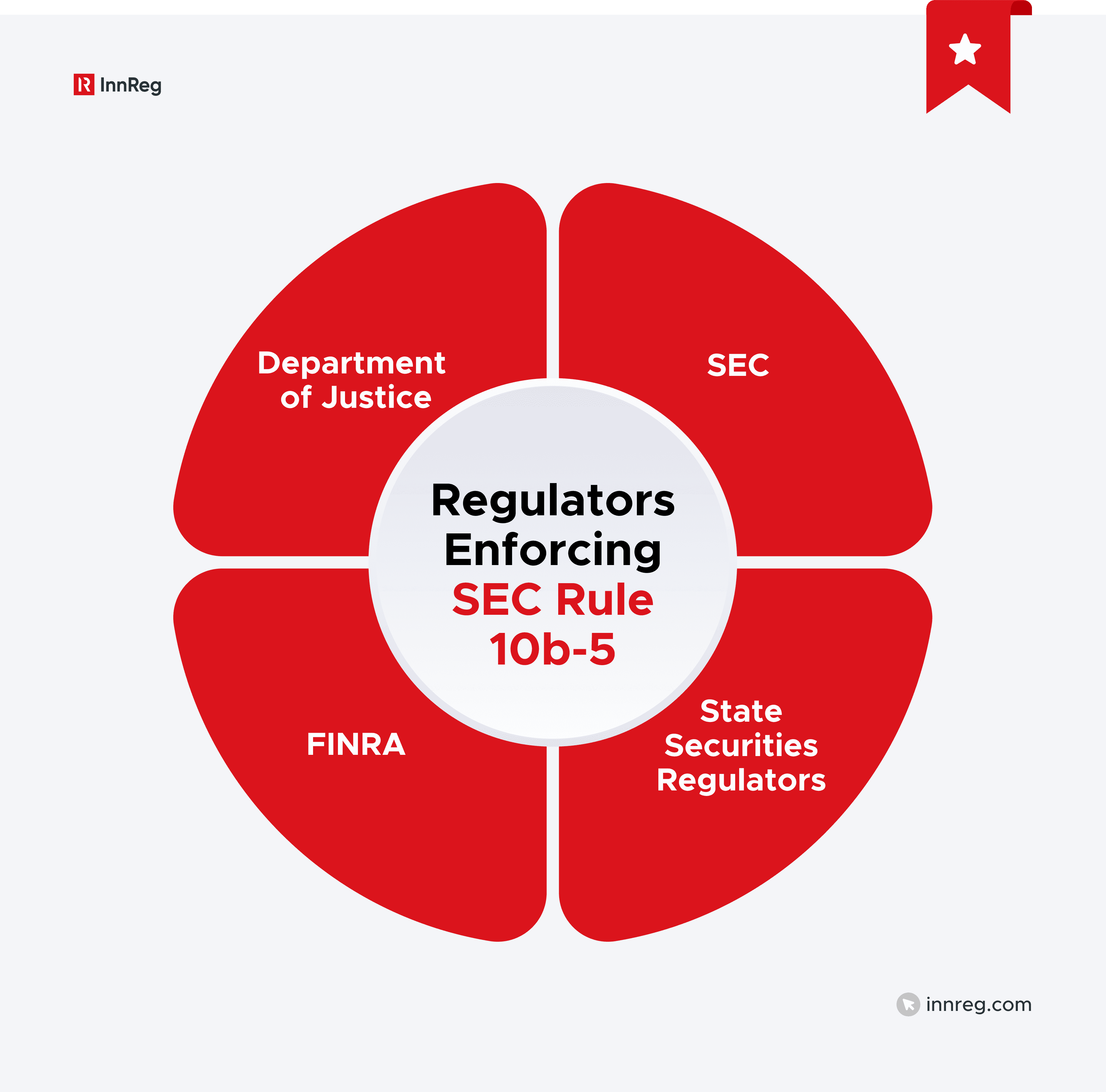
Securities and Exchange Commission (SEC) as Primary Enforcer
The SEC is the primary regulator that enforces Rule 10b-5. It investigates potential misconduct, brings civil actions, and reviews the disclosures companies share with investors.
Because the rule covers a wide range of communications, the SEC’s attention can extend to fundraising materials, public statements, marketing language, and internal documents that influence investor decisions.
For fintech companies, the SEC may step in when products involve securities or when the company raises capital from investors. This agency uses data analytics, whistleblower reports, and routine exams to spot patterns that look concerning.
If it sees signs of misleading statements or unusual trading activity, it may open an inquiry or a more formal investigation.

Department of Justice (DOJ) as Criminal Prosecutor
The DOJ becomes involved in Rule 10b-5 cases when the conduct appears intentional, deceptive, or tied to insider trading schemes.
While the SEC handles civil enforcement, the DOJ focuses on criminal violations, which carry the possibility of fines and imprisonment. This agency works closely with the SEC and often steps in when evidence suggests deliberate fraud or coordinated misconduct.
For fintech companies, DOJ involvement usually centers on actions like purposeful misstatements during fundraising, intentional manipulation of metrics, or trading activity that clearly relied on material nonpublic information.
The DOJ also looks at situations where individuals try to hide their actions through offshore accounts, encrypted channels, or coordinated trades among multiple people.
Self-Regulatory Organizations (SROs) Providing Oversight
Self-regulatory organizations like FINRA are critical in monitoring how broker-dealers and related professionals follow securities laws. They don't enforce Rule 10b-5 directly, but they do identify misconduct, review member communications, and refer potential violations to the SEC or DOJ when needed.
For fintech broker-dealers, FINRA oversight tends to zero in on how the firm talks to customers, promotes investment features, and supervises the people working under its registration.
If marketing materials, platform disclosures, or customer interactions contain misleading statements, FINRA can initiate examinations or request corrective action. These reviews can escalate if they uncover patterns that fall under Rule 10b-5.
State Securities Regulators Enforcing Blue Sky Laws
State securities regulators enforce their own anti-fraud rules, often called Blue Sky laws. These laws closely mirror Rule 10b-5 and apply to companies that offer or sell securities within the state.
Even if a fintech operates nationally, state regulators may investigate if residents in their state were affected by misleading statements or improper trading activity.
For fintech startups, this becomes relevant during fundraising rounds, investor outreach, and regional marketing. A statement that seems minor at the national level can catch the attention of a state regulator if local investors rely on it. State agencies also respond quickly to complaints from investors, employees, or partners who believe they were misled.
Because fintech teams often raise capital across multiple states, they may fall under several jurisdictions at once. Clear and consistent communication helps reduce the chance of conflicting statements that could attract state-level scrutiny.
SEC Rule 10b-5’s Approach to Insider Trading
Insider trading is one of the clearest ways Rule 10b-5 shows up in enforcement. It focuses on how people handle material nonpublic information and whether their actions give them an unfair advantage. For fintech teams that work closely with sensitive data, it is important to understand how these rules apply.
See also:
Distinction Between Classical Theory and Misappropriation Theory
The SEC uses two main theories to evaluate insider trading cases:
Classical theory: Here, insiders such as executives, employees, and directors violate the law when they trade a company’s securities while aware of material nonpublic information. This theory applies when someone owes a direct duty to the company and uses privileged information for personal gain.
Misappropriation theory: It applies when someone trades based on confidential information they obtained through a relationship of trust, even if they are not part of the company whose securities they trade. This can involve vendors, contractors, consultants, or spouses and partners who gain access to sensitive data through their work or relationships.

Definition of Insiders, Tippees, and Outsiders
Insider trading rules apply to more than just executives. Anyone who has access to material nonpublic information through a position of trust can fall into one of several categories. Understanding these roles helps fintech teams identify who needs training, restrictions, or closer supervision.
Category | Who They Are | Why They Create Risk |
|---|---|---|
Insiders | Executives, employees, and directors with ongoing access to confidential company information | They regularly handle (Material Nonpublic Information) MNPI and must not trade while in possession of it. |
Tippees | Individuals who receive MNPI from insiders, such as friends, family, or business contacts | They can be liable if they know or should know the information is confidential. |
Outsiders | Vendors, contractors, advisors, lawyers, consultants, or partners who gain MNPI through trusted relationships | They may trade or share MNPI even without being part of the company, creating clear insider trading exposure. |
In fintech, each of these groups can appear in everyday operations. Teams often work with external partners, share updates during product development, and collaborate across multiple platforms. Knowing who falls into each category helps reduce the risk of unintentional information leaks or improper trading.
Identification of Material Nonpublic Information
MNPI is any non-public confidential information that a reasonable investor would consider important when deciding whether to buy or sell a security.
It often includes financial results, revenue trends, product delays, regulatory updates, partnership negotiations, security incidents, or leadership changes. The information does not need to be formal or final. Even early signals, drafts, or internal forecasts can qualify if they would matter to investors.
Building a shared understanding of MNPI across the company helps employees pause before trading or sharing sensitive updates. When teams know what counts as material, they are more likely to raise questions and involve compliance when needed.
How Do SEC 10b5-1 Trading Plans Fit Into Rule 10b-5 Compliance?
SEC Rule 10b5-1 trading plans offer insiders a safe and predictable way to trade their company’s securities. By setting preset conditions for when trades occur, these plans help separate personal trading from access to confidential information.
For fintech leaders who hold equity, they can be an essential tool for managing risk.
What Is a 10b5-1 Plan?
A 10b5-1 plan is a prearranged trading plan that allows insiders to buy or sell their company’s securities according to a schedule set in advance.
The idea is simple. When the plan is created, the insider must not have any material nonpublic information. Once the plan is active, trades follow the predetermined instructions without further input.
These plans help insiders avoid the appearance that they traded based on confidential information. Because the trades occur automatically, the insider is not making real-time decisions that could raise questions. This makes 10b5-1 plans especially helpful for founders, executives, and employees who regularly work with sensitive data.
What Changes Did the SEC Introduce in 2023?
In 2023, the SEC updated the rules for 10b5-1 plans to address concerns that insiders were using them too flexibly.
The new requirements focus on timing, transparency, and accountability. They are designed to confirm that these plans reflect genuine pre-planning rather than last-minute attempts to avoid insider trading scrutiny.
A key change is the introduction of cooling-off periods. Insiders must now wait a set amount of time between adopting a plan and executing the first trade. Officers and directors face a longer waiting period, while companies also need to verify that plans are not created or changed during sensitive moments.
The updates also require insiders to certify that they are not aware of material nonpublic information when establishing a plan. In addition, overlapping plans are restricted, and certain disclosures about plan use must now be included in SEC filings.
These changes make 10b5-1 plans more structured and reduce opportunities for misuse.
How to Use 10b5-1 Plans Without Violating Rule 10b-5
Using a 10b5-1 plan responsibly starts with adopting it at the right time. Insiders should only create or modify a plan when they don't possess any material nonpublic information. This protects the plan’s credibility and reduces the chance that trades appear connected to confidential updates.
A good practice is to keep plans simple and consistent. Trades should follow a clear schedule or formula that does not change frequently. Sudden revisions, complex structures, or overlapping plans can raise questions about intent.
Teams should also maintain strong internal documentation to show when a plan was adopted and what information was known at the time.
What Compliance Challenges Do Fintechs Face Under Rule 10b-5?
Fintech companies move quickly, launch products often, and share information across many channels.
That pace creates unique challenges under Rule 10b-5, particularly when communications may affect investors or involve material nonpublic information. Recognizing these risks helps teams build practical controls that support growth.
Managing Accurate and Timely Disclosures
Fintech companies handle data that changes quickly. User activity, transaction volume, revenue trends, and regulatory updates can shift from week to week. When this information is shared with investors, partners, or the public, even minor delays or inconsistencies can create Rule 10b-5 risk.
A big challenge is that updates often come from many different teams. Product managers, marketers, founders, and analysts may each highlight their own metrics or timelines. If those messages don’t match, investors can walk away with a picture of the business that isn’t quite right.
A shared internal source of truth makes a huge difference. When everyone works from the same data and knows what is ready for external use, disclosures become clearer and more consistent. Regular check-ins, simple approval steps, and open communication across teams can also help reduce the chance of accidental misstatements.
Monitoring Access to Material Nonpublic Information
Fintech companies generate material nonpublic information as part of normal operations.
This includes product roadmaps, revenue trends, regulatory developments, customer activity, and security findings. Because teams often collaborate across shared tools and channels, access to this information can be wider than expected.
The challenge is knowing who has visibility into sensitive updates and when that access creates trading restrictions. Employees or contractors who see early financial results or confidential product plans may not realize the information qualifies as material. If they trade or share it, even casually, regulators may view it as insider trading.
Well-defined access controls help reduce these risks. Fintech teams can limit who sees sensitive data, track who receives updates, and maintain lists of individuals who should avoid trading during specific periods.
Preventing Insider Trading Among Employees and Partners
Fintech teams often collaborate with vendors, contractors, and strategic partners, which means more people may encounter sensitive information. When several groups work together on product features, regulatory filings, or financial updates, material nonpublic information can spread more easily than teams intend.
Not everyone who encounters this information is familiar with trading restrictions. Developers, designers, or marketing partners may see early metrics or product roadmaps without realizing that personal trading should be avoided.
Fintech companies can lower this risk by setting clear expectations. Training programs, trading blackout periods, and simple reminders about confidentiality help employees and partners understand their responsibilities.
Developing Effective Training on Securities Fraud Risks
Compliance training is one of the most effective ways to manage Rule 10b-5 risk. Fintech teams bring together people from many backgrounds, and not everyone starts with a clear sense of what qualifies as a misleading statement or material nonpublic information.
Without practical guidance, employees may share details or make comments that unintentionally create exposure.
The key is making training useful in everyday situations. High-level explanations of securities rules are helpful, but teams learn best through examples that reflect their actual work. This might include how to talk about product timelines, how to describe growth metrics accurately, or when to flag questions about investor communications.
Tip: Regular sessions, short refreshers, and role-specific tips help employees spot red flags earlier. When people feel comfortable asking questions and understand how their work connects to compliance expectations, the company is in a much stronger position to avoid costly mistakes.
Overseeing Communications Across Digital Channels
Fintech teams rely on digital tools to keep work moving. Slack, email, shared documents, project platforms, and messaging apps make collaboration fast and convenient. The flip side is that sensitive information can spread more widely than expected, simply because communication happens so quickly.
Informal messages can create problems when they touch on material information. A quick comment about performance metrics or a screenshot from an internal dashboard can easily be misunderstood. Even a lighthearted remark about a delayed feature may land differently if it circulates beyond the intended group. Moments like these can raise Rule 10b-5 concerns when they shape how others view the business.
Clear communication guidelines help reduce these risks. Encouraging teams to avoid sharing sensitive details in casual chats, using dedicated channels for confidential topics, and setting expectations for message retention all support safer communication habits.
Maintaining Adequate Surveillance and Recordkeeping
Fintech companies generate large volumes of data through their trading systems, communication tools, and internal workflows.
Regulators expect firms to keep records that show how decisions were made, what information was shared, and how potential issues were handled. Without strong recordkeeping, it becomes difficult to explain or defend past actions.
The challenge is that fast-moving teams may not prioritize documentation. Emails, chat messages, and internal reports can get lost or deleted, which creates gaps during regulatory reviews. Missing records can make regular business activity appear suspicious because there is no clear evidence of what happened.
Fintech teams benefit from tools and processes that automatically retain key communications and trading data. Regular audits and structured storage practices help make important information easier to locate when needed.
Aligning Automated Systems With Regulatory Expectations
Fintech products often rely on automation. Algorithms execute trades, scoring models generate recommendations, and automated tools deliver disclosures or messages to users. While automation can reduce manual errors, it also creates new risks if the underlying logic is inaccurate or missing important context.
The challenge is that automated systems may produce statements or results that investors rely on. If an algorithm highlights performance projections, risk levels, or investment opportunities without reflecting real conditions, regulators may view the output as a misleading communication. Even minor bugs can create patterns that fall under Rule 10b-5.
These risks can be mitigated through regular reviews of system logic, testing of automated features, and consistency checks between automated outputs and official disclosures. Platforms like Regly help teams operationalize these controls and document them in a way that's clear, consistent, and audit-ready.
Real-World Examples of Rule 10b-5 Enforcement
Enforcement cases show how Rule 10b-5 applies in practice and where companies often make mistakes. These examples highlight the types of conduct that regulators focus on and the patterns that raise the most concern. They also help fintech teams understand how everyday actions can create real exposure.

Shadow Trading in the Panuwat Case
The Panuwat case introduced the concept of shadow trading, where someone trades in the securities of a different company based on confidential information about their own employer. In this case, a biotech executive learned about a pending acquisition of his company and used that information to trade stock in a competitor expected to benefit from the news.
The SEC viewed this as insider trading because the information was material and nonpublic, and the executive used it to gain an advantage in a related market. This case expanded the understanding of how MNPI can affect companies beyond the one directly involved.
For fintech teams, shadow trading shows that MNPI can influence multiple markets or assets. When employees or partners have access to data that may affect competitors, vendors, or correlated assets, the risk extends beyond direct company stock. That’s why it’s important to think broadly about how confidential information may impact trading decisions.
See also:
Misuse of 10b5-1 Plans: DOJ’s Criminal Case Against a CEO
One high-profile case involved a CEO who created multiple 10b5-1 trading plans shortly after learning confidential information about a major business setback. He then executed trades through those plans before the news became public. Regulators argued that the plans were used to disguise trades made with the benefit of MNPI.
The DOJ brought criminal charges because the CEO appeared to adopt the plans with knowledge of negative information that would likely impact the company’s stock price. The timing and pattern of the trades suggested that the plans were not used for legitimate, pre-planned diversification but as a way to avoid scrutiny.
For fintech leaders, this case underscores that 10b5-1 plans must be created thoughtfully and at moments when no material nonpublic information is present. Plans that are rushed, overly complex, or frequently revised may attract regulatory attention, especially if trading occurs close to significant company events.
Fraudulent Fundraising Claims by Fintech Founders
Regulators have taken action against fintech founders who overstated growth, misstated revenue, or suggested partnerships that did not actually exist.
Many of these cases began with upbeat fundraising materials or investor updates that left out important context. Even when founders were trying to inspire confidence, the omissions and overstated claims created a misleading picture of the business.
For fintech teams, these cases underscore the value of keeping fundraising narratives aligned with what the company can genuinely support. When claims reflect the company’s true condition, investor conversations become more credible, and the risk of enforcement drops sharply.
Leaking MNPI via Messaging Apps or Remote Work
As remote work grows, regulators keep seeing more cases involving leaks of material nonpublic information through messaging apps and informal digital channels. Employees sometimes share confidential updates in group chats, personal devices, or collaboration tools without realizing how easily that information can spread or be accessed by others.
In several enforcement actions, MNPI was mentioned casually during virtual meetings or forwarded to friends and family through personal apps. Even short references to revenue trends, product delays, or regulatory developments created openings for improper trading.
Regulators focused on the fact that the information was both material and nonpublic, regardless of whether the person intended to share it.
For fintech companies, these trends highlight the importance of strong communication habits in remote settings. Clear expectations around what can be discussed, how information should be stored, and which channels are appropriate help reduce accidental leaks.
SEC's Use of Analytics and Whistleblower Leads
The SEC increasingly relies on data analytics and whistleblower tips to identify potential Rule 10b-5 violations.
Advanced tools allow the agency to spot unusual trading patterns, rapid stock price movements, and correlations between trades and confidential company events. These insights often trigger deeper investigations that uncover misleading statements or insider trading.
Whistleblower reports are also a major driver of enforcement. Employees, contractors, and partners may file confidential tips when they see communication gaps, questionable trading activity, or internal discussions that contradict external statements. Regulators take these reports seriously and often use them as starting points for broader reviews.

—
Rule 10b-5 touches nearly every part of a fintech company’s operations. From fundraising and product updates to internal conversations and automated systems, it shapes how teams share information and handle sensitive data. In fast-moving environments, missteps can happen quickly, especially when multiple groups collaborate across digital channels.
A practical, well-coordinated approach goes a long way. Strong communication habits, meaningful training, reliable data sources, and clear workflows help teams avoid the kinds of misstatements, omissions, and leaks that attract regulatory attention. These practices support responsible growth and help companies maintain credibility with investors.

Marina is a Compliance Consultant at InnReg with over 15 years of experience in operations and financial services. She has held senior roles at Amity Services and HSBC, with expertise in operations management, client portfolio growth, and end-to-end service delivery. She holds an MBA from the British School of Commerce.
How Can InnReg Help?
InnReg is a global regulatory compliance and operations consulting team serving financial services companies since 2013.
We are especially effective at launching and scaling fintechs with innovative compliance strategies and delivering cost-effective managed services, assisted by proprietary regtech solutions.
If you need help with broker-dealer compliance, reach out to our regulatory experts today:
Related Articles




Featured LinkedIn Posts